NEC Code for Arc Fault Breakers: Which Circuits Need AFCI Protection (2017–2026)
Table of Contents
Table of Contents
The NEC code for arc fault breakers sits in Section 210.12 of Article 210 (Branch Circuits), and it decides which 15- and 20-amp circuits in a home must shut off when a dangerous arc starts inside the wiring. Get it wrong and you fail inspection. Get it right and you remove one of the most common ignition sources behind electrical fires. This guide walks through the rules edition by edition, answers the questions people search most, and shows how each requirement changes your panel and your budget.
Quick answer
- Code section: NEC 210.12; the devices are listed to UL 1699.
- Covers: 120-volt, single-phase, 15- and 20-amp branch circuits serving the listed living areas of dwelling units (the 2023 NEC also names 10-amp circuits).
- Not on the list: bathrooms, garages, unfinished basements, attics and outdoor outlets.
- Always confirm which edition your state has adopted, plus any local amendments.
What Is the Code for an Arc-Fault Circuit Breaker?
An arc-fault circuit interrupter (AFCI) watches the current waveform and opens the circuit when it recognizes the signature of a series arc (a broken or loose conductor) or a parallel arc (conductor to conductor, or conductor to ground). A standard breaker reacts only to overload and short-circuit current, and many damaging arcs sit well below those trip levels.
The NEC code for arc fault breakers does not describe the electronics. Section 210.12 says where protection is required and which methods are acceptable: an AFCI circuit breaker in the panel or, for extended or modified wiring, an outlet branch-circuit AFCI at the first receptacle. The product itself is tested under UL 1699. Today’s panels use combination-type AFCIs that cover both arc types, and that is what inspectors expect to see.
NEC Code for Arc Fault Breakers by Edition: 2017, 2020, 2021, 2022 and 2023
First, a myth-buster: there is no 2021 or 2022 NEC. The code is republished every three years (2017, 2020, 2023, 2026). When people search for the NEC code for arc fault breakers 2021 or 2022, they usually mean the 2020 edition, which many states enforced from 2021 onward, or the 2023 edition.
| Edition | AFCI changes that matter |
|---|---|
| 2014 | Kitchens and laundry areas added to the protected list. |
| 2017 | Protection applies across all the listed living areas, and dormitory units are brought in. This is the edition behind most 2017 NEC arc-fault requirements questions. |
| 2020 | Hotel and motel guest rooms and suites added. GFCI rules expanded at the same time, so more circuits now need both protections. |
| 2023 | Section reorganized into (A) through (E), “AFCI” adopted as the defined term, listing required, 10-amp circuits named, and sleeping quarters in fire, police and ranger stations added. |
| 2026 | Section 210.12 remains; subsection (E) widens the options for AFCI protection when you extend, modify or replace branch-circuit wiring. |
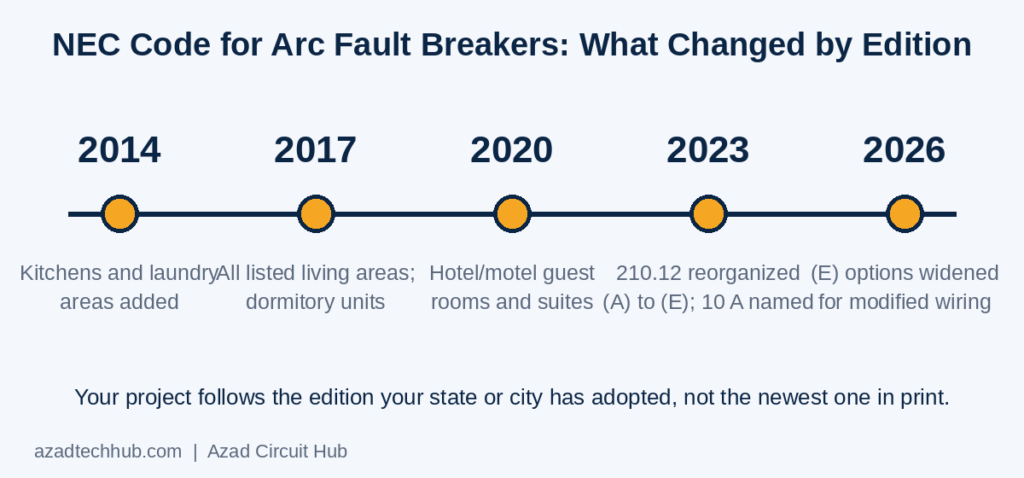
Your project follows the edition your jurisdiction has adopted, not the newest one in print. Many states are still on 2017, 2020 or 2023, and some amend 210.12 locally.
2023 NEC Arc Fault Requirements in Plain English
The 2023 NEC arc fault requirements split the rule by occupancy. Subsection (B) covers dwelling units, (C) dormitory units, (D) other occupancies such as guest rooms and sleeping quarters, and (E) wiring extensions, modifications or replacements. If an outlet or device in a listed area is fed by a 120-volt, single-phase circuit of 10, 15 or 20 amps, that circuit needs AFCI protection in a readily accessible location.
What Rooms Have to Be AFCI Protected?
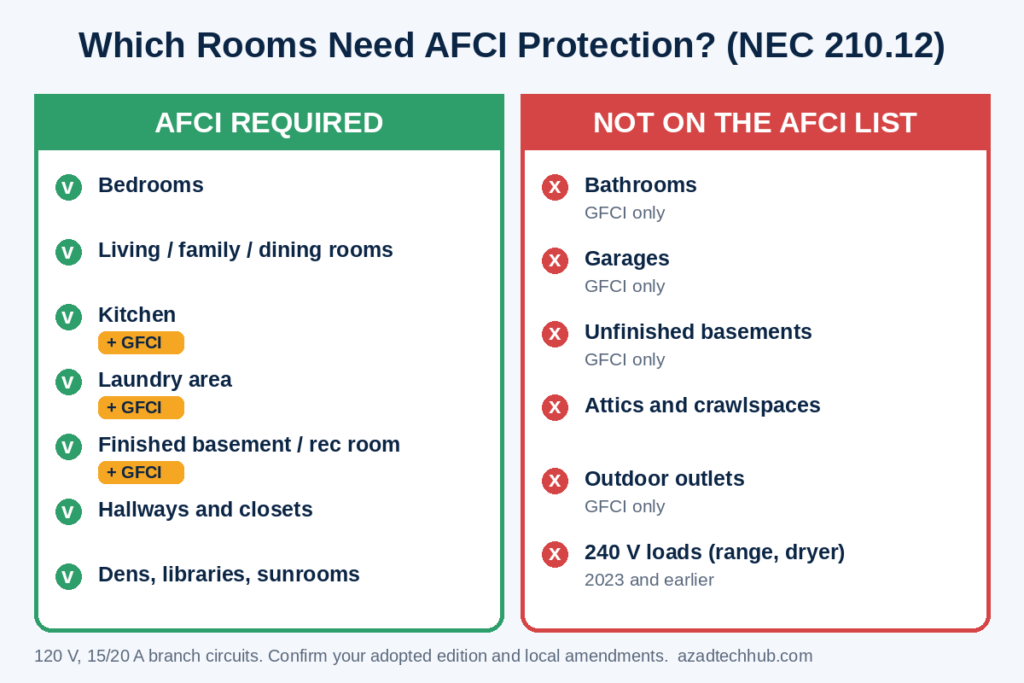
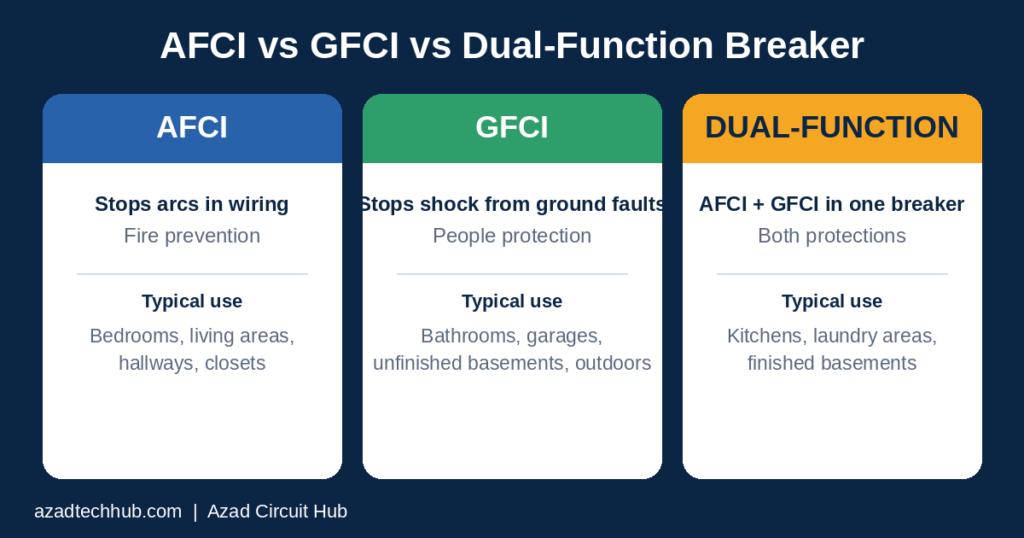
The dwelling unit list names kitchens, family rooms, dining rooms, living rooms, parlors, libraries, dens, bedrooms, sunrooms, recreation rooms, closets, hallways, laundry areas, and similar rooms or areas. In practice, that is nearly every habitable space. Many of these rooms also fall under GFCI rules in 210.8, which is where dual-function protection comes in.
Where Are AFCI Breakers Not Required?
If you are asking where arc fault breakers are not required under the 2023 NEC or earlier editions, start with the spaces that never made the list: bathrooms, garages, unfinished basements, attics and crawlspaces, and outdoor outlets. Those areas lean on GFCI protection instead. Dedicated 240-volt circuits for ranges, dryers and water heaters also sit outside the 120-volt rule in those editions.
The second source of exceptions is local. Some states and cities have trimmed or rewritten 210.12 during adoption, citing cost, so the NEC code for arc fault breakers you must follow may differ from the model text. Ask your inspector before you buy the panel, not after.
Does a Refrigerator or Laundry Need AFCI?
Refrigerator. If the receptacle sits in a kitchen, it is on a circuit that needs AFCI protection. The NEC has not carved out a refrigerator exception for kitchen circuits since kitchens were added in 2014. A refrigerator in a garage or unfinished basement is outside the AFCI list, though GFCI rules may apply there. Modern combination-type breakers handle compressor start-up well, so true nuisance tripping is the exception, not the rule.
Laundry. Yes. Laundry areas have been on the list since 2014, so the 120-volt, 20-amp washer receptacle needs AFCI protection, and under current GFCI rules it usually needs GFCI as well. A 240-volt dryer circuit is a separate question and was not covered by 210.12 in the 2023 edition.
Where Are Arc Fault GFCI Breakers Required?
An arc fault GFCI breaker, sold as a dual-function AFCI/GFCI breaker, is required wherever one circuit falls under both rules: kitchens, laundry areas and finished basements are the usual cases. You can meet the code two ways: install a dual-function breaker in the panel, or pair an AFCI breaker with a GFCI receptacle at the first outlet. The dual-function breaker protects the whole run and leaves a cleaner trip story when something goes wrong.
Buying one? Match the breaker to your panel’s brand and series, because breakers are not interchangeable across manufacturers. Check the panel label, then compare current prices on dual-function AFCI/GFCI breakers for your panel.
Are Arc-Fault Breakers Still Code?
Yes. Section 210.12 remains in the 2026 NEC, and the coverage has grown with almost every cycle since AFCIs first appeared in the 1999 edition. What changes from place to place is adoption: your jurisdiction may enforce the 2017, 2020, 2023 or 2026 edition, with its own amendments. Treat the adopted edition as the rule and the newest edition as a preview.
NEC Code for Arc Fault Breakers PDF: Where to Read the Official Text
Searchers often hunt for an NEC code for arc fault breakers PDF. Skip the unofficial copies, which are frequently out of date or copyright violations. NFPA offers free read-only online access to NFPA 70 on its website, which lets you read 210.12 for the edition you need. Pair it with your state’s amendment list for the full picture.
Testing Your AFCI Circuits Safely
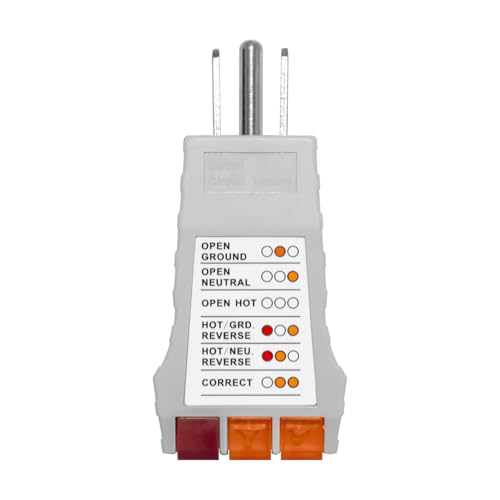
After any panel or receptacle work, press the test button on each AFCI and reset it, then confirm your outlets with a receptacle tester. Before touching a panel cover or a device, confirm the circuit is dead.
A receptacle tester with AFCI/GFCI test function catches open grounds and reversed wiring that a visual check misses. And a non-contact voltage tester belongs in your pocket every time a cover comes off. See our clamp meter reviews if you also want to measure load.

Panel work carries real shock and arc-flash risk. If you are not qualified, hire a licensed electrician.
Related Tools and NEC Guides
- Residential Electrical Load Calculator – size the panel before adding AFCI circuits
- Conduit Fill Calculator – check NEC conduit fill for new branch-circuit runs
- Cable Size Calculator – conductor sizing for 15- and 20-amp circuits
- Junction Box Size Calculator (NEC) and Pull Box Sizing (NEC 314.28)
- NEC Article for Grounding and Bonding – Article 250 explained
- NEC Code for Underground Conduit Depth – burial depths by wiring method
FAQ: NEC Code for Arc Fault Breakers
Do I need AFCI in a bathroom?
No, bathrooms are not on the 210.12 list, but they need GFCI.
Does a garage need AFCI?
Not under 210.12 in the 2023 edition and earlier; GFCI applies.
Do I need dual-function breakers everywhere?
Only where both AFCI and GFCI rules apply to the same circuit.
Can I retrofit AFCI into an older home?
Yes, and new or modified wiring in listed areas must meet current requirements.
Conclusion
The NEC code for arc fault breakers is simple to state and easy to misapply: 210.12 covers 120-volt, 15- and 20-amp circuits in nearly every living space, skips bathrooms, garages, unfinished basements and outdoors, and pairs with GFCI in kitchens, laundry areas and finished basements. Confirm your adopted edition, pick breakers that match your panel, and test every circuit after the work.
Get new guides in your feed. Follow Electrical Insights on LinkedIn for new electrical standards guides, calculators and design tips from Azad Circuit Hub.