
Best Solar Charge Controller for LiFePO4 Batteries: Top 7 Picks
I am Abdul Wassay, an electrical engineer, and I have spent years sizing, wiring and troubleshooting small solar systems. Most of the failures I see come down to one mistake: a charge controller that does not match the battery. If you run lithium iron phosphate cells, picking the best solar charge controller for LiFePO4 batteries matters even more than choosing the panels.
This guide ranks seven controllers I would trust on a real LiFePO4 bank. Each one is judged on charging profile, efficiency, monitoring and value for money. Start with the comparison table, then jump to the review that fits your system.
Best Solar Charge Controller for LiFePO4 Batteries: Top 7 Picks
| Rank | Model | Max Charge Current | Max PV Voltage | Battery Voltage | LiFePO4 Charging | Best For |
|---|---|---|---|---|---|---|
| 1 | Victron SmartSolar MPPT 100/50 | 50A | 100V | 12V / 24V | Built-in preset and full custom tuning | Best overall |
| 2 | Renogy Rover Li 40A | 40A | 100V | 12V / 24V | Lithium-ready profile | RVs and vans |
| 3 | EPEVER Tracer 4210AN | 40A | 100V | 12V / 24V | User-defined lithium mode | Tight budgets |
| 4 | Victron SmartSolar MPPT 75/15 | 15A | 75V | 12V / 24V | Built-in preset and custom tuning | Small systems |
| 5 | Genasun GV-10-Li-14.2V | 10A | 28V | 12V | Fixed LiFePO4 voltage | Boats and portable kits |
| 6 | Victron SmartSolar MPPT 150/35 | 35A | 150V | 12V / 24V / 48V | Built-in preset and custom tuning | Long panel strings |
| 7 | Midnite Solar Classic 150 | Up to 96A | 150V | 12V to 72V | Fully programmable | Large off-grid homes |
Specs can change between production batches, so always confirm the final numbers on the Amazon listing before you order.
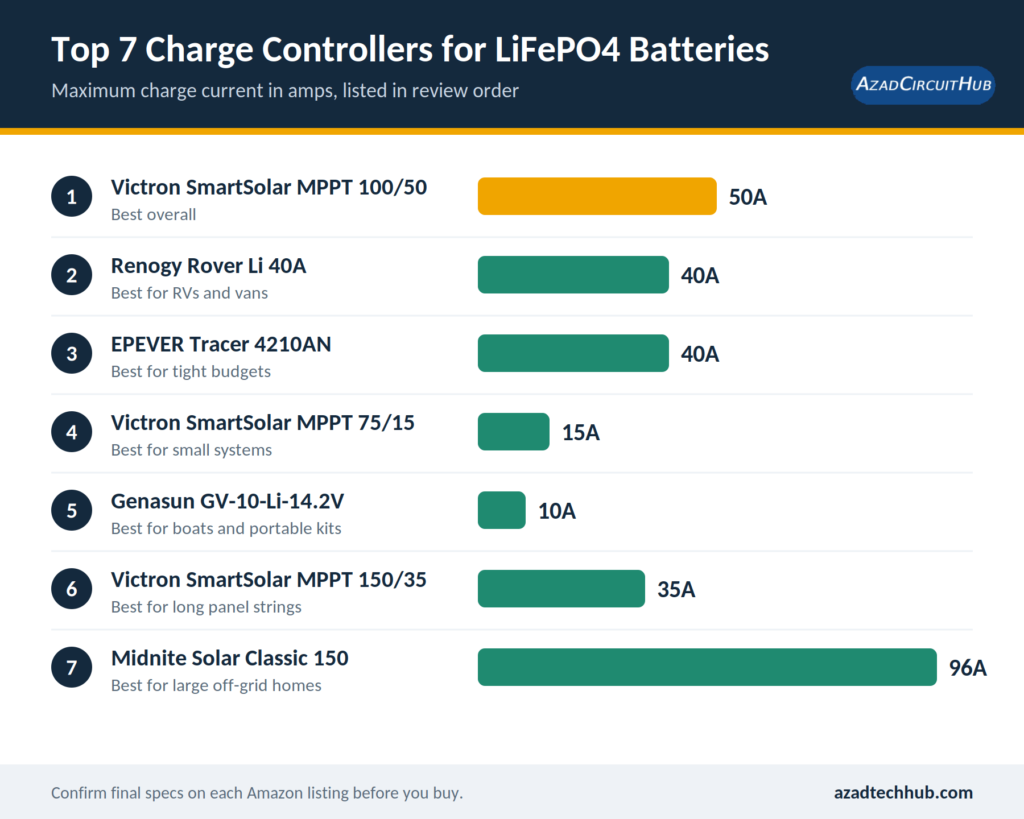
Table of Contents
Table of Contents
Why LiFePO4 Batteries Need a Smarter Charge Controller
Lead acid batteries forgive sloppy charging. LiFePO4 cells do not. They want a clean constant current phase, a firm absorption voltage and a short or even zero float stage. They also hate being charged below freezing, and they never need an equalization cycle.
A controller built around lead acid logic can push the wrong voltage for too long. The result is a battery management system that trips, a bank that never fills, or cells that age early. That is why the best solar charge controller for LiFePO4 batteries must offer either a lithium profile or fully adjustable voltage settings.
My own rule is simple. If I cannot set absorption, float and low temperature cutoff by hand, I do not install the controller on lithium.
How I Chose These Controllers
When I shortlist the best solar charge controller for LiFePO4 batteries, I check five things before anything else.
- A true lithium charge profile or manual voltage control
- MPPT tracking with efficiency near 98 percent
- Low temperature protection or a temperature sensor input
- Monitoring through Bluetooth, a display or a communication port
- Build quality and proven reliability in hot, dusty conditions
I work in a region where summer heat is brutal. Enclosures that cook, fans that clog and cheap terminals that loosen have all cost me time. So heat handling carried real weight in this ranking.
The 7 Best Solar Charge Controllers for LiFePO4 Batteries
1. Victron Energy SmartSolar MPPT 100/50: Best Overall
The Victron SmartSolar MPPT 100/50 is the controller I reach for first. I have wired this model into a 12V 200Ah LiFePO4 bank, and the difference from a basic unit was clear in the first week. The charge curve was smooth, the bank reached full on time, and the BMS never complained.
Bluetooth is built in, so the VictronConnect app shows yield, voltage and charge stage on your phone. No extra dongle is needed. For anyone who wants the best solar charge controller for LiFePO4 batteries without compromise, this is the benchmark.

- SMART SOLAR CHARGE CONTROLLER: Solar charge the smart way with the Victron Energy SmartSolar MPPT charge controller, to …
Key specs:
- 50A output, 100V maximum PV input
- 12V and 24V automatic or manual battery selection
- Up to 700W of panels on 12V and 1400W on 24V
- Peak efficiency of about 98 percent
- Ultra fast tracking for shaded or cloudy conditions
Pros:
- Excellent LiFePO4 control with a ready preset
- Built-in Bluetooth monitoring
- Strong build and long track record
Cons:
- Higher price than budget units
- No built-in screen
If you want a controller you can install once and forget, this is it. Check the Victron SmartSolar MPPT 100/50 price and availability on Amazon.
2. Renogy Rover Li 40A: Best Value for RVs and Vans
I fitted a Rover Li on a small camper van build with a 12V LiFePO4 battery and 400W of panels. The setup took less than an hour. The lithium profile worked straight out of the box, which is exactly what a beginner needs.
The Rover Li is also designed to wake up a lithium battery that has been shut down by its BMS, provided panel power is present. That saves a lot of frustration after a deep discharge.
Key specs:
- 40A output, 100V maximum PV input
- 12V and 24V system support
- Lithium and lead acid battery types
- Bluetooth available through the optional BT module
Read complete review of renogy rover 40a mppt charge controller here.
Pros:
- Easy setup for first time builders
- Good price for the feature set
- Handy battery reactivation function
Cons:
- Bluetooth needs an extra module
- App is less polished than Victron
For budget minded RV owners, this is a strong contender for the best solar charge controller for LiFePO4 batteries under a tight spend. See the current Renogy Rover Li 40A deal on Amazon.
3. EPEVER Tracer 4210AN: Best Budget Flexibility
EPEVER controllers have a loyal following among DIY builders, and I understand why. The Tracer 4210AN gives you a user-defined battery mode, so you can type in the exact absorption and float values your battery maker recommends. For LiFePO4 that is a big advantage.
I used one on a workshop backup system where cost mattered. After setting absorption to the manufacturer value and disabling equalization, it ran without a single fault through a full summer.
Key specs:
- 40A output, 100V maximum PV input
- 12V and 24V auto detection
- User-defined lithium charging voltages
- RS485 port for remote meters and monitoring
Pros:
- Very flexible voltage settings
- Lower price than comparable Victron models
- Reliable in heavy daily use
Cons:
- Setup is less friendly for beginners
- Wireless monitoring needs extra hardware
Check the EPEVER Tracer 4210AN price on Amazon before you buy.
4. Victron SmartSolar MPPT 75/15: Best for Small Systems
Not every build needs a big controller. For a 12V shed light, a weather station or a small boat, the SmartSolar MPPT 75/15 is a neat answer. I installed one on a 100Ah LiFePO4 battery powering a remote camera, and it has quietly done its job ever since.
It has the same Bluetooth monitoring and tuning options as its bigger siblings. You simply get less current capacity, which keeps the price friendly.
Key specs:
- 15A output, 75V maximum PV input
- About 220W of panels on a 12V battery
- Built-in Bluetooth
- Compact body that fits tight enclosures
Pros:
- Same smart features as larger Victron models
- Small size and low weight
- Accurate LiFePO4 charging
Cons:
- Limited to small panel arrays
- Will not grow with your system
See the Victron SmartSolar MPPT 75/15 on Amazon if your system is small and compact.
5. Genasun GV-10-Li-14.2V: Best for Boats and Portable Kits
Genasun builds tough little MPPT units that are sealed against moisture. The GV-10-Li-14.2V is set for LiFePO4 at the factory, so there is nothing to program. I tested a similar Genasun unit on a small boat, where salt air destroys most electronics, and the sealed case held up well.
The trade-off is that it only supports low voltage panels and a single 12V battery. Treat it as a specialist tool for compact systems.
Key specs:
- 10A output, designed for 12V LiFePO4
- Fixed charge voltage of 14.2V
- Sealed, potted construction
- Suits nominal 12V panels
Pros:
- No setup needed
- Excellent for wet or rough environments
- Very light
Cons:
- No adjustable settings
- Not suited to large arrays or higher voltage strings
Check the Genasun GV-10-Li-14.2V price on Amazon for your boat or portable kit.
6. Victron SmartSolar MPPT 150/35: Best for Long Panel Strings
Higher voltage strings reduce cable losses, and that matters when your panels sit far from the battery. I used a SmartSolar 150/35 on a farm pump system where the array stood about 40 meters from the battery room. Wiring panels in series let me use thinner cable and still keep voltage drop low.
This controller also supports 12V, 24V and 48V batteries, so it can follow you if you upgrade your bank later.
Key specs:
- 35A output, 150V maximum PV input
- 12V, 24V and 48V battery support
- Up to 2000W of panels on a 48V bank
- Built-in Bluetooth monitoring
Pros:
- Handles long cable runs well
- Flexible battery voltage support
- Full LiFePO4 tuning
Cons:
- Costs more than 100V models
- Current rating is lower than the 100/50
View the Victron SmartSolar MPPT 150/35 on Amazon if you plan to expand later.
7. Midnite Solar Classic 150: Best for Large Off-Grid Homes
The Midnite Classic 150 is a heavy duty controller for serious off-grid systems. It supports a wide battery voltage range and offers deep programmability, with a built-in display and network features. I have worked with it on a larger lithium bank where several strings fed one controller.
It is overkill for a camper, but if you run a full home system, it earns its place. Availability on Amazon can vary, so check stock before planning your build around it.
Key specs:
- Up to 96A output, 150V maximum PV input
- 12V to 72V battery voltage range
- Built-in display and communication options
- Wide range of user adjustable charging stages
Pros:
- Huge capacity for big systems
- Highly programmable
- Rugged and serviceable
Cons:
- Expensive for small builds
- Setup takes patience
Check the Midnite Solar Classic 150 availability on Amazon for your off-grid home.
The Tool I Never Commission a Solar System Without
A great controller still needs verification. After every install I measure real current at the battery and at the panel cable. A DC clamp meter does that without breaking the circuit, which keeps the job safe and fast.
I use a clamp meter with non-contact voltage detection, a 40V to 600V range and dual backlit displays. It also reads temperature, frequency, resistance, continuity and capacitance, and the probe holder keeps my hands free on a roof or in a cramped battery box. I have used this style of meter to catch a loose lug that was quietly cutting charge current by almost a fifth.
If you are building a LiFePO4 system, a DC clamp meter pays for itself on the first install. Check the DC clamp meter with NCV and dual backlit displays on Amazon.

- VERSATILE CLAMP METER: Measures AC/DC current and NCVT via clamp; AC/DC voltage, resistance, continuity, frequency/duty …
- NON-CONTACT VOLTAGE TESTING: Integrated into the clamp jaw for convenient electrical testing
- REVERSE-CONTRAST DISPLAY: High-visibility reverse-contrast LCD ensures improved viewability in all lighting conditions
How to Size a Controller for Your LiFePO4 Bank
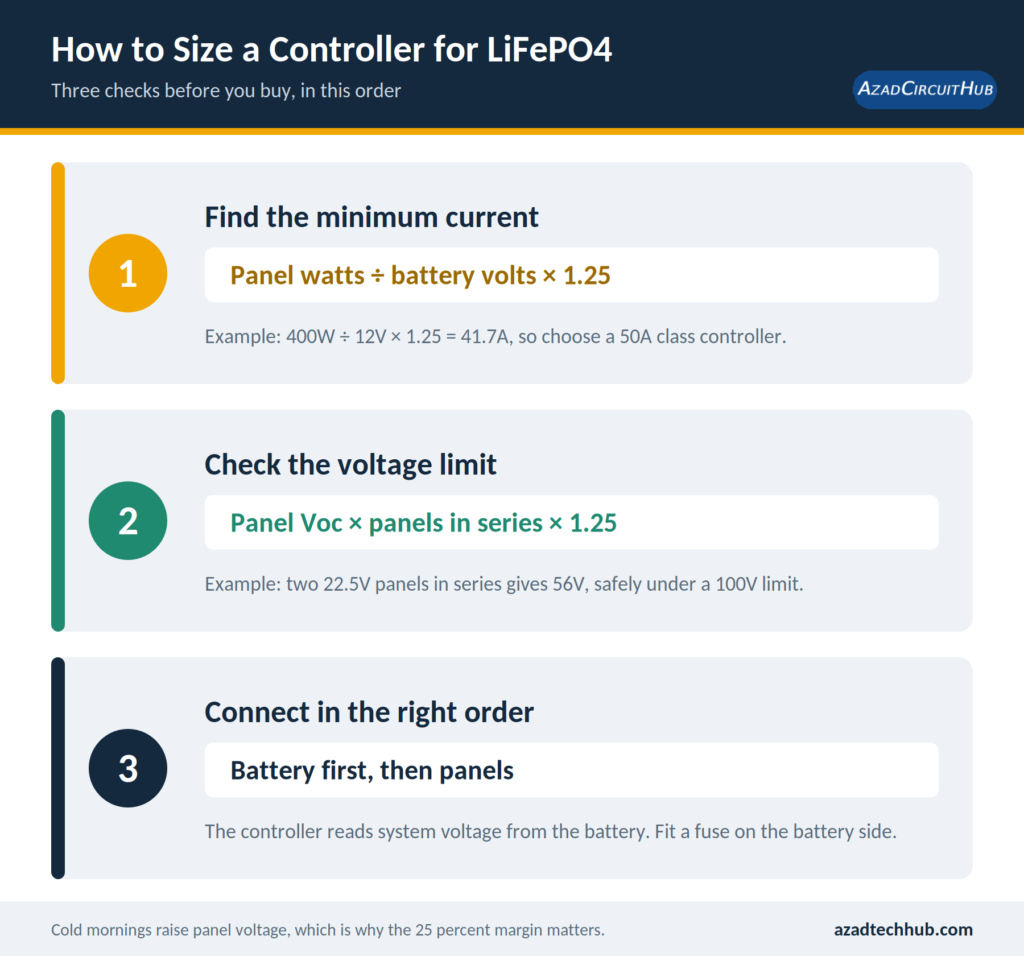
Sizing is simple once you know the formula. Divide your total panel wattage by the battery voltage, then add a 25 percent safety margin. The answer is the minimum controller current.
| Battery Voltage | Panel Wattage | Raw Current | With 25% Margin | Suggested Controller |
|---|---|---|---|---|
| 12V | 200W | 16.7A | 20.8A | Victron 75/15 may be tight, step up to a 30A class |
| 12V | 400W | 33.3A | 41.7A | Renogy Rover Li 40A or Victron 100/50 |
| 12V | 600W | 50A | 62.5A | Victron 100/50 with a smaller array or a larger controller |
| 24V | 800W | 33.3A | 41.7A | Victron 100/50 or EPEVER 4210AN |
| 48V | 1500W | 31.3A | 39.1A | Victron 150/35 or Midnite Classic 150 |
Also check voltage. Multiply the panel open circuit voltage by the number of panels in series, then add about 25 percent for cold mornings. That number must stay below the controller PV limit. Going over it is the fastest way to destroy a controller.
Recommended LiFePO4 Charging Settings
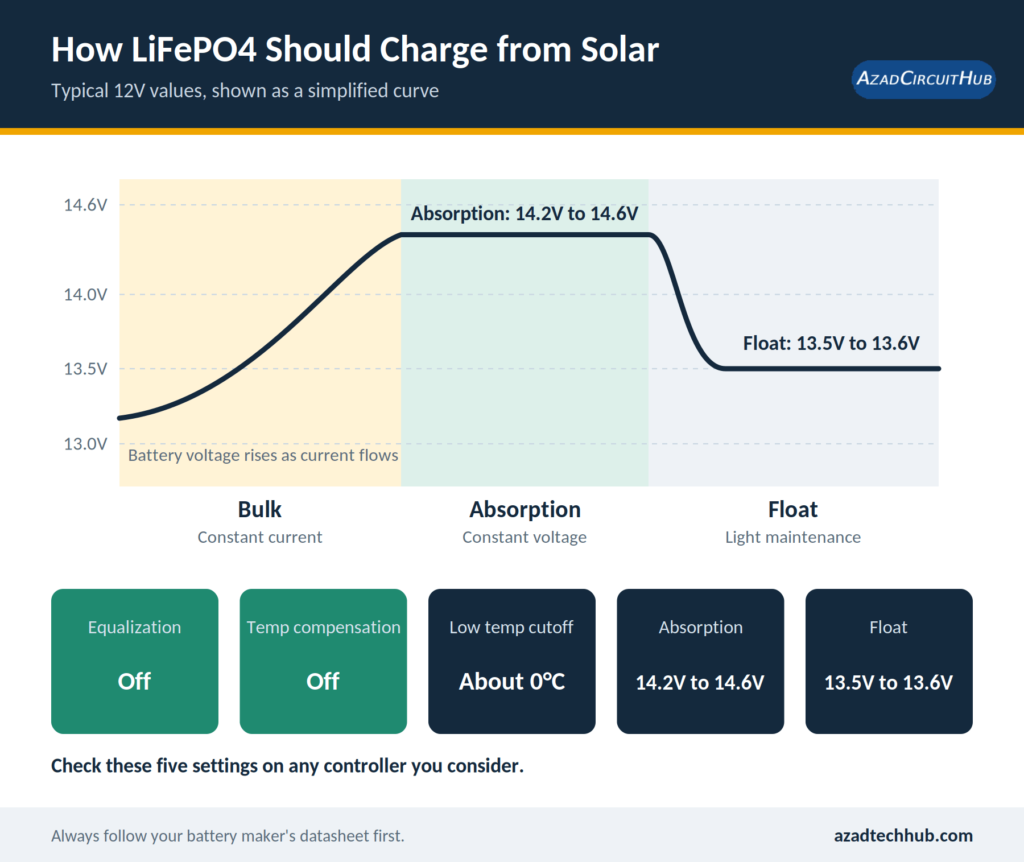
Always follow your battery manufacturer first. If no data is given, these typical values for a 12V LiFePO4 battery are a safe starting point.
| Setting | Typical 12V Value | Why It Matters |
|---|---|---|
| Absorption Voltage | 14.2V to 14.6V | Fills the cells without stressing them |
| Float Voltage | 13.5V to 13.6V | Holds charge with minimal stress |
| Equalization | Off | LiFePO4 never needs it |
| Temperature Compensation | Off | Lithium does not follow lead acid temperature curves |
| Low Temperature Cutoff | Around 0°C | Protects cells from damaging charge in the cold |
When you pick the best solar charge controller for LiFePO4 batteries, make sure every one of these settings can be reached.
MPPT or PWM for Lithium Batteries
PWM controllers cost less, but they waste panel power and they struggle with the voltage window lithium needs. MPPT controllers convert extra panel voltage into extra charging current, and that gain is the main reason I recommend them. In colder weather the gain is even larger.
If you want a deeper comparison, read our guide to the best mppt solar charge controller where I explain both technologies with real wiring examples. For most lithium users, MPPT is the clear winner.
Common Mistakes to Avoid
I have repaired plenty of systems that failed for avoidable reasons. These are the mistakes I see most often.
- Leaving a lead acid profile active on a lithium battery
- Connecting panels to the controller before the battery
- Using undersized cable that overheats under load
- Ignoring cold weather charging limits
- Skipping a fuse or breaker between controller and battery
Always connect the battery first, then the panels. That order lets the controller detect the system voltage correctly. Choosing the best solar charge controller for LiFePO4 batteries only helps if the install is done properly.
More Solar Controller Guides From Azad Tech Hub
If you are comparing options, browse all of our solar charge controller reviews for hands-on testing notes on more brands. Each review covers wiring tips, real world output and honest pros and cons.
Frequently Asked Questions
What is the best solar charge controller for LiFePO4 batteries?
For most people, the Victron SmartSolar MPPT 100/50 is the best choice. It offers a LiFePO4 preset, full custom tuning, built-in Bluetooth and excellent efficiency. If your budget is tight, the Renogy Rover Li 40A and EPEVER Tracer 4210AN are strong alternatives.
Do I need a special charge controller for LiFePO4 batteries?
You need a controller that offers a lithium profile or adjustable voltage settings. A basic lead acid controller can overcharge or undercharge lithium cells. Always confirm that you can set absorption and float voltage before buying.
Is MPPT better than PWM for LiFePO4?
Yes, in nearly every case. MPPT harvests more energy, handles higher voltage panels and offers better control over the charging stages. PWM is only worth considering for very small, low cost setups.
What voltage should a controller charge a 12V LiFePO4 battery at?
Most 12V LiFePO4 batteries charge at an absorption voltage between 14.2V and 14.6V, with a float voltage near 13.5V. Check your battery datasheet, because the exact figures vary by manufacturer.
What size controller do I need for a 100Ah LiFePO4 battery?
It depends on your panel wattage, not only the battery size. A 400W array on a 12V system needs roughly a 40A to 50A controller once you add a safety margin. A smaller 200W array can work with a 20A to 30A unit.
Final Verdict
After years of hands-on installs, I keep coming back to Victron for quality, tuning and monitoring. The SmartSolar MPPT 100/50 is my top recommendation as the best solar charge controller for LiFePO4 batteries for most home, RV and cabin builds. Renogy and EPEVER give you solid value, while Genasun, Victron 150/35 and Midnite cover specialist needs.
Pick the controller that matches your panel wattage and voltage, set the lithium profile correctly, and verify your results with a clamp meter. Do that and your LiFePO4 bank will reward you with years of reliable service. Ready to buy? Check the Victron SmartSolar MPPT 100/50 on Amazon today.
- SMART SOLAR CHARGE CONTROLLER: Solar charge the smart way with the Victron Energy SmartSolar MPPT charge controller, to …
- MAXIMIZE POWER OUTPUT: With lightning-fast optimum power point tracking and intelligent charge algorithms the Victron MP…
- SYNCHRONIZED CHARGING: Multiple SmartSolar MPPT charge controllers can synchronize to behave as one, simultaneously swit…
Do I need a special solar charge controller for a LiFePO4 battery?
You need a controller that offers a lithium profile or lets you set the voltages by hand. A lead acid only controller can float the battery at the wrong voltage or run an equalization cycle, and lithium cells should never get either. Any MPPT controller with these features is compatible, including the Victron, Renogy Rover Li and EPEVER models in this guide.
What is the best solar charge controller for LiFePO4 batteries?
For most systems, the Victron SmartSolar MPPT 100/50 is my pick. It has a LiFePO4 preset, full custom tuning and built-in Bluetooth, and it holds up well in heat. The Renogy Rover Li 40A is the better choice if you want a lithium-ready unit at a lower price. Check the Victron SmartSolar MPPT 100/50 price on Amazon if you want the safest all round option.
Can I charge a LiFePO4 battery with a solar panel?
Yes, but never connect the panel straight to the battery. A charge controller must sit between them to manage voltage and current and to stop overcharging. Pair the panels with an MPPT controller set to a lithium profile, and the battery will charge safely.
How do I set a solar charge controller for LiFePO4 batteries?
Choose the lithium or LiFePO4 profile first, or switch to user mode if there is no preset. For a 12V battery, set absorption between 14.2V and 14.6V and float near 13.5V. Turn equalization and temperature compensation off. If the controller allows it, set a low temperature cutoff near 0°C so the battery never charges in freezing weather. Your battery maker’s datasheet always overrides these typical values.
What is the best charge rate for a LiFePO4 battery?
Most LiFePO4 batteries charge happily between 0.2C and 0.5C, which means 20A to 50A for a 100Ah battery. Many can accept 1C, but gentler charging helps the cells last longer. Solar rarely reaches those currents anyway, so check the maximum charge current on your battery label and size the controller to stay under it.
What is the disadvantage of MPPT?
The main drawbacks are higher cost and more complexity than PWM. On very small systems, or in hot climates with panels matched to the battery voltage, the extra energy gain can be small. MPPT controllers also have a strict maximum panel voltage, so you must calculate your series strings carefully. For most lithium builds above about 200W, the gain is still worth it.
What is the best brand of solar charge controller?
No single brand wins in every case. Victron leads for build quality, tuning and monitoring. Renogy offers good value for RVs and vans, and EPEVER suits budget builds that need flexible settings. Genasun is a strong choice for compact marine kits, and Midnite suits large off-grid homes. See the Renogy Rover Li 40A deal on Amazon if value matters most to you.
How long will a 300W solar panel take to charge a 100Ah lithium battery?
A 100Ah 12V LiFePO4 battery holds about 1,280Wh. Real panel output with an MPPT controller is usually around 75 percent of the rating, so a 300W panel delivers roughly 225W in good sun. That means about 5.7 hours of strong sunlight to charge it from empty.
Cloud, heat, dust and cable losses can stretch these times. A 300W array on a 12V battery also needs a controller rated around 40A once you add a safety margin.
Get new guides in your feed. Follow Electrical Insights on LinkedIn for new electrical standards guides, calculators and design tips from Azad Circuit Hub.
