Neutral to Ground Voltage: NEC Standard
Electricians often measure voltage between the neutral and grounding conductor when troubleshooting a panel, receptacle, or branch circuit. A small reading is common, but a higher reading can point to voltage drop, loose connections, incorrect bonding, or other wiring problems.
The important point is that the NEC does not give one universal numerical limit for Neutral to Ground Voltage. Instead, NEC requirements focus on correct grounding and bonding, neutral isolation downstream of the service disconnect, and preventing objectionable current on grounding paths.
Quick Reference: NEC Neutral-to-Ground Voltage
| Check | Typical field reading | What it may indicate |
|---|---|---|
| Neutral to ground at service equipment | Close to 0 V | Normal when the system is correctly bonded |
| Neutral to ground at loaded branch circuit | Often a small voltage | Neutral voltage drop under load |
| Around 0.5–2 V | Can occur under load | Check load and conductor length |
| Several volts | Requires investigation | Excessive neutral impedance, loose connection, or other issue |
| Neutral-ground voltage with no load | Usually very low | Higher readings deserve investigation |
| Neutral to ground in subpanel | Small voltage may occur | Neutral and ground should remain isolated |
| NEC maximum N-G voltage | No single universal value | NEC does not establish a general numerical limit |
The values above are practical troubleshooting guidance, not an NEC voltage limit.
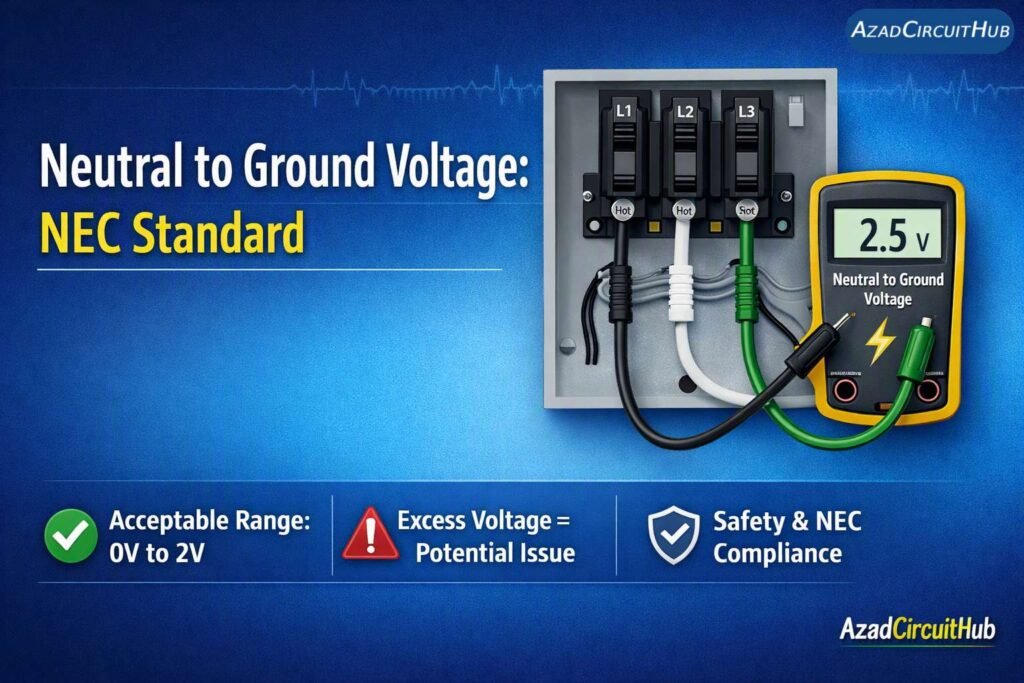
Table of Contents
Table of Contents
What Does Neutral to Ground Voltage Mean?
Neutral and ground have different jobs in a properly wired system. The neutral is a current-carrying conductor that normally carries return current from line-to-neutral loads. The equipment grounding conductor is intended to provide a low-impedance fault-current path and normally carries no current during normal operation.
At the service equipment, the grounded conductor and equipment grounding system are bonded as required by the NEC. Because current flowing through the neutral creates voltage drop, a downstream measurement between neutral and ground can show some voltage when loads are operating.
For example, imagine a 120V branch circuit supplying a substantial load. Current flowing through the neutral creates a voltage drop based on the resistance and impedance of the conductor. The neutral at the load can therefore be slightly above the grounding conductor potential.
This is why a reading of a fraction of a volt does not automatically mean there is a wiring fault.
Does the NEC Specify an Acceptable Neutral-to-Ground Voltage?
No. The NEC does not state that Neutral to Ground Voltage must always be exactly 0 V, nor does it establish a general rule such as “anything below 2 V is NEC compliant.”
Instead, several NEC requirements are relevant to the condition.
| NEC concept | Relevance |
|---|---|
| Article 250 | Grounding and bonding requirements |
| 250.24 | Grounding connections for grounded systems |
| 250.24(A)(5) | Restricts connections between grounded and grounding conductors on the load side of the service disconnect |
| 250.6 | Addresses objectionable current on grounding and bonding paths |
| 250.142(B) | Contains specific rules and an exception concerning grounded conductor connections to equipment grounding conductors |
The exact installation matters, including the service configuration, separately derived systems, panel location, and applicable NEC edition.
If you are comparing measurements against a broader neutral earth voltage standard, remember that an engineering or utility guideline is not necessarily an NEC requirement.
Why Does Neutral-to-Ground Voltage Increase Under Load?
A useful field test is to compare the reading with the circuit unloaded and then loaded.
Suppose a receptacle shows almost 0 V between neutral and ground with no significant load. You turn on a large 120V load and the measurement rises. That change can be caused by voltage drop in the neutral conductor.
Ohm’s law explains the basic relationship:
Voltage drop = Current × Resistance
A longer conductor, smaller conductor, higher current, or poor connection can increase the measured voltage.
| Observation | Possible cause |
|---|---|
| Low reading unloaded, higher when loaded | Normal conductor voltage drop or excessive neutral impedance |
| High reading with little load | Wiring or connection problem should be investigated |
| Different readings at different receptacles | Branch-circuit voltage drop |
| High reading at several circuits | Possible feeder or service neutral issue |
| Neutral-ground voltage in a subpanel | Check neutral/ground separation and wiring |
| Fluctuating neutral voltage | Loose or high-resistance connection may be present |
How to Measure Neutral to Ground Voltage
Use a properly rated digital multimeter and follow appropriate electrical safety procedures.
At a standard 120V receptacle, measure AC voltage between the neutral slot and the equipment grounding contact. The reading should normally be close to zero, although a small voltage can appear when the circuit is carrying load.
For electricians who regularly troubleshoot panels and branch circuits, a quality instrument such as the Fluke 87V can be useful because it provides accurate AC/DC voltage measurements and additional troubleshooting functions.
You can also compare line-to-neutral, line-to-ground, and neutral-to-ground measurements.
| Measurement | Typical nominal system value |
|---|---|
| Line to neutral | About 120 V |
| Line to ground | About 120 V |
| Neutral to ground | Ideally near 0 V |
| 120/240V split-phase line to line | About 240 V |
For additional test-instrument guidance, see this practical guide to the best multimeter for electricians.
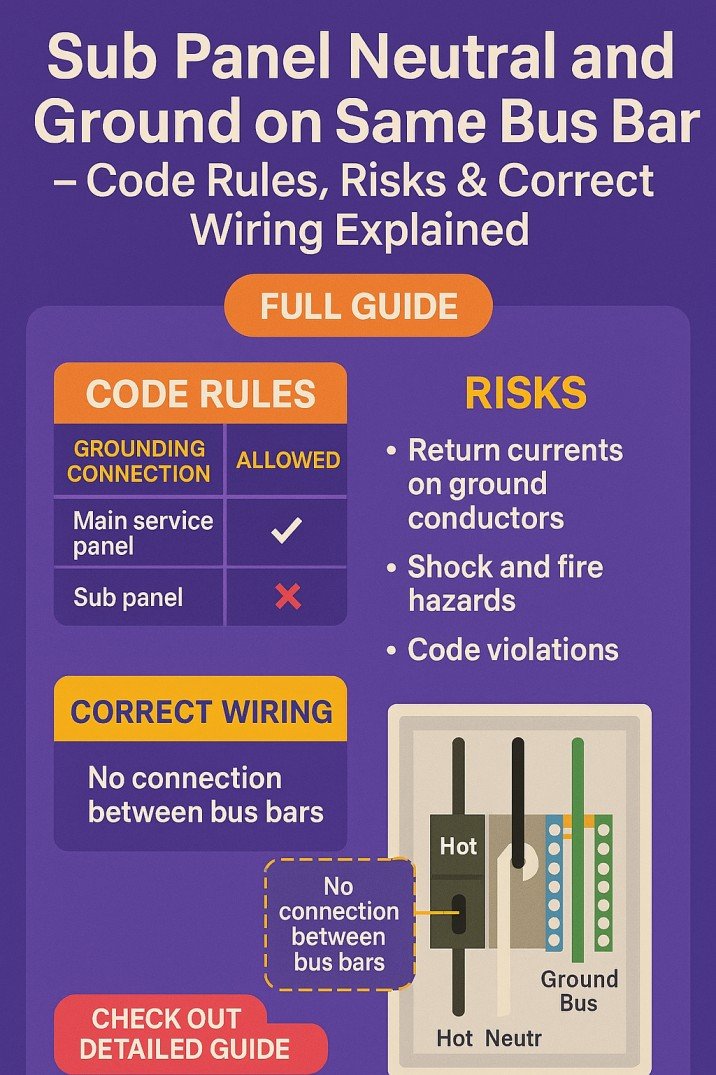
Neutral and Ground in a Subpanel
One of the most important checks is whether the neutral and equipment grounding conductors are correctly separated downstream of the service disconnect.
In a typical subpanel, the neutral bar is isolated from the panel enclosure and equipment grounding bar. Bonding neutral and ground together downstream can place normal neutral current onto grounding paths.
That is not simply a matter of whether the meter displays 0 V. Correct conductor separation and bonding are fundamental to the electrical system.
If you are researching an earth to neutral voltage standard, distinguish the measurement itself from the code requirements governing the installation.
What a High Reading Can Tell You
A higher-than-expected measurement should be treated as a troubleshooting clue rather than automatically declared an NEC violation.
Possible causes include:
- Excessive neutral conductor voltage drop
- Loose neutral termination
- Damaged or undersized conductor
- High-resistance connection
- Incorrect neutral-ground bonding
- Shared-neutral problems
- Service neutral problems
- Heavy load on the circuit
- Poor connections in upstream equipment
A loose service neutral deserves particular attention because it can produce unstable voltages on a 120/240V system and potentially damage equipment.
Neutral-to-Ground Troubleshooting Guide
| Test | Result | Next step |
|---|---|---|
| N-G near 0 V | Normal condition | Continue other checks if needed |
| N-G rises slightly under load | Possible normal voltage drop | Compare with load current |
| N-G rises significantly | Abnormal condition possible | Inspect neutral path |
| N-G fluctuates heavily | Possible connection issue | Investigate promptly |
| N-G exists at subpanel with improper bond | Wiring issue | Verify bonding and isolation |
| N-G high throughout installation | Upstream problem possible | Check feeder/service neutral |
For readers comparing terminology, the neutral to earth voltage standard should also be considered separately from NEC grounding and bonding requirements.
FAQs About Neutral to Ground Voltage
1. What is normal neutral to ground voltage?
There is no single NEC-defined numerical value. A correctly installed system should generally have a very small difference, especially at the service equipment. Some voltage can appear downstream because of neutral voltage drop under load.
2. Is 2 volts between neutral and ground acceptable?
A 2V measurement is not automatically an NEC violation, because the NEC does not establish a universal 2V maximum for this measurement. The electrician should consider circuit load, conductor length, voltage drop, connections, and bonding.
3. Should neutral and ground have continuity?
They are intentionally connected at the service bonding point in a typical system, but they should not be indiscriminately bonded together at downstream panels. The installation and applicable NEC provisions determine the correct arrangement.
4. Why do I get voltage between neutral and ground?
The most common reason is voltage drop on the neutral caused by load current. A higher or unstable reading can also indicate a loose connection, excessive impedance, or an incorrect bonding arrangement.
5. What does high neutral-to-ground voltage mean?
It means further troubleshooting is warranted. Measure the circuit under different loads and compare neutral-to-ground voltage at several points. Also check neutral terminations, conductor sizing, voltage drop, and the grounding/bonding arrangement.
Final Takeaway
The key point is simple: the NEC does not provide a universal numerical Neutral to Ground Voltage limit. Instead, it establishes requirements for grounding, bonding, conductor connections, and avoidance of objectionable current. A small reading can result from normal neutral voltage drop, while a high or unstable reading should prompt systematic troubleshooting.
For code compliance, always apply the NEC edition adopted by the authority having jurisdiction and consider the specific system configuration rather than relying on a single meter reading.
Get new guides in your feed. Follow Electrical Insights on LinkedIn for new electrical standards guides, calculators and design tips from Azad Circuit Hub.
#NeutralToGroundVoltage, #NECStandard, #ElectricalSafety, #NECCode, #GroundVoltage, #NeutralVoltage, #ElectricalTesting, #ElectricalTroubleshooting, #Grounding, #Electricians