
IEC 61000-6 vs IEC 61000-4 : Key Differences, EMC Standards Comparison & Compliance Guide
Electromagnetic compatibility is a critical part of modern electrical and electronic system design. Whether it is industrial equipment, solar inverters, or automation systems, ensuring that devices operate without causing or suffering from electromagnetic interference is essential. This is where standards like IEC 61000 come into play. When discussing iec 61000-6 vs iec 61000-4, many engineers and compliance professionals often get confused because both belong to the same family but serve very different purposes.
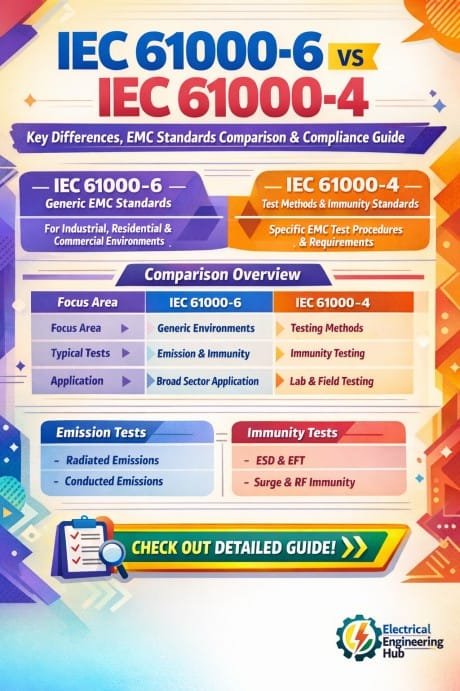
Table of Contents
Understanding the difference between iec 61000-6 vs iec 61000-4 helps manufacturers ensure proper testing, certification, and market compliance. This guide explains both standards in a clear and practical way so you can apply them correctly in real-world projects.
Know more about Phase to Phase Clearance as per IEC 61439: Best Guide
What is IEC 61000-6
IEC 61000-6 is a group of generic EMC standards that define emission and immunity requirements for equipment operating in different environments. These standards are not test methods themselves but define the limits and performance criteria.
The IEC 61000-6 series is divided based on environment:
| Standard | Description | Application Area |
|---|---|---|
| IEC 61000-6-1 | Immunity for residential, commercial | Homes, offices |
| IEC 61000-6-2 | Immunity for industrial environments | Factories, plants |
| IEC 61000-6-3 | Emission for residential environments | Consumer devices |
| IEC 61000-6-4 | Emission for industrial environments | Heavy equipment |
When analyzing iec 61000-6 vs iec 61000-4, it is important to note that IEC 61000-6 tells you what limits your product must meet depending on where it will be used.
What is IEC 61000-4
IEC 61000-4 is a series of standards that define specific EMC test methods. These standards describe how to perform tests such as electrostatic discharge, surge immunity, and radiated emissions.
Know more about How to Comply with OSHA Electrical Standards in detail
Each part focuses on a specific phenomenon:
| Standard | Test Type | Purpose |
|---|---|---|
| IEC 61000-4-2 | Electrostatic discharge (ESD) | Simulates human touch discharge |
| IEC 61000-4-3 | Radiated immunity | Tests resistance to RF signals |
| IEC 61000-4-4 | Electrical fast transients | Simulates switching noise |
| IEC 61000-4-5 | Surge immunity | Lightning and surge testing |
| IEC 61000-4-6 | Conducted immunity | RF disturbances via cables |
| IEC 61000-4-8 | Power frequency magnetic field | Magnetic interference |
In simple terms, while comparing iec 61000-6 vs iec 61000-4, IEC 61000-4 explains how testing is done in the lab.
Core Difference Between IEC 61000-6 vs IEC 61000-4
The confusion around iec 61000-6 vs iec 61000-4 usually comes from the fact that both are used together during compliance testing. However, their roles are clearly different.
Know more about Electrical Standards USA – National Electrical Code | Electrical Safety Foundation
Here is a direct comparison:
| Aspect | IEC 61000-6 | IEC 61000-4 |
|---|---|---|
| Type | Generic standard | Test method standard |
| Purpose | Defines limits and requirements | Defines testing procedures |
| Usage | Specifies what to meet | Specifies how to test |
| Application | Environment-based | Phenomena-based |
| Role in compliance | Requirement setting | Verification method |
This table simplifies the understanding of iec 61000-6 vs iec 61000-4 for engineers working on EMC certification.
How IEC 61000-6 Uses IEC 61000-4
A key point in iec 61000-6 vs iec 61000-4 is that both are interconnected. IEC 61000-6 standards reference IEC 61000-4 standards to define testing procedures.
For example:
- IEC 61000-6-2 may require surge immunity testing
- The actual test is performed using IEC 61000-4-5
Learn more in detail on NEMA 250 Enclosures – Electrical Enclosure Standards | Best Manufacturing Companies in USA
This means:
- IEC 61000-6 = What level of immunity or emission is required
- IEC 61000-4 = How to measure and verify that level
Without IEC 61000-4, IEC 61000-6 cannot be practically implemented.
Practical Example for Better Understanding
Consider a solar inverter installed in an industrial environment. To ensure compliance:
- IEC 61000-6-2 will define immunity requirements
- IEC 61000-6-4 will define emission limits
- IEC 61000-4 standards will be used to perform:
- ESD testing
- Surge testing
- Conducted immunity testing
This example makes the concept of iec 61000-6 vs iec 61000-4 much clearer in real applications.
Learn more about NFPA 70 National Electrical Code | Electrical Safety Experts
Key EMC Testing Parameters
When dealing with iec 61000-6 vs iec 61000-4, the following parameters are commonly evaluated:
- Radiated emissions
- Conducted emissions
- Electrostatic discharge levels
- Surge voltage levels
- Immunity to RF interference
- Power frequency disturbances
Each of these parameters is tested using IEC 61000-4 methods while ensuring limits defined by IEC 61000-6 are not exceeded.
Compliance Workflow
Understanding iec 61000-6 vs iec 61000-4 also helps in setting up a proper compliance workflow.
Explore details on iec 61508 functional safety
Typical process:
- Identify product category and environment
- Select applicable IEC 61000-6 standard
- Determine required tests
- Perform tests using IEC 61000-4 methods
- Document results and verify compliance
This structured approach ensures faster certification and fewer design failures.
Common Mistakes in EMC Compliance
Many manufacturers misunderstand iec 61000-6 vs iec 61000-4, leading to costly delays.
Common mistakes include:
- Assuming IEC 61000-6 contains test procedures
- Ignoring environment classification
- Using incorrect test levels
- Skipping pre-compliance testing
- Not aligning product design with EMC requirements
Avoiding these mistakes improves product reliability and reduces certification time.
Read in detail about iec 61439 busbar calculation
Industries Where These Standards Apply
The importance of iec 61000-6 vs iec 61000-4 extends across multiple industries:
| Industry | Application |
|---|---|
| Renewable energy | Solar inverters, wind systems |
| Industrial automation | PLCs, drives, control panels |
| Consumer electronics | Home appliances |
| Telecommunications | Network equipment |
| Medical devices | Sensitive electronic systems |
Each industry relies on proper EMC testing to ensure safety and performance.
Tips for Smooth Compliance
To handle iec 61000-6 vs iec 61000-4 effectively, follow these practical tips:
- Start EMC considerations at design stage
- Use shielded cables and proper grounding
- Select components with EMC ratings
- Conduct pre-compliance testing early
- Work with certified EMC laboratories
These steps reduce redesign costs and improve product quality.
Find out more about iec 61439 busbar clearance
Final Thoughts
The discussion around iec 61000-6 vs iec 61000-4 becomes simple once you understand their roles. IEC 61000-6 defines the limits based on environment, while IEC 61000-4 provides the methods to test those limits. Both standards work together to ensure that electronic devices operate reliably without causing interference.
For manufacturers, engineers, and compliance teams, mastering iec 61000-6 vs iec 61000-4 is essential for successful product certification. It not only ensures regulatory approval but also enhances product performance in real-world conditions.
Learn more about earthing cable size as per iec
Get new guides in your feed. Follow Electrical Insights on LinkedIn for new electrical standards guides, calculators and design tips from Azad Circuit Hub.
#IEC61000, #EMCStandards, #IEC610006, #IEC610004, #ElectromagneticCompatibility, #ComplianceStandards, #IndustrialEMC, #ElectricalStandards, #EMCTesting, #PowerQuality
