
How To Use A Oscilloscope: Complete Beginner to Professional Guide for Accurate Signal Testing
An oscilloscope is one of the most important tools used in electronics, electrical maintenance, communication systems, automotive diagnostics, and industrial troubleshooting. Whether you are testing a simple sensor circuit or analyzing high-frequency electronic signals, understanding How To Use A Oscilloscope can help you measure voltage, frequency, waveform patterns, and signal stability with precision.
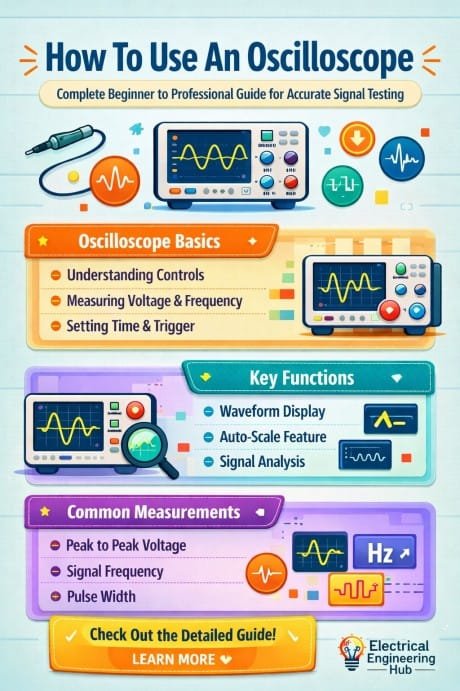
Table of Contents
Many beginners feel confused when they first see an oscilloscope screen filled with grids, channels, probes, and waveform settings. However, once you understand the basic controls and testing methods, operating this device becomes much easier. This guide explains everything from connecting probes to interpreting waveforms so you can perform accurate signal testing like a professional.
What Is an Oscilloscope?
An oscilloscope is an electronic testing instrument that displays electrical signals in the form of waveforms. It shows how voltage changes over time and helps technicians analyze circuit behavior in real-time.
Know more about cathode ray oscilloscope
Oscilloscopes are widely used in:
- Electronics repair
- Industrial automation
- Power systems
- Solar inverter diagnostics
- Communication equipment testing
- Automotive electronics
- Embedded systems development
The horizontal axis usually represents time, while the vertical axis represents voltage.
Main Parts of an Oscilloscope
Before learning How To Use A Oscilloscope, it is important to understand its major components.
| Part | Function |
|---|---|
| Display Screen | Shows signal waveforms |
| Probe | Connects oscilloscope to the circuit |
| Vertical Controls | Adjust voltage scale |
| Horizontal Controls | Adjust time scale |
| Trigger Controls | Stabilize waveform display |
| Input Channels | Connect multiple signals |
| Ground Clip | Provides reference grounding |
Modern digital oscilloscopes may also include USB ports, automatic measurements, waveform storage, and advanced signal analysis features.
Know more about How To Choose An Oscilloscope
Types of Oscilloscopes
Different oscilloscopes are designed for different applications.
| Oscilloscope Type | Common Use |
|---|---|
| Digital Oscilloscope | General electronics and diagnostics |
| Analog Oscilloscope | Traditional waveform viewing |
| USB Oscilloscope | Portable computer-based testing |
| Handheld Oscilloscope | Field maintenance work |
| Mixed Signal Oscilloscope | Digital and analog signal analysis |
Digital storage oscilloscopes are the most commonly used today because they offer better accuracy and advanced measurement features.
How To Use A Oscilloscope Step by Step
Learning the correct setup process is essential for safe and accurate testing.
Step 1: Turn On the Oscilloscope
Connect the oscilloscope to a stable power source and switch it on. Most modern oscilloscopes perform a self-test during startup.
Wait until the display screen becomes stable before connecting any signal.
Step 2: Connect the Probe
Insert the oscilloscope probe into Channel 1 input. Attach the probe tip to the signal point and connect the ground clip to circuit ground.
Proper grounding is important because incorrect grounding may create inaccurate readings or equipment damage.
Findt all about AC Hipot Test Procedure for Cables
Step 3: Adjust Probe Settings
Most probes have 1X and 10X attenuation settings.
| Probe Setting | Purpose |
|---|---|
| 1X | Low-voltage signals |
| 10X | High-voltage or high-frequency signals |
Ensure the oscilloscope channel setting matches the probe setting.
Step 4: Set Voltage Scale
Use the volts/division control to adjust waveform height on the screen.
If the waveform appears too small, reduce the voltage scale. If the waveform exceeds screen limits, increase the voltage scale.
This adjustment helps you analyze signal amplitude more clearly.
Step 5: Set Time Base
The time/division control adjusts how quickly the waveform moves across the screen.
For slow-changing signals, increase the time scale. For fast electronic signals, decrease the time scale to capture detailed waveform behavior.
Find all about Top 15 Partial Discharge Tester Suppliers in United States
Step 6: Configure Trigger Settings
Trigger settings stabilize the waveform display. Without proper triggering, the waveform may continuously move across the screen.
Common trigger modes include:
- Auto Trigger
- Normal Trigger
- Single Trigger
Most beginners start with Auto Trigger because it automatically stabilizes the signal.
Understanding Oscilloscope Waveforms
A waveform represents electrical signal behavior over time. Reading waveforms correctly is one of the most important skills in signal analysis.
Sine Wave
A smooth periodic waveform commonly found in AC power systems and audio signals.
Square Wave
Used in digital electronics, pulse circuits, and communication systems.
Triangle Wave
Often found in waveform generators and modulation circuits.
Pulse Wave
Commonly used in switching circuits and PWM motor control systems.
Know more about Partial Discharge Test Equipment Price in USA & Europe
Important Oscilloscope Measurements
Oscilloscopes can measure several signal parameters.
| Measurement | Description |
|---|---|
| Voltage | Signal amplitude |
| Frequency | Signal repetition rate |
| Period | Time for one complete cycle |
| Duty Cycle | Ratio of ON time to total cycle |
| Rise Time | Speed of signal transition |
| Peak-to-Peak Voltage | Difference between highest and lowest voltage |
These measurements are useful for diagnosing faulty components and analyzing electronic circuits.
Safety Tips While Using an Oscilloscope
Understanding safety procedures is critical while learning How To Use A Oscilloscope.
- Always verify voltage ratings before testing
- Never exceed probe voltage limits
- Use insulated probes for high-voltage circuits
- Avoid touching exposed conductors
- Ensure proper grounding
- Disconnect power before changing circuit connections
Electrical testing without safety precautions can damage equipment and create serious hazards.
Know more about Power Quality Analyzer Buying Guide
Common Oscilloscope Problems and Solutions
Beginners often face display and signal issues during testing.
| Problem | Possible Cause | Solution |
|---|---|---|
| No waveform display | Loose probe connection | Reconnect probe properly |
| Unstable waveform | Incorrect trigger setting | Adjust trigger controls |
| Distorted signal | Wrong voltage scale | Change volts/div setting |
| Noise in waveform | Poor grounding | Improve ground connection |
| Flat line display | No input signal | Verify circuit signal |
Learning troubleshooting methods improves testing accuracy and saves diagnostic time.
Applications of Oscilloscopes
Oscilloscopes are used across many industries for signal analysis and troubleshooting.
Electronics Repair
Technicians use oscilloscopes to identify damaged components and analyze signal flow inside electronic devices.
Industrial Maintenance
Factories use oscilloscopes for motor drive testing, PLC diagnostics, and power quality analysis.
Know more about Top 12 Electrical Testing Equipment Suppliers in USA
Solar Power Systems
Engineers test inverter output waveforms, communication signals, and controller circuits using oscilloscopes.
Automotive Diagnostics
Modern vehicles contain sensors, ECUs, and communication networks that require waveform analysis during troubleshooting.
Communication Systems
Oscilloscopes help analyze RF signals, modulation quality, and digital communication timing.
Beginner Tips for Better Oscilloscope Usage
New users can improve their testing skills by following simple practices.
- Start with low-voltage circuits
- Learn one control at a time
- Practice reading common waveforms
- Use automatic measurement functions
- Compare known good signals with faulty signals
- Keep probe wires short to reduce noise
Consistent practice improves waveform interpretation and signal analysis accuracy.
Find all about Best Megger Insulation Testers 5000V
Choosing the Right Oscilloscope
If you are purchasing an oscilloscope, consider these factors.
| Feature | Importance |
|---|---|
| Bandwidth | Determines signal frequency range |
| Sample Rate | Affects waveform accuracy |
| Number of Channels | Allows multi-signal analysis |
| Memory Depth | Stores waveform data |
| Portability | Useful for field testing |
For beginners, a digital oscilloscope with moderate bandwidth and automatic functions is usually the best option.
Conclusion
Learning How To Use A Oscilloscope is an essential skill for anyone working with electronics, electrical systems, industrial automation, or communication equipment. An oscilloscope helps visualize electrical signals, measure waveform characteristics, and troubleshoot complex circuit problems with precision.
Explore all about How to Test a 3 Phase Motor With a Megger
By understanding probe connections, voltage scaling, trigger settings, waveform interpretation, and safety practices, beginners can confidently perform accurate signal testing. With regular practice and hands-on experience, you can move from basic waveform observation to professional-level electronic diagnostics and advanced signal analysis.
Get new guides in your feed. Follow Electrical Insights on LinkedIn for new electrical standards guides, calculators and design tips from Azad Circuit Hub.
#HowToUseAOscilloscope,#OscilloscopeGuide,#ElectronicsTesting,#SignalAnalysis,#DigitalOscilloscope,#CircuitDiagnostics,#ElectronicMeasurements,#OscilloscopeTutorial,#ElectricalEngineering,#TestAndMeasurement
