
Fluke 87V Review: Best Industrial Multimeter?
The Fluke 87V is one of the most respected digital multimeters for industrial electrical work. It is designed for electricians, maintenance technicians, automation engineers, and electrical engineers who need more than basic voltage and continuity measurements.
As an electrical engineer with hands-on experience in industrial electrical systems, troubleshooting, automation, power equipment, and field maintenance, I look at a multimeter differently from a casual buyer. Accuracy matters, but so do input protection, low-impedance measurement, temperature capability, current measurement, durability, and performance around electrically noisy equipment.
This Fluke 87V Review examines those points in practical terms and explains where this industrial multimeter makes sense compared with cheaper meters.
Fluke 87V Quick Specifications
| Feature | Fluke 87V |
|---|---|
| Product type | True-RMS industrial digital multimeter |
| AC/DC voltage | Up to 1,000 V |
| AC/DC current | Up to 10 A |
| Resistance | Up to 50 MΩ |
| Frequency | Up to 200 kHz |
| Capacitance | Yes |
| Temperature | Built-in temperature measurement capability |
| Display | Large digital display with analog bar graph |
| Industrial troubleshooting | Excellent |
| Low-pass filter | Yes |
| LoZ voltage function | Yes |
| Safety rating | CAT III 1000 V / CAT IV 600 V |
| Warranty | Limited lifetime warranty |
| Best suited for | Industrial electricians, engineers, technicians and maintenance teams |
The specifications can vary slightly by package or regional version, so check the current Amazon listing before purchasing.
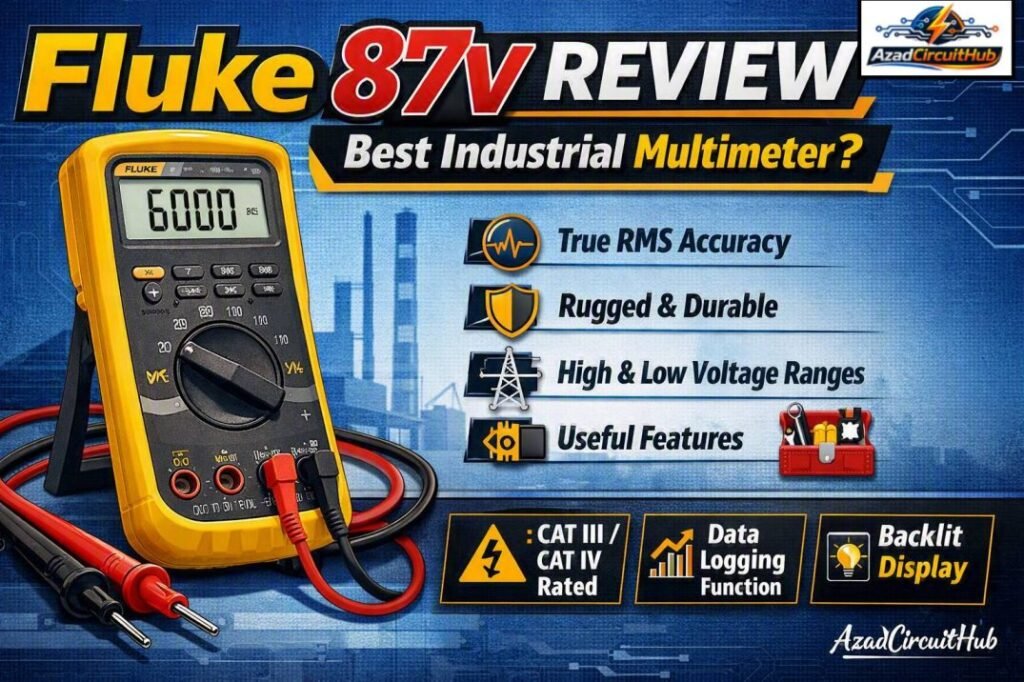
Table of Contents
Table of Contents
What Is the Fluke 87V?
The Fluke 87V is a professional-grade True-RMS multimeter built primarily for industrial troubleshooting. It is considerably more capable than an entry-level electrical tester.
One of its biggest strengths is its ability to handle measurements around variable-frequency drives, motors, control panels, industrial power supplies, and other equipment where electrical noise can make troubleshooting difficult.
The meter includes a selectable low-pass filter that helps electricians obtain more useful voltage readings when working with variable-frequency drives and motor-drive systems.
For someone working mainly on household outlets and simple circuits, many of its features may be unnecessary. For industrial maintenance, however, those features can save troubleshooting time.
Fluke 87V Features That Matter in the Field
| Feature | Why It Matters |
|---|---|
| True RMS | Provides accurate AC measurements on non-linear loads |
| Low-pass filter | Helps measure drive output more effectively |
| LoZ function | Helps reduce false voltage readings caused by ghost voltage |
| Temperature measurement | Useful for motors, panels and thermal troubleshooting |
| Min/Max/Avg | Helps capture changing electrical conditions |
| High-resolution display | Makes difficult measurements easier to interpret |
| Rugged construction | Suitable for demanding jobsite environments |
| CAT III/CAT IV protection | Designed for higher-energy electrical environments |
| Analog bar graph | Useful for observing rapidly changing signals |
| Manual and auto-ranging | Gives flexibility during troubleshooting |
Fluke 87V Review: Testing Performance
The most important reason professionals buy the Fluke 87V is measurement performance.
The meter uses True-RMS technology, which is particularly useful when measuring AC voltage or current from modern electronic loads. Conventional averaging meters can produce inaccurate readings when the waveform is distorted.
Industrial electrical systems frequently contain variable-speed drives, switching power supplies, UPS systems, rectifiers, electronic controls, and other nonlinear loads. These devices can produce waveforms that are far from a clean sine wave.
The 87V is better suited to these conditions.
Its accuracy is also useful when diagnosing relatively small differences between expected and measured values. During electrical troubleshooting, a meter that provides stable and repeatable readings can be more valuable than a meter that simply offers a large number of functions.
Low-Pass Filter for VFD Troubleshooting
One standout feature is the low-pass filter.
Variable-frequency drives generate high-frequency switching components that can complicate measurements. When troubleshooting a motor-drive system, measuring the drive output with an ordinary multimeter may produce confusing results.
The 87V's low-pass filter is intended to help technicians obtain a more useful fundamental-frequency voltage reading.
This makes the meter especially attractive for:
- Variable-frequency drives
- Industrial motors
- Motor control centers
- Automation panels
- Pump systems
- HVAC equipment
- Conveyor systems
- Industrial machinery
For engineers involved in PLC and automation troubleshooting, this is one of the features that separates the 87V from inexpensive general-purpose multimeters.
LoZ Voltage Measurement
Another useful function is low-input-impedance, or LoZ, voltage measurement.
Ghost voltage can appear on an apparently disconnected conductor because of capacitive coupling from nearby energized wiring. A high-impedance meter can detect this induced voltage even though the circuit cannot supply meaningful current.
The LoZ function loads the circuit more heavily and can help distinguish actual energized voltage from induced or ghost voltage.
That is particularly useful when working inside control cabinets and electrical distribution systems where multiple conductors run close together.
Is the Fluke 87V Safe for Industrial Work?
Safety is one of the strongest reasons to consider the 87V.
The meter carries CAT III 1000 V and CAT IV 600 V measurement-category ratings, making it appropriate for many demanding electrical environments when used within its specifications and with suitable leads and procedures.
However, a CAT rating does not make electrical work automatically safe.
The measurement category, voltage level, available fault current, test leads, accessories, PPE, and working procedure all matter. Users should always follow the applicable electrical safety requirements for the installation.
The Fluke 87V is a professional test instrument, not a substitute for safe isolation and proper electrical work practices.
Fluke 87V for Electricians and Electrical Engineers
The 87V makes the most sense for professionals who regularly troubleshoot electrical equipment.
An industrial electrician may use it to check motor voltage, control circuits, contactors, fuses, current draw, resistance, continuity, and drive systems.
An electrical engineer may use the meter during commissioning, preventive maintenance, fault finding, panel inspection, or equipment testing.
For field engineers, the rugged design is another advantage. A professional meter often gets exposed to dust, vibration, repeated handling, and demanding work environments. The 87V is built with this type of use in mind.
If you are comparing professional meters before upgrading your test kit, see our Best Multimeter for Electricians guide for additional options and use-case comparisons.
Fluke 87V Temperature Measurement
Temperature measurement can be useful when electrical troubleshooting involves overheating equipment.
With a compatible temperature probe, technicians can investigate conditions such as:
- Motor temperature
- Terminal overheating
- Control-panel hotspots
- Transformer-related temperature checks
- HVAC equipment
- Electrical connections
- Bearing or machinery temperature
A multimeter should not replace a dedicated thermal imaging camera for detailed thermal surveys, but having temperature measurement available in the same instrument can be convenient during routine troubleshooting.
Fluke 87V vs Cheap Multimeter
The price difference between the Fluke 87V and a budget multimeter can be significant. The question is whether you will actually use the additional capability.
| Requirement | Budget Multimeter | Fluke 87V |
|---|---|---|
| Basic voltage testing | Yes | Yes |
| Continuity | Yes | Yes |
| Resistance | Yes | Yes |
| True RMS | Sometimes | Yes |
| Industrial troubleshooting | Limited | Excellent |
| VFD troubleshooting | Limited | Strong |
| LoZ measurement | Not always | Yes |
| High-energy installation rating | Varies | CAT III/CAT IV |
| Rugged professional use | Varies | Excellent |
| Advanced troubleshooting | Limited | Excellent |
If you only check batteries, outlets, small control circuits, or hobby electronics, a cheaper meter can provide better value.
If your work involves industrial machinery, drives, motors, panels, or commercial electrical systems, the 87V becomes much easier to justify.
Should You Buy the Fluke 87V?
The Fluke 87V is not the cheapest digital multimeter, but its value comes from professional measurement capability rather than simply the number of functions.
I would particularly consider it for technicians and engineers who spend significant time troubleshooting industrial electrical systems.
The low-pass filter, True-RMS measurement, LoZ function, rugged construction, safety ratings, and temperature capability make it a strong all-around troubleshooting instrument.
Check the Fluke 87V on Amazon before buying and compare the current price, included accessories, seller, and warranty terms. Product packages can differ between listings.
If your work involves daily electrical testing and you want a meter that can stay in your tool bag for years, the investment is much easier to justify.
Where the Fluke 87V May Be Overkill
Despite its excellent capabilities, the 87V is not automatically the right meter for everyone.
It can be excessive for:
- Homeowners
- Basic DIY electrical work
- Simple battery testing
- Basic automotive checks
- Students who only need introductory measurements
- Occasional low-voltage electronics testing
A less expensive meter may provide all the functions these users actually need.
The best multimeter should match the electrical environment and measurement requirements rather than simply having the highest specification.
For a wider comparison of professional options, our multimeter for electrician guide can help you choose a meter based on application, budget, and required functions.
Pros and Cons of the Fluke 87V
| Pros | Cons |
|---|---|
| Excellent industrial troubleshooting capability | Higher price than basic meters |
| True-RMS measurement | May be excessive for simple jobs |
| Low-pass filter for drive applications | Some advanced functions require learning |
| LoZ voltage function | Not designed specifically as an electronics bench meter |
| Strong safety ratings | Genuine Fluke accessories can add to overall cost |
| Rugged professional construction | Larger investment for occasional users |
| Temperature measurement |
Who Should Buy the Fluke 87V?
The Fluke 87V is best suited to industrial electricians, electrical engineers, maintenance technicians, automation professionals, commissioning engineers, and contractors who regularly work around energized electrical equipment.
It is especially attractive when VFDs, motors, control panels, power distribution, and industrial machinery are part of your daily work.
If you need a reliable instrument for demanding electrical troubleshooting, the 87V is one of the models worth putting on your shortlist.
For more options across different price levels and applications, check our digital multimeter for electricians guide before making your final choice.
Final Verdict: Is Fluke 87V the Best Industrial Multimeter?
The Fluke 87V earns its reputation because it solves real problems encountered during industrial electrical troubleshooting.
It combines True-RMS accuracy, useful drive-measurement features, LoZ testing, temperature capability, rugged construction, and strong safety ratings in one instrument.
In my experience as an electrical engineer working around power systems, industrial equipment, automation, and electrical troubleshooting, these practical features are more important than simply counting how many functions a multimeter has.
Is it the best industrial multimeter for everyone? No. But for professionals who need a dependable meter for industrial troubleshooting, the Fluke 87V is one of the strongest choices in its class.
If your priority is a dependable professional meter rather than the lowest purchase price, the 87V deserves serious consideration. You can also compare it with other professional instruments in our best electricians multimeter guide.
Frequently Asked Questions
Is the Fluke 87V worth the money?
Yes, particularly for industrial electricians, electrical engineers, and maintenance technicians. Its True-RMS measurement, low-pass filter, LoZ function, safety ratings, and rugged construction provide capabilities that inexpensive multimeters often lack.
Is Fluke 87V good for VFD testing?
Yes. The 87V is specifically well suited to troubleshooting variable-frequency drive systems. Its low-pass filter can help produce more useful readings when measuring drive-related voltage signals.
What is the difference between Fluke 87V and a regular multimeter?
The Fluke 87V is designed for demanding professional troubleshooting. It combines True-RMS measurement, LoZ voltage testing, a low-pass filter, advanced measurement functions, high safety ratings, and rugged construction.
Can Fluke 87V measure temperature?
Yes. The Fluke 87V supports temperature measurement when used with the appropriate temperature probe. This can be useful for checking motors, electrical connections, machinery, and other equipment.
Is Fluke 87V suitable for electricians?
Yes. It is particularly suitable for electricians working with industrial machinery, motor controls, VFDs, distribution equipment, commercial systems, and electrical panels. For basic residential testing, however, a less expensive meter may be sufficient.
Follow Us on Social:
Subscribe our Newsletter on Electrical Insights for latest updates from Azad Circuit Hub
#Fluke87V, #Fluke87VReview, #IndustrialMultimeter, #DigitalMultimeter, #ElectricalTesting, #ElectriciansTools, #FlukeMultimeter, #MultimeterReview, #ElectricalTools, #ProfessionalMultimeter
