Best Oscilloscope For Beginners – Top Affordable Digital Oscilloscopes for Learning & DIY Electronics
Choosing the right oscilloscope can feel overwhelming for someone just starting in electronics. With so many bandwidth ratings, sampling rates, and display types, it is easy to get confused. A good starter device should be simple, reliable, and accurate enough for learning basic signals. For hobbyists, students, and DIY enthusiasts, the Best Oscilloscope For Beginners is the one that balances price, usability, and essential measurement features without unnecessary complexity.
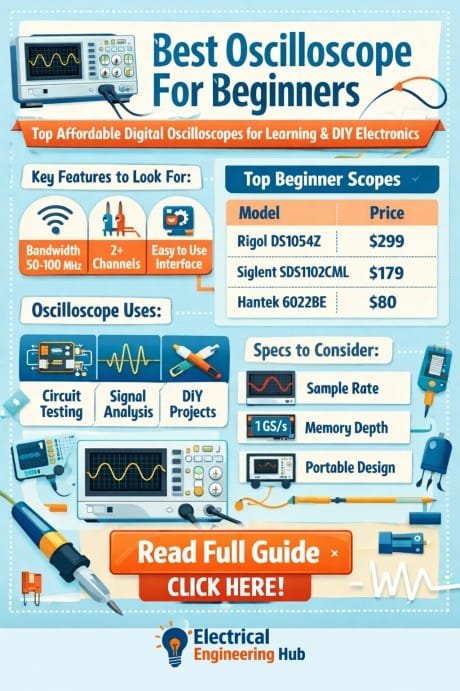
Table of Contents
Modern digital storage oscilloscopes have made learning much easier by offering clear waveforms, auto-setup functions, and USB connectivity. These tools help users visualize voltage changes in real time, making circuit testing and debugging more intuitive.
What Makes a Good Beginner Oscilloscope
A beginner-friendly oscilloscope should focus on simplicity and practical features rather than advanced laboratory-level performance. The Best Oscilloscope For Beginners typically includes a bandwidth between 20MHz and 100MHz, which is more than enough for audio circuits, Arduino projects, and basic electronics experiments.
Ease of use is equally important. A clear interface with auto-triggering and one-button setup helps new users understand waveforms without deep technical knowledge. Storage capability also adds value, allowing users to capture and analyze signals later.
Explore step wise guide on How To Read Oscilloscopes
The Best Oscilloscope For Beginners often includes a color LCD screen, at least two channels, and decent sampling speed for stable signal representation. These features ensure smooth learning without unnecessary frustration.
| Feature | Recommended Range | Why It Matters |
|---|---|---|
| Bandwidth | 20MHz – 100MHz | Suitable for most beginner circuits |
| Sampling Rate | 100MSa/s – 1GSa/s | Improves waveform accuracy |
| Channels | 2 channels minimum | Enables comparison of signals |
| Display | Color LCD | Easier waveform interpretation |
| Connectivity | USB or PC sync | Useful for data analysis and saving |
When evaluating entry-level models, it is important to consider upgrade potential as well. Many users who start with a basic unit later move to more advanced equipment as their skills improve. Know more about cathode ray oscilloscope
Top Affordable Digital Oscilloscopes for Learning
Budget-friendly options have improved significantly in recent years, offering features once found only in professional devices. The Best Oscilloscope For Beginners often comes from brands like Rigol, Siglent, Hantek, and Owon, which provide reliable performance at reasonable prices.
Know more about Best Low Cost Oscilloscopes to Buy
These oscilloscopes are widely used in electronics labs, repair shops, and home DIY setups. They support tasks such as waveform analysis, circuit troubleshooting, and signal verification in microcontroller projects.
| Model Name | Bandwidth | Sampling Rate | Channels | Key Feature |
|---|---|---|---|---|
| Rigol DS1054Z | 50MHz | 1GSa/s | 4 | Upgradeable bandwidth |
| Hantek 6022BE | 20MHz | 48MSa/s | 2 | USB powered compact design |
| Siglent SDS1102C | 100MHz | 1GSa/s | 2 | Stable waveform display |
| Owon VDS1022I | 25MHz | 100MSa/s | 2 | Lightweight and portable |
Among these, users often prefer models that provide software support and firmware updates. A strong PC interface allows deeper analysis, making it easier to understand circuit behavior.
The Best Oscilloscope For Beginners in this category usually offers auto-measurement tools such as frequency counting, peak detection, and RMS voltage display. These features reduce manual calculations and speed up learning.
How to Choose the Right Specifications
Selecting the right specifications is essential for getting the most value from your device. Many beginners assume higher numbers are always better, but practical needs should guide the decision.
The Best Oscilloscope For Beginners should match the type of projects you plan to build. For example, Arduino and Raspberry Pi work typically require moderate bandwidth and sampling rates. Audio electronics may need better low-frequency stability.
Know more about How To Choose An Oscilloscope
Here are key factors to consider:
- Bandwidth should be at least five times higher than the highest signal frequency
- Sampling rate must be sufficient to avoid distorted waveforms
- Memory depth helps in capturing long signals accurately
- Trigger functions improve waveform stability
- Portability matters if working in multiple locations
| Specification | Beginner Recommendation | Advanced Consideration |
|---|---|---|
| Bandwidth | 20–70MHz | 100MHz+ |
| Sampling Rate | 100MSa/s+ | 1GSa/s or higher |
| Memory Depth | 1K–10K points | 1M+ points |
| Trigger Options | Edge trigger | Advanced pattern triggers |
Understanding these specifications helps avoid overspending on features that may not be needed early on. The Best Oscilloscope For Beginners focuses on practical usability rather than extreme technical power.
Find the Best 12 Budget Oscilloscope For Beginners
Practical Applications in DIY Electronics
Oscilloscopes are essential tools in electronics learning and repair. They allow users to visualize signals that cannot be seen with a multimeter. This makes troubleshooting much faster and more accurate.
In DIY projects, users commonly check PWM signals, sensor outputs, and communication protocols like I2C and SPI. The Best Oscilloscope For Beginners is especially helpful when working with microcontrollers, as it reveals timing issues and signal noise clearly.
It is also widely used in audio projects, where waveform clarity helps in designing amplifiers and filters. Even simple tasks like checking battery ripple voltage become easier with proper signal visualization.
Conclusion
Selecting the right entry-level device can significantly improve the learning experience in electronics. A well-balanced oscilloscope helps beginners understand complex signals in a simple and visual way. The Best Oscilloscope For Beginners is not just about price, but about usability, clarity, and long-term learning value.
Explore Top 25 Questions Regarding Usage Of Oscilloscope
By focusing on essential specifications, practical features, and reliable brands, users can confidently build their skills in circuit design and troubleshooting. Whether for education or DIY experimentation, the right choice ensures smoother progress and deeper understanding of electronics fundamentals.
Get new guides in your feed. Follow Electrical Insights on LinkedIn for new electrical standards guides, calculators and design tips from Azad Circuit Hub.
#BestOscilloscopeForBeginners,#DigitalOscilloscope,#ElectronicsTools,#OscilloscopeReview,#BeginnerElectronics,#DIYElectronics,#ElectronicsLab,#EngineeringTools,#AffordableOscilloscope,#TechEquipment