3/4 EMT Hand Bender Review: Features, Uses & Buying Guide
A reliable conduit bender can make a noticeable difference when installing electrical raceways. As an electrical engineer with more than 15 years of field experience in panel work, industrial automation, PLCs, SCADA systems, and electrical installation work, I have found that clean conduit bends depend as much on the right hand tool as they do on technique.
This 3/4 EMT hand bender review looks at what electricians should consider when selecting a bender for 3/4-inch EMT, including bending accuracy, shoe design, handling, durability, and common field applications.
Quick verdict: A good 3/4-inch EMT bender is a practical choice for electricians who regularly install exposed conduit, branch circuits, control wiring, and small commercial electrical systems. For the best results, choose a model with clear markings, a rigid shoe, and a comfortable handle.
3/4 EMT Hand Bender at a Glance
| Feature | What to Look For |
|---|---|
| Conduit type | 3/4-inch EMT |
| Main use | 90° bends, offsets, saddles |
| Material | Heavy-duty cast or reinforced construction |
| Bend markings | Degree and alignment marks |
| Handle | Long handle for better leverage |
| Best for | Electricians, contractors, maintenance teams |
| Key advantage | Accurate field bends without power |
| Skill level | Beginner to professional |
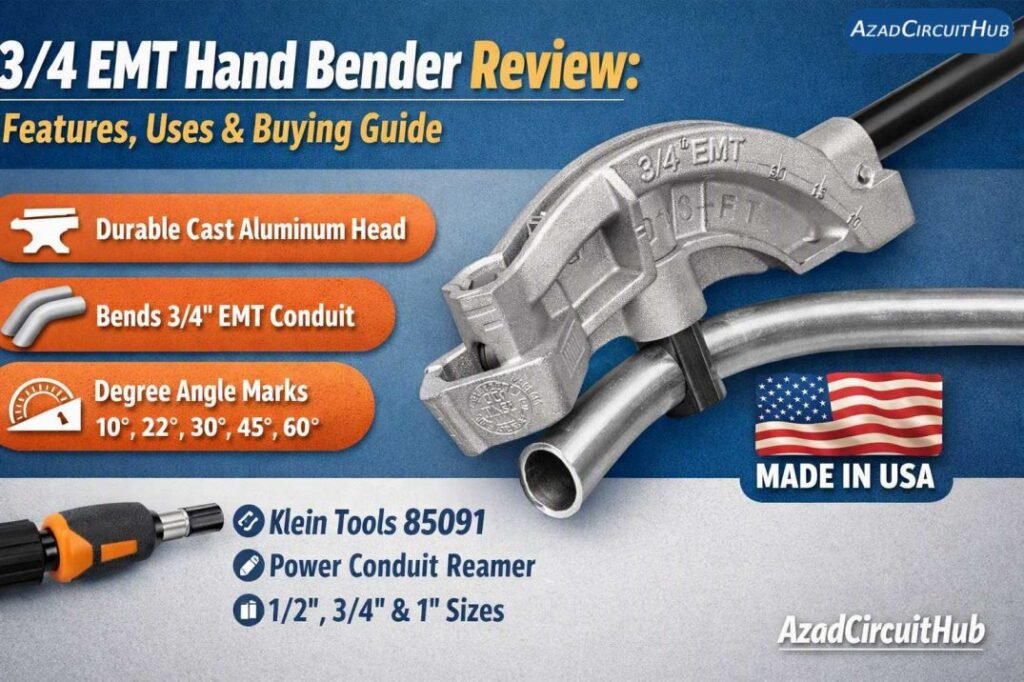
Table of Contents
Table of Contents
What Is a 3/4 EMT Hand Bender?
A 3/4 EMT hand bender is a manual tool designed to form 3/4-inch electrical metallic tubing without crushing or damaging the conduit. It is commonly used for 90-degree bends, offsets, back-to-back bends, and saddle bends.
The size matters because EMT benders are designed around specific conduit dimensions. Using the wrong shoe can produce inaccurate bends, deformation, or poor alignment.
For electricians, a good bender should provide clear degree markings and reference points. These markings make it easier to repeat bends and reduce trial and error when fabricating conduit runs on site.
What Makes a Good 3/4 EMT Bender?
The first thing I check is the quality of the bending shoe. It needs to hold the conduit firmly while allowing smooth movement through the bend.
A good handle is equally important. Bending 3/4-inch EMT requires more leverage than smaller conduit, especially when making repeated bends during a large installation.
Look for these features:
- Clearly visible degree markings
- Accurate arrow and star alignment marks
- Strong bending shoe
- Comfortable grip
- Good leverage
- Low conduit deformation
- Durable construction
- Easy-to-read reference points
For regular electrical work, these details can save considerable time over dozens of bends.
My Field Experience With EMT Bending
During electrical installation and control-panel work, I have often found that conduit layout becomes much easier when the bend marks are easy to read. A small error at the first bend can become a much larger alignment problem farther down the raceway.
The technique also matters. The conduit should be positioned correctly in the shoe, and pressure should be applied smoothly rather than with sudden force.
For repetitive installations, I recommend practicing the first few bends and checking the finished angle before continuing with the remaining pieces. This is particularly useful when installing parallel conduits or making multiple offsets.
Common 3/4 EMT Bends
A quality bender should handle the basic bends required in most electrical installations.
| Bend | Typical Application |
|---|---|
| 90° stub-up | Turning conduit into a panel or box |
| Offset | Moving conduit around an obstruction |
| Back-to-back | Maintaining a parallel conduit route |
| Saddle | Passing over pipes or other obstacles |
| Three-point saddle | Larger obstacles and more complex routing |
The correct bending technique helps maintain the internal diameter of the conduit while producing a professional-looking installation.
Buying Tip for Electricians
If you are purchasing a bender, don't focus only on the lowest price. A tool used every day should be comfortable, accurate, and durable enough to survive repeated job-site use.
For occasional DIY work, a basic model may be sufficient. For professional electricians, contractors, and maintenance technicians, investing in a better-quality bender usually makes more sense.
You can also keep a compatible conduit reaming tool nearby. After cutting EMT, removing sharp edges is important before pulling conductors.
For a useful companion tool, check the Klein Tools 85091 Power Conduit Reamer on Amazon. It is designed for 1/2-, 3/4-, and 1-inch conduit and combines reaming functions with improved bit retention.
Why a Conduit Reamer Is Worth Carrying
Cutting EMT leaves sharp edges that can damage wire insulation. A conduit reamer helps remove those edges quickly before conductors are installed.
The Klein Tools 85091 is particularly useful for electricians working with several common EMT sizes. Its compatibility with 1/2-, 3/4-, and 1-inch conduit makes it a convenient addition to a tool bag.
The reamer is not a replacement for a good hand bender, but the two tools work well together during conduit fabrication.
Planning a larger conduit installation? Use the Conduit Fill Calculator to check conductor capacity before selecting and routing your raceway.
Pros and Cons
| Pros | Cons |
|---|---|
| Manual operation needs no power | Requires physical effort |
| Suitable for field fabrication | Requires practice for accurate bends |
| Good leverage with the right handle | Bulkier than compact conduit tools |
| Useful for common EMT bends | One bender does not fit every EMT size |
| Can produce professional bends | Poor technique can deform conduit |
How to Get Cleaner EMT Bends
Start by measuring the required stub or offset carefully. Account for the bender's take-up dimension when making a 90-degree bend.
Keep the conduit seated properly in the bending shoe. Apply steady pressure and watch the degree markings rather than relying entirely on visual judgment.
For offsets, calculate the required spacing before bending. Making both bends at the correct angle is much easier than trying to correct an offset after the conduit has already been formed.
This approach reduces wasted EMT and helps create cleaner installations.
Is a 3/4 EMT Hand Bender Worth Buying?
For electricians who frequently work with 3/4-inch EMT, a quality bender is absolutely worth having. It is a relatively simple tool, but it directly affects the accuracy and appearance of conduit installations.
The best choice depends on how frequently you bend EMT and whether you need professional-grade durability. For everyday commercial, industrial, or maintenance work, I would prioritize construction quality, clear markings, and comfortable handling over saving a few dollars.
Before fabricating a large conduit run, use the Conduit Fill Calculator to verify that your planned conductors fit within the permitted raceway fill.
Frequently Asked Questions
What is a 3/4 EMT hand bender used for?
It is used to manually bend 3/4-inch EMT into shapes such as 90-degree stub-ups, offsets, saddles, and back-to-back bends.
How do you bend 3/4 EMT without crushing it?
Keep the EMT properly seated in the bender shoe and apply steady pressure. Avoid excessive force or bending beyond the tool's intended angle.
Can one EMT bender handle different conduit sizes?
Some benders are designed for a single conduit size, while others may accommodate multiple sizes. Always check the manufacturer's specifications before use.
What is the best tool to deburr EMT?
A dedicated conduit reamer is a practical option. The Klein Tools 85091, for example, is designed for 1/2-, 3/4-, and 1-inch conduit and can help remove sharp edges after cutting.
Is 3/4-inch EMT suitable for residential wiring?
Yes. 3/4-inch EMT is commonly used where metal raceway is required or preferred, although the appropriate conduit size depends on conductor count, conductor size, installation conditions, and applicable electrical codes.
Final Verdict
A good 3/4 EMT hand bender remains one of the most useful manual tools for electricians working with metal raceway. Accurate markings, solid construction, good leverage, and proper technique are the main factors that determine how cleanly it performs.
For a professional tool kit, I would pair the bender with a quality conduit reamer such as the Klein Tools 85091. Keeping both tools available makes the basic cut, deburr, and bend workflow much faster on site.
Get new guides in your feed. Follow Electrical Insights on LinkedIn for new electrical standards guides, calculators and design tips from Azad Circuit Hub.
#3_4EMTHandBender, #EMTHandBender, #EMTBender, #ConduitBender, #ElectricalTools, #ElectricianTools, #EMTConduit, #ConduitBending, #ElectricalInstallation, #ElectricianGea