
SDG&E Rate per kWh: Current San Diego Electricity Rates, TOU Prices & Cost Guide
The SDG&E Rate per kWh depends on the residential plan, time of use, season, electricity consumption, and several charges included on the bill. San Diego Gas & Electric (SDG&E) is one of California’s higher-cost utilities, so the price shown on a bill can be noticeably higher than the basic energy-generation cost.
For residential customers, an effective bill rate can often fall in the roughly $0.40 to $0.70+ per kWh range, while some time-of-use periods and higher-cost plans can be above that level. The exact price should always be checked against the current SDG&E tariff for the customer’s rate plan.
SDG&E Rate per kWh at a Glance
| Item | Typical/current range or treatment |
|---|---|
| SDG&E residential electricity | About $0.40–$0.70+ per kWh depending on plan and usage |
| Basic energy unit | 1 kWh |
| Time-of-use pricing | Changes by hour and plan |
| Peak pricing | Higher than off-peak on applicable TOU plans |
| Off-peak pricing | Lower than peak on applicable TOU plans |
| Summer pricing | Can differ from other seasonal periods |
| Solar customer | Import rate depends on applicable tariff |
| EV charging | Special EV rates/plans may provide lower overnight prices |
| Monthly bill | Energy charge + delivery + other applicable charges |
| Exact current rate | Check the customer’s SDG&E tariff/rate schedule |
Important: SDG&E rates change through approved tariff updates. The figures above are useful planning ranges, not a substitute for the rate printed on your latest bill or the current SDG&E tariff sheet.
SDG&E Rate Chart by Time of Use
| Period | What it means | Expected price level |
|---|---|---|
| On-peak | High-demand hours | Highest |
| Off-peak | Lower-demand hours | Lower |
| Super off-peak | Available on selected plans | Lowest |
| Overnight | Often favorable for EV charging | Lower on qualifying plans |
| Daytime | Depends on the specific tariff | Variable |
| Summer | Seasonal rates may apply | Variable to high |
| Winter | Seasonal rates may apply | Variable |
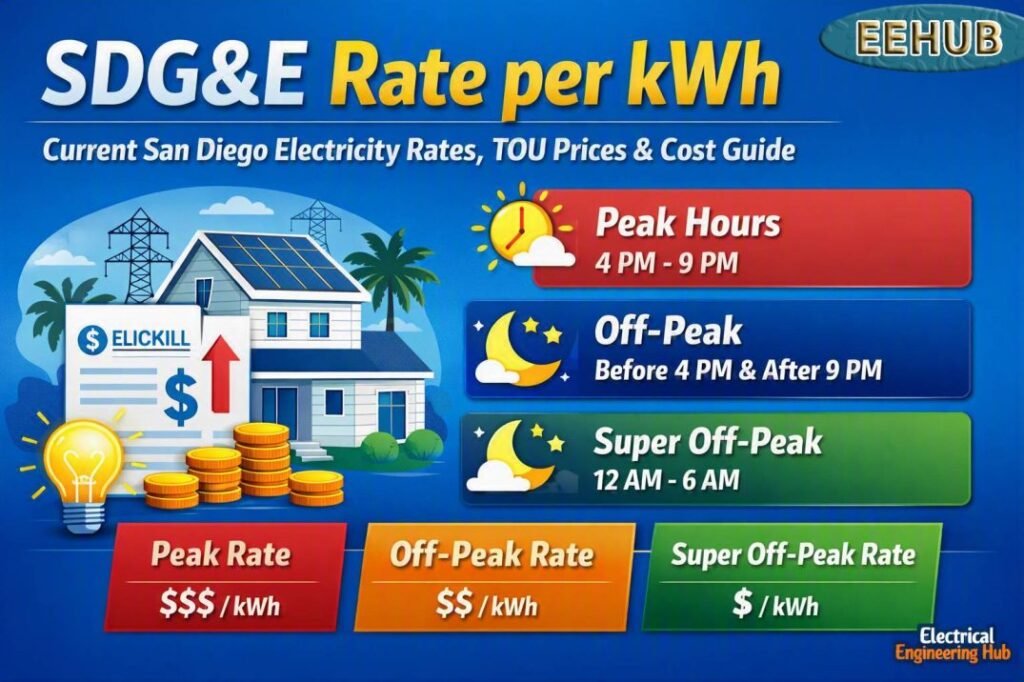
Table of Contents
Table of Contents
What Is the SDG&E Rate per kWh?
The SDG&E Rate per kWh is the amount associated with using one kilowatt-hour of electricity. One kWh equals the energy consumed by a 1,000-watt appliance operating for one hour.
For example, a 1,500-watt space heater running for two hours consumes:
1.5 kW × 2 hours = 3 kWh
At an effective electricity cost of $0.50/kWh, those three kWh would represent approximately $1.50 of electricity cost before considering how the utility bill separates generation, delivery, taxes, fees, and other charges.
This is why the kWh rate on a bill may not look exactly like the advertised energy rate.
Need to estimate your complete monthly bill? Use our san diego electric bill calculator to calculate electricity costs from your kWh usage and applicable rate.
How SDG&E Calculates Its Electricity Cost
SDG&E billing is more complicated than simply multiplying usage by one fixed price. The total amount can include energy procurement or generation costs, transmission and distribution, public-purpose programs, wildfire-related costs, taxes, and other authorized charges.
A simplified calculation is:
Electricity cost = kWh used × applicable effective rate
For example:
| Monthly usage | Example effective rate | Estimated energy cost |
|---|---|---|
| 250 kWh | $0.45/kWh | $112.50 |
| 500 kWh | $0.50/kWh | $250 |
| 750 kWh | $0.55/kWh | $412.50 |
| 1,000 kWh | $0.60/kWh | $600 |
| 1,500 kWh | $0.65/kWh | $975 |
These are examples for estimating consumption. They are not guaranteed SDG&E bill totals because the actual bill depends on the customer’s tariff and other charges.
SDG&E Rate per kWh for Residential Customers
Residential customers do not all pay the same kWh price. SDG&E offers different rate structures, including time-of-use plans and specialized plans for certain electricity uses.
A homeowner using electricity mostly during expensive evening hours can have a substantially different effective rate from someone who shifts washing, laundry, water heating, or EV charging to lower-priced periods.
The SDG&E rate per kWh also changes with the customer’s monthly consumption and applicable billing structure.
SDG&E Rate per kWh by Hour
There is no single SDG&E rate by hour that applies to every customer. The hourly price depends on the exact rate plan.
For a TOU customer, the important concept is:
- Peak hours generally carry higher prices.
- Off-peak hours generally carry lower prices.
- Super off-peak periods can be particularly attractive for EV charging.
- Seasonal schedules can change the applicable hours.
- The same clock hour can have different prices under different tariffs.
Therefore, searches such as “SDG&E rate per kWh at night,” “SDG&E rate per kWh during peak hours,” and “SDGE rate by hour” should be answered using the customer’s actual tariff rather than one universal number.
SDG&E Rate per kWh During Summer
Summer electricity demand can affect the applicable time-of-use schedule and pricing. Air conditioning is a major reason electricity consumption rises during hot weather.
A customer searching for the SDG&E rate per kWh in August, June, or July should check the rate schedule that applies to that billing period. Rates can change during the year, so a monthly rate table from an older year should not automatically be used for today’s bill.
For budgeting, multiply expected monthly kWh by a realistic effective rate and then compare that estimate with the actual SDG&E statement.
For a faster usage-based estimate, try our San Diego electric bill calculator and enter your monthly electricity consumption.
SDG&E Rate per kWh for EV Charging
Electric vehicle owners should pay close attention to time-of-use pricing. Charging a vehicle during a lower-cost period can reduce the effective electricity cost compared with charging during an expensive peak period.
For example, a 60-kWh EV charge at:
| Charging price | Cost for 60 kWh |
|---|---|
| $0.30/kWh | $18.00 |
| $0.40/kWh | $24.00 |
| $0.50/kWh | $30.00 |
| $0.60/kWh | $36.00 |
| $0.70/kWh | $42.00 |
The actual EV rate depends on the applicable SDG&E EV tariff. This is why terms such as SDG&E EV rate, SDG&E electric car rate, SDG&E Leaf rate, and Model 3 charging cost should be evaluated against the specific plan rather than treated as separate utility prices.
SDG&E Rate per kWh With Solar
Solar changes the way a household purchases electricity from the grid, but it does not necessarily eliminate the utility bill.
A solar customer can generate electricity during the day and export excess energy. Electricity may still be imported from SDG&E when solar production is insufficient, especially after sunset.
The relevant comparison is therefore not simply “SDG&E rate vs solar.” A homeowner should consider:
- Imported electricity price
- Export compensation
- Time of use
- Battery storage
- Solar production
- Fixed or minimum charges
- Applicable solar tariff
The SDG&E rate per kWh is especially important when estimating the value of electricity that a solar system or battery can offset.
SDG&E Rate per kWh vs Other Locations
Many searches incorrectly combine SDG&E with rates from other utilities. SDG&E serves the San Diego area, so it does not establish electricity prices in Alabama, Texas, Colorado, Florida, Georgia, Nevada, New York, Washington, or other states.
| Search term | Correct comparison |
|---|---|
| SDG&E vs Edison | SDG&E vs Southern California Edison |
| SDG&E vs PG&E | Two California investor-owned utilities |
| SDG&E vs Duke Energy NC | Different utility and state |
| SDG&E vs Alabama Power | Different utility and state |
| SDG&E vs Austin Texas | Different market and utility structure |
| SDG&E vs Florida | Different state |
| SDG&E vs Nevada | Different utility territory |
| SDG&E vs New York | Different utility market |
Similarly, SDG&E prices should not be confused with electricity generation costs from coal, natural gas, diesel generators, or other energy sources. The retail rate paid by a customer includes much more than the cost of producing one kWh.
SDG&E Rate per kWh by Year
Electricity prices change over time because utility tariffs, energy costs, infrastructure expenses, regulatory requirements, and other charges change.
| Period | What to check |
|---|---|
| 2024 | Historical SDG&E tariff and customer bill |
| 2025 | Historical tariff and rate updates |
| 2026 | Current applicable tariff |
| Future years | Cannot be known with certainty |
This also explains searches for SDG&E rate per kWh 2024, SDG&E rate per kWh annual, SDG&E rate per kWh yearly, and SDG&E rate per kWh over the years. Historical rates are useful for trend analysis, but they should not be presented as today’s price.
Why Is SDG&E Rate per kWh So High?
SDG&E’s retail electricity price reflects more than wholesale electricity generation. California’s electricity system includes significant transmission and distribution infrastructure, wildfire-related costs, public programs, regulatory requirements, and other components.
The result is a retail electricity price that can be considerably higher than the wholesale cost of generating electricity.
A useful distinction is:
Generation cost ≠ retail electricity rate
A gas plant, solar farm, wind project, battery, or diesel generator may have a particular generation cost per kWh, but a household buying electricity from the grid pays a retail rate that includes the broader electricity delivery system.
SDG&E Rate per kWh Calculator
A simple SDG&E electricity estimate can be calculated using:
Monthly cost = Monthly kWh × effective SDG&E rate
Suppose a home uses 650 kWh and its effective rate for estimation is $0.55/kWh:
650 × $0.55 = $357.50
The actual bill may be higher or lower because the customer’s plan, TOU periods, fixed charges, credits, taxes, and other billing components can affect the final amount.
For accurate budgeting, use your actual average effective rate from a recent bill instead of assuming every kWh costs the same.
How to Lower Your SDG&E Electricity Bill
Reducing consumption during expensive periods can make a meaningful difference.
- Shift EV charging to lower-cost hours when permitted by your plan.
- Run major appliances during cheaper TOU periods.
- Improve air-conditioner efficiency and thermostat settings.
- Use smart thermostats and appliance scheduling.
- Consider battery storage when the economics support it.
- Compare your current SDG&E tariff with available alternatives.
- Monitor monthly kWh instead of focusing only on the dollar amount.
- Use solar production data to shift loads toward high-generation periods.
Want to see how different usage levels affect your bill? Use our San Diego electricity bill calculator to estimate monthly electricity costs.
Frequently Asked Questions
What is the SDG&E Rate per kWh in California?
SDG&E does not have one universal residential kWh price. The effective cost can commonly fall around $0.40–$0.70+ per kWh depending on the customer’s tariff, time of use, and billing circumstances. Check the current SDG&E rate schedule for the exact price.
Is SDG&E electricity charged per kWh or per kW?
Electricity consumption is measured and billed in kWh. A kW measures power capacity or instantaneous demand, while a kWh measures energy consumed over time. Some specialized tariffs can also include demand-related charges.
What is the SDG&E rate per kWh at night?
There is no single nighttime rate for every SDG&E customer. On qualifying time-of-use plans, overnight hours can fall into a lower-priced period, making them useful for EV charging and other flexible loads.
Why is the SDG&E rate per kWh so high?
The retail price includes generation and energy procurement plus transmission, distribution, public programs, wildfire-related costs, regulatory expenses, and other components. Therefore, the retail rate is higher than the generation cost alone.
Will SDG&E rates increase?
SDG&E rates can change as approved tariffs are updated. Future increases cannot be stated with certainty. Customers should use the latest SDG&E tariff or current bill when calculating present electricity costs rather than relying on an old annual or monthly rate.
Final Takeaway
The SDG&E Rate per kWh is not a single fixed number for every San Diego household. Your actual cost depends on the residential plan, TOU period, season, electricity consumption, solar or EV status, and other bill components.
For a practical estimate, start with your monthly kWh and effective rate, then compare the result with your latest utility statement. This approach is more reliable than using an old rate chart or a generic California electricity price.
Get new guides in your feed. Follow Electrical Insights on LinkedIn for new electrical standards guides, calculators and design tips from Azad Circuit Hub.
SDGERatePerKwh, #SDGE, #SanDiegoElectricity, #ElectricityRates, #TOURates, #EnergyCosts, #SanDiegoEnergy, #ElectricityBill, #UtilityRates, #EnergySavings
