
QESCO Bill Calculator 2026 – Free Estimator
The QESCO Bill Calculator makes it easier to estimate your monthly electricity bill before the official bill arrives. By entering your electricity consumption in kWh, users can get a quick estimate based on the applicable tariff, fixed charges, GST, electricity duty, and other common bill components.
QESCO, or Quetta Electric Supply Company, supplies electricity across a large part of Balochistan. Your final bill can vary significantly depending on the consumer category, monthly units, protected or non-protected status, and government adjustments.
This guide explains how to estimate your QESCO electricity bill in 2026, how residential tariff slabs work, and why the amount calculated from units may differ from the final amount printed on your WAPDA/QESCO bill.
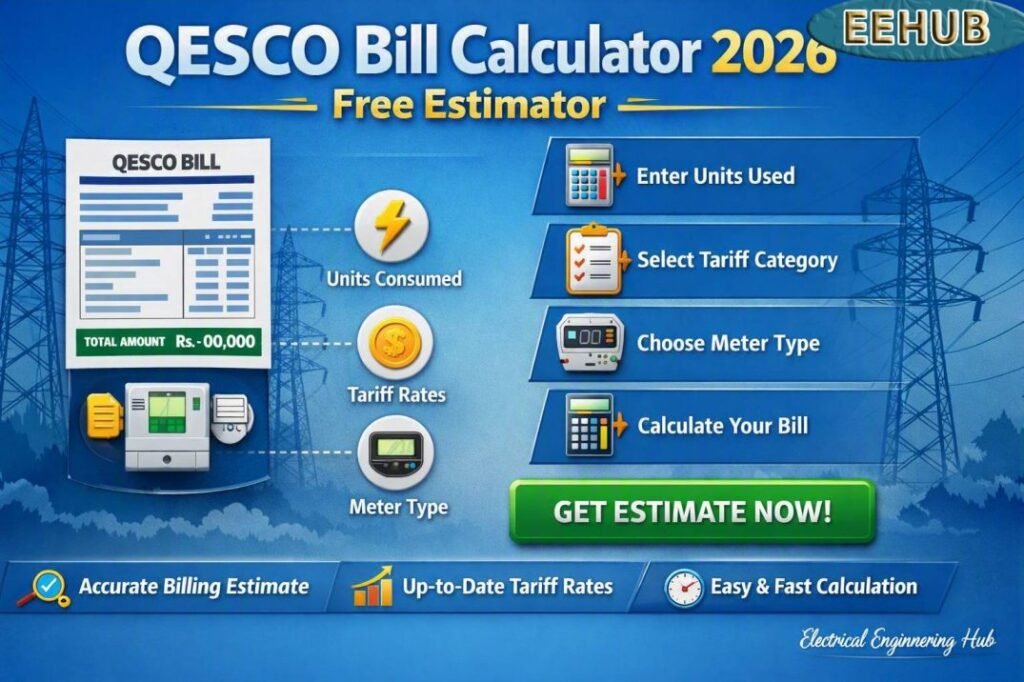
Table of Contents
Table of Contents
QESCO Bill Calculator
QESCO Electricity Bill Calculator (Quetta Electric Supply Company)
Estimate your monthly QESCO electricity bill for residential, commercial, industrial, and agricultural (tubewell) connections in Balochistan, using NEPRA slab-based tariff logic. All rate fields are editable so you can match the latest notified tariff or your own bill.
1 Connection Details
2 Residential Slab Rates (PKR per unit)
QESCO domestic bills are charged on a slab basis. Consumers using up to 200 units in a month may qualify as “protected,” with lower rates. Edit the per-unit rates below to match the currently notified NEPRA tariff.
Slab Rates
3 Taxes, Surcharges & Adjustments
Bill Breakdown
How to Use This Calculator
- Select your consumer category. Residential connections use the NEPRA slab system; commercial, industrial, and agricultural connections use a flat per-unit rate plus a demand charge.
- Enter your connection phase, units consumed for the billing month, and sanctioned load in kW (found on your bill or connection agreement).
- Check the meter rent and any other fixed charges shown on a recent bill and adjust the fields if needed.
- Review the tariff rates. Public tariff notifications change periodically, so the default values are starting points – replace them with the figures printed on your own bill for the most accurate estimate.
- Adjust the fuel price adjustment, quarterly tariff adjustment, surcharges, GST, and electricity duty fields to match your latest bill, or leave the defaults for a general estimate.
- Click “Calculate Bill” to see your total estimated bill along with a full line-item breakdown. Use “Reset” to start over.
How QESCO Bills Are Structured
A QESCO bill combines an energy charge based on how much electricity was consumed, fixed charges tied to the connection itself, and a set of government taxes and regulatory surcharges. Residential bills use a tiered slab structure, meaning different portions of your consumption are charged at different rates rather than one flat rate applying to the whole bill. Commercial, industrial, and agricultural connections are typically billed at a single per-unit rate along with a demand or fixed charge linked to sanctioned load.
Why Rates Vary by Category
Residential tariffs are structured to keep essential, low-usage consumption affordable while charging progressively more as consumption rises. Agricultural tariffs for tubewells are generally subsidized to support irrigation costs, while commercial and industrial tariffs reflect the cost of serving business and manufacturing loads, including demand-related infrastructure costs.
Understanding the Extra Charges
Beyond the base energy charge, bills typically include a fuel price adjustment that reflects the actual cost of generation fuel compared to what was originally estimated, and a quarterly tariff adjustment that reconciles differences in distribution company costs over a quarter. Electricity duty and general sales tax are provincial and federal levies applied on top of the energy charge, while the Neelum-Jhelum surcharge funds a specific hydropower project and is applied per unit consumed.
Protected vs Unprotected Residential Consumers
Consumers whose monthly usage stays within a lower threshold are generally classified as protected and billed at more favourable slab rates, while those who cross that threshold are billed as unprotected, with the tariff structure shifting accordingly. This calculator reflects that distinction automatically based on the units you enter.
QESCO Bill Calculator: Quick Comparison
| Monthly Usage | Approx. Consumption Category | What Affects the Bill | Best Use |
|---|---|---|---|
| 50 kWh | Low usage | Slab rate, fixed charges, taxes | Small household |
| 100 kWh | Low residential usage | Tariff slab and taxes | Basic home estimate |
| 200 kWh | Moderate usage | Slab structure and adjustments | Average household |
| 300 kWh | Higher usage | Tariff, taxes and surcharges | Larger household |
| 500 kWh | High usage | Higher applicable slabs | Heavy household load |
| 700+ kWh | Very high usage | Applicable tariff and adjustments | Large home/business |
The table gives a quick view of how electricity consumption changes the calculation. For an exact estimate, however, you should enter your actual units and consumer category because QESCO does not charge every customer at one flat per-unit price.
How the QESCO Bill Calculator Works
A QESCO electricity bill is not simply the number of units multiplied by one electricity rate. Pakistan’s electricity tariff structure uses consumption slabs, consumer categories, fixed charges, taxes, and other adjustments.
The basic calculation starts with your monthly electricity consumption.
For example, if your meter shows 250 units during the billing period, the calculation uses the applicable residential tariff slabs rather than applying one rate to all 250 units.
A simplified calculation looks like this:
Estimated energy charge = applicable tariff × consumed units
The actual bill can then include:
- Fixed charges
- Electricity duty
- GST
- TV fee where applicable
- FPA or other applicable adjustments
- Quarterly tariff adjustments
- Financing or other government-approved charges
- Arrears or previous balance
- Late-payment surcharge, if applicable
This is why the result from a QESCO bill estimator should be treated as an estimate rather than an exact replacement for the official bill.
QESCO Electricity Rates 2026
QESCO consumers fall into different tariff categories. Residential users are generally billed according to domestic tariff slabs, while commercial, industrial, agricultural, and other users have separate rates.
For a residential estimate, the applicable unit rate depends on monthly consumption.
| Residential Usage | Tariff Slab | 2026 Calculation Basis |
|---|---|---|
| Up to 50 units | Lifeline/low-use category where applicable | Applicable notified slab |
| 51–100 units | Residential slab | Applicable notified slab |
| 101–200 units | Residential slab | Applicable notified slab |
| 201–300 units | Residential slab | Applicable notified slab |
| 301–400 units | Residential slab | Applicable notified slab |
| 401–500 units | Residential slab | Applicable notified slab |
| 501–600 units | Residential slab | Applicable notified slab |
| 601–700 units | Residential slab | Applicable notified slab |
| Above 700 units | Higher residential slab | Applicable notified slab |
QESCO tariffs can change following NEPRA determinations and government notifications. The applicable rate can also depend on whether the consumer qualifies for protected status.
For this reason, users should match their calculation with the tariff period printed on the latest QESCO bill.
How to Calculate Your QESCO Bill From Units
Suppose your electricity meter shows 350 units for the billing period.
The first step is to identify the applicable consumer category. For a normal domestic connection, the residential tariff is used.
Next, determine the applicable slab structure. Do not assume that all 350 units are charged at the rate of the first 100 units.
The calculation should account for the applicable slab rules, followed by fixed charges and government taxes.
For a simple planning estimate:
Monthly electricity cost = energy charges + fixed charges + taxes + applicable adjustments
This approach provides a more realistic result than multiplying total units by a single advertised rate.
Example QESCO Bill Estimate
Consider a household that uses approximately 300 kWh in one month.
The estimated bill can be built from several components:
| Bill Component | Calculation |
|---|---|
| Electricity consumption | 300 kWh |
| Energy charges | Based on applicable residential slabs |
| Fixed charges | Based on applicable tariff category |
| Electricity duty | Applicable percentage/amount |
| GST | Applied according to prevailing rules |
| Other adjustments | If applicable |
| Previous balance | Added only when outstanding |
| Estimated payable amount | Sum of applicable charges |
This example shows why two households with similar electricity consumption can sometimes receive different bills.
A customer with arrears, a different tariff category, or an adjustment from an earlier billing period may have a different payable amount.
Protected and Non-Protected Consumers
One of the most important factors in estimating a domestic electricity bill is consumer status.
Protected consumers generally need to meet specific consumption and eligibility conditions under the applicable tariff policy. Non-protected consumers can face different rates when their consumption moves into higher slabs.
This distinction is particularly important when comparing two bills with similar unit consumption.
Before using a QESCO Bill Calculator, check your previous bill for the consumer category and other information printed near the billing details.
What Information Do You Need?
You can estimate your monthly QESCO bill using a few basic details.
1. Electricity Units
Enter the number of kWh consumed during the billing period. This is usually available on the current meter reading or previous bill.
2. Consumer Category
Select the appropriate category, such as residential, commercial, industrial, or agricultural.
3. Protected Status
If applicable, identify whether your domestic connection is protected or non-protected.
4. Billing Period
The billing month matters because tariffs and adjustments can change between notification periods.
5. Previous Balance
If you are trying to reproduce your actual payable amount, include any outstanding balance shown on your bill.
If you regularly compare electricity costs between different DISCOs, use our electricity bill calculator pakistan resource to find the appropriate calculator for your distribution company.
Why Your Estimated Bill May Differ From QESCO’s Bill
Even a carefully calculated estimate may not exactly match your QESCO bill.
The most common reasons include tariff adjustments, taxes, fixed charges, arrears, meter-related charges, and government-approved surcharges.
Fuel and quarterly adjustments can also affect the final amount. These charges may be applied according to the relevant notification and billing period.
Another common mistake is using the current tariff to calculate an older bill. Always compare the billing month with the tariff period used by QESCO.
How to Reduce Your QESCO Electricity Bill
Reducing electricity consumption is often more effective than trying to calculate the bill after the month has ended.
Start with high-consumption appliances. Air conditioners, electric heaters, water pumps, refrigerators, irons, and electric cooking equipment can account for a large portion of household electricity use.
Practical steps include:
- Set air conditioners to a reasonable temperature.
- Clean AC filters regularly.
- Replace old bulbs with LED lighting.
- Avoid running water pumps unnecessarily.
- Unplug equipment that remains on standby.
- Use efficient inverter appliances where practical.
- Shift flexible loads to suitable lower-cost periods if your tariff allows it.
- Check for faulty wiring or abnormal meter consumption.
- Monitor monthly kWh rather than only the rupee amount.
Tracking units is especially useful because electricity prices can change while your consumption pattern remains the same.
Check Your QESCO Bill Online
QESCO customers can also verify their electricity bill using the reference number or consumer information shown on the bill.
Checking the online bill helps you compare:
- Current meter reading
- Previous meter reading
- Units consumed
- Billing period
- Amount payable
- Due date
- Arrears
- Tariff information
If your calculated amount looks significantly different from the official bill, compare every component instead of looking only at the total.
For users who want to compare electricity costs across Pakistan, our electricity bill calculator pakistan guide provides a broader way to estimate bills from different distribution companies.
QESCO Bill Calculator vs Manual Calculation
A manual calculation can be useful, but it requires checking the correct tariff notification and applying every relevant charge.
A calculator is faster for everyday budgeting.
| Method | Advantage | Limitation |
|---|---|---|
| Online calculator | Fast and convenient | Depends on tariff data |
| Manual calculation | More control | Time-consuming |
| Official QESCO bill | Most reliable payable amount | Available after billing |
| Previous bill comparison | Easy for budgeting | Does not account for tariff changes |
For monthly household budgeting, a calculator is useful because you can estimate the cost before the bill is issued.
Frequently Asked Questions
How is a QESCO electricity bill calculated?
The bill is calculated using the consumer’s electricity consumption, applicable tariff slab, fixed charges, taxes, and any approved adjustments or outstanding amounts. Residential consumers may have different rates depending on consumption and protected status.
What is the QESCO rate per unit in 2026?
There is no single rate that applies to every QESCO customer. The applicable per-unit charge depends on the consumer category and residential consumption slab. Additional taxes, fixed charges, and adjustments can also affect the final bill.
How can I check my QESCO bill online?
You can check the current bill through QESCO’s online bill service using the required reference or consumer information printed on your electricity bill. Always verify the meter reading, billing period, units, and amount payable.
Why is my QESCO bill higher than my unit calculation?
Your bill may include fixed charges, GST, electricity duty, tariff adjustments, arrears, or other approved charges. A higher consumption slab can also change the applicable tariff.
Can I use the calculator for commercial QESCO connections?
Yes, provided the calculator supports the commercial tariff category. Commercial consumers should not use residential rates because tariff structures, fixed charges, and other applicable components can differ.
Final Thoughts
The QESCO Bill Calculator is a practical tool for estimating electricity expenses and planning your monthly household budget. The most important input is your actual electricity consumption in kWh, but an accurate estimate also requires the correct consumer category, tariff slab, billing period, and applicable charges.
Because electricity tariffs can change through NEPRA and government notifications, always compare the calculation with the latest QESCO tariff information and your official bill.
For users managing electricity costs across different areas of Pakistan, our electricity bill calculator pakistan hub can help you find the relevant DISCO calculator and estimate monthly electricity expenses more conveniently.
Related Tools
Get new guides in your feed. Follow Electrical Insights on LinkedIn for new electrical standards guides, calculators and design tips from Azad Circuit Hub.
#QESCOBillCalculator, #QESCOBill, #QESCORates2026, #ElectricityBillCalculator, #QESCOOnlineBill, #QESCOUnits, #PakistanElectricityBill, #QESCOTariff, #ElectricityCost, #QESCO2026
QESCO Bill Calculator 2026 - Free Estimator
Calculate your QESCO electricity bill instantly with QESCO bill calculator. Free 2026 calculator using current Quetta Electric Supply tariff rates.
Price Currency: PKR
Operating System: Web Browser
Application Category: UtilitiesApplication
