
PG&E Rate per kWh 2026: Current Pacific Gas and Electric Electricity Rates Explained
If you want to estimate your electricity costs accurately, understanding the PG&E Rate per kWh is essential. Pacific Gas and Electric (PG&E) serves millions of customers across Northern and Central California. Electricity prices vary depending on the rate plan, season, time of use, and energy consumption.
The comparison table below provides a quick overview of the latest residential rates before we explore how PG&E pricing works, what affects your bill, and how you can reduce monthly electricity costs.
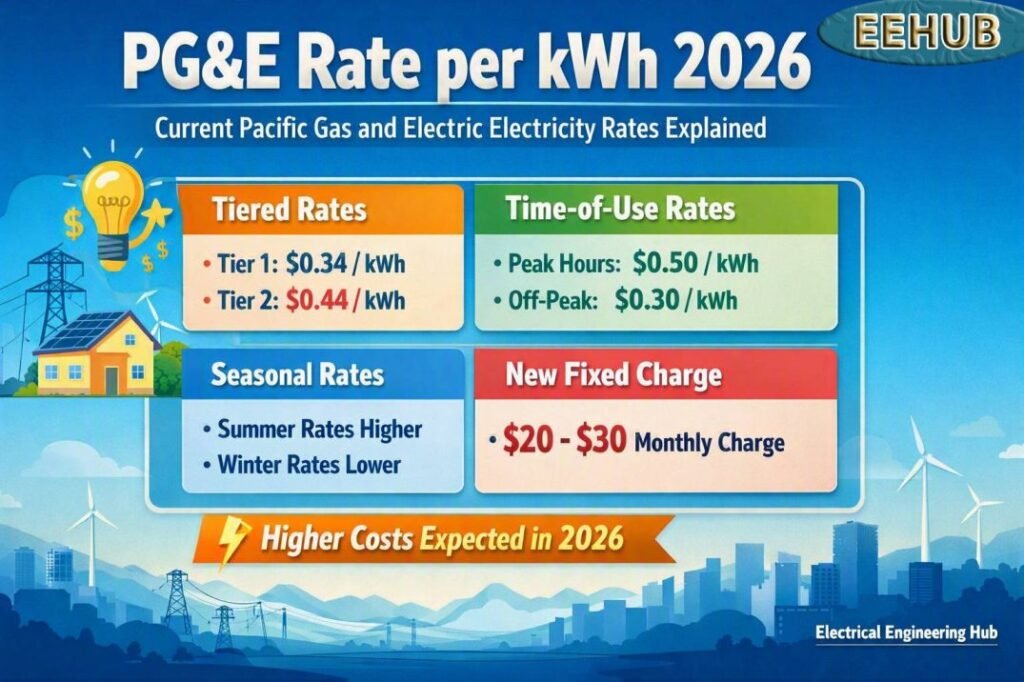
Table of Contents
Table of Contents
| Feature | Details (2026) |
|---|---|
| Utility | Pacific Gas and Electric (PG&E) |
| Service Area | Northern & Central California |
| Average Residential PG&E Rate per kWh | $0.41–$0.54 per kWh |
| Lowest Off-Peak TOU Rate | Around $0.34 per kWh |
| Peak TOU Rate | Up to $0.63 per kWh |
| Billing Method | Per kWh plus fixed charges and taxes |
| Best For | Residential and commercial customers |
Knowing these rates makes it much easier to understand your monthly statement and estimate future electricity costs more accurately.
Looking for an accurate monthly cost estimate? Use our pge bill estimator to calculate your expected electricity bill based on your actual energy usage before your next statement arrives.
What Is PG&E Rate per kWh?
PG&E Rate per kWh refers to the amount customers pay for every kilowatt-hour (kWh) of electricity consumed. One kilowatt-hour equals using a 1,000-watt appliance for one hour.
Your final electricity price depends on several factors including:
- Rate schedule
- Time-of-use plan
- Season
- Daily energy usage
- Fixed delivery charges
- State and local fees
Unlike many utilities that charge a flat rate, PG&E primarily uses Time-of-Use (TOU) pricing, meaning electricity costs more during high-demand periods.
Current PG&E Residential Rate per kWh (2026)
The latest residential electricity prices are approximately as follows.
| Rate Category | Estimated Rate per kWh |
|---|---|
| Off-Peak | $0.34–$0.38 |
| Mid-Peak | $0.40–$0.47 |
| Peak Hours | $0.54–$0.63 |
| Average Residential Rate | $0.41–$0.54 |
These rates are representative residential prices for 2026 and may vary depending on the selected tariff, location, and seasonal adjustments approved by the California Public Utilities Commission (CPUC).
Why Is PG&E Electricity So Expensive?
Many California residents notice that PG&E electricity prices are among the highest in the United States.
Several factors contribute to higher rates.
| Cost Factor | Impact |
|---|---|
| Wildfire prevention programs | Higher infrastructure costs |
| Grid maintenance | Increased delivery charges |
| Renewable energy investments | Supports clean energy goals |
| Underground power lines | Improves reliability but raises costs |
| Regulatory compliance | Adds operational expenses |
Although the energy itself is only part of the bill, transmission and distribution charges make up a significant percentage of total electricity costs.
PG&E Time-of-Use Rates
Most residential customers are enrolled in a Time-of-Use plan.
| Time Period | Typical Rate |
|---|---|
| Off-Peak | Lowest |
| Partial Peak | Moderate |
| Peak (usually evening) | Highest |
Electricity used during evening peak hours costs considerably more than electricity used early in the morning or late at night.
Running appliances outside peak periods can significantly reduce your monthly bill.
PG&E Rate Plans
PG&E offers several residential electricity plans.
| Rate Plan | Best For |
|---|---|
| E-TOU-C | General residential customers |
| E-ELEC | Electric vehicle owners |
| CARE | Income-qualified households |
| FERA | Larger qualifying families |
Each plan has different pricing structures, making it important to choose the one that matches your electricity usage pattern.
Average Monthly Electricity Cost
Below is an estimate using the average PG&E Rate per kWh.
| Monthly Usage | Estimated Bill |
|---|---|
| 300 kWh | $123–$162 |
| 500 kWh | $205–$270 |
| 750 kWh | $307–$405 |
| 1,000 kWh | $410–$540 |
Actual bills can be higher after taxes, delivery charges, public purpose programs, and fixed monthly fees are added.
Factors That Affect PG&E Rate per kWh
Several variables influence what you ultimately pay.
Season
Summer electricity rates are generally higher because of increased demand from air conditioning.
Time of Day
Using electricity during peak hours increases your effective rate per kWh.
Energy Usage
Higher consumption naturally results in a larger monthly bill.
Rate Schedule
Electric vehicle customers and CARE participants pay different rates than standard residential users.
Fixed Charges
Monthly service charges remain regardless of electricity consumption.
How to Reduce Your PG&E Electricity Bill
Reducing energy usage during expensive hours can make a noticeable difference.
Some effective strategies include:
- Run dishwashers and washing machines during off-peak hours.
- Charge electric vehicles overnight.
- Replace incandescent bulbs with LED lighting.
- Install smart thermostats.
- Improve home insulation.
- Upgrade to ENERGY STAR appliances.
- Turn off standby electronics.
- Monitor daily electricity consumption.
Even small changes can lower annual electricity expenses by hundreds of dollars.
Need to compare your estimated costs before your bill arrives? Try our pge bill estimator to see how different usage levels affect your monthly electricity charges.
PG&E Rate per kWh Compared with Other California Utilities
| Utility | Average Residential Rate per kWh |
|---|---|
| PG&E | $0.41–$0.54 |
| Southern California Edison | $0.32–$0.46 |
| San Diego Gas & Electric | $0.43–$0.58 |
While rates fluctuate throughout the year, PG&E remains among California’s higher-priced electric utilities due to infrastructure investments and wildfire mitigation programs.
Who Should Monitor Their PG&E Rate per kWh?
Tracking electricity prices benefits many customers, including:
- Homeowners
- Apartment residents
- Small businesses
- Electric vehicle owners
- Solar customers
- Property managers
- Rental property owners
Understanding your electricity rate helps you make better decisions about appliance usage, home upgrades, and energy-saving investments.
How to Calculate Your Electricity Cost
The basic calculation is straightforward.
Electricity Cost = Energy Usage (kWh) × PG&E Rate per kWh
Example:
| Usage | Rate | Estimated Energy Cost |
|---|---|---|
| 650 kWh | $0.46 | $299.00 |
Remember that your final utility bill also includes delivery charges, taxes, and regulatory fees.
Why Monitoring Rates Matters
Electricity prices may change several times during the year following CPUC approvals. Monitoring current rates helps you:
- Budget monthly expenses
- Compare rate plans
- Schedule energy-intensive activities
- Estimate electric vehicle charging costs
- Evaluate rooftop solar savings
- Improve household energy efficiency
Regularly reviewing your electricity usage alongside current pricing allows you to identify opportunities for long-term savings.
Before paying your next utility bill, use our pge bill estimator to calculate your expected charges based on your actual monthly kWh consumption and compare different usage scenarios.
Frequently Asked Questions
What is the current PG&E Rate per kWh?
The average residential PG&E Rate per kWh in 2026 ranges from approximately $0.41 to $0.54 per kWh, depending on the rate plan, season, and time of use.
Why does my PG&E rate change during the day?
PG&E uses Time-of-Use pricing. Electricity costs more during peak demand hours and less during off-peak periods when demand is lower.
Does PG&E charge the same rate for every customer?
No. Rates vary based on residential plans, CARE or FERA eligibility, electric vehicle tariffs, seasonal pricing, and individual rate schedules.
How can I lower my PG&E electricity bill?
Use major appliances during off-peak hours, improve energy efficiency, install LED lighting, charge EVs overnight, and reduce unnecessary electricity consumption.
How do I estimate my PG&E monthly bill?
Multiply your monthly electricity usage in kilowatt-hours by your applicable PG&E Rate per kWh, then add delivery charges, fixed fees, taxes, and other applicable utility charges.
Get new guides in your feed. Follow Electrical Insights on LinkedIn for new electrical standards guides, calculators and design tips from Azad Circuit Hub.
PGERatePerkWh, #PGEElectricRates, #PacificGasAndElectric, #ElectricityRates2026, #CaliforniaEnergy, #EnergyCosts, #UtilityBills, #PowerRates, #ElectricityPrices, #EnergySavings
