
Load Flow Analysis Methods: Newton-Raphson vs Gauss-Seidel vs Fast Decoupled
Load flow analysis is one of the basic studies used to understand how an electrical power system operates under a given set of generation and load conditions. Engineers use it to calculate bus voltages, voltage angles, real power flow, reactive power flow, and system losses.
The three classical Load Flow Analysis Methods are Newton-Raphson, Gauss-Seidel, and Fast Decoupled. Each solves the same nonlinear power-flow equations, but the numerical approach, speed, memory requirement, and convergence behavior are different.
For engineers working with transmission and distribution networks, understanding these differences helps when selecting a suitable power-system analysis technique.
Quick Comparison of Load Flow Analysis Methods
| Method | Convergence | Speed | Memory Requirement | Best Use |
|---|---|---|---|---|
| Newton-Raphson | Very good | Fast | Higher | Large and complex systems |
| Gauss-Seidel | Moderate to slow | Slow | Low | Small systems and teaching |
| Fast Decoupled | Good | Very fast | Low to moderate | Large transmission systems |
| Newton-Raphson | Quadratic near solution | High | Higher | Difficult operating conditions |
| Gauss-Seidel | Linear | Lower | Low | Simple networks |
| Fast Decoupled | Near-linear | Very high | Low | Repeated transmission studies |
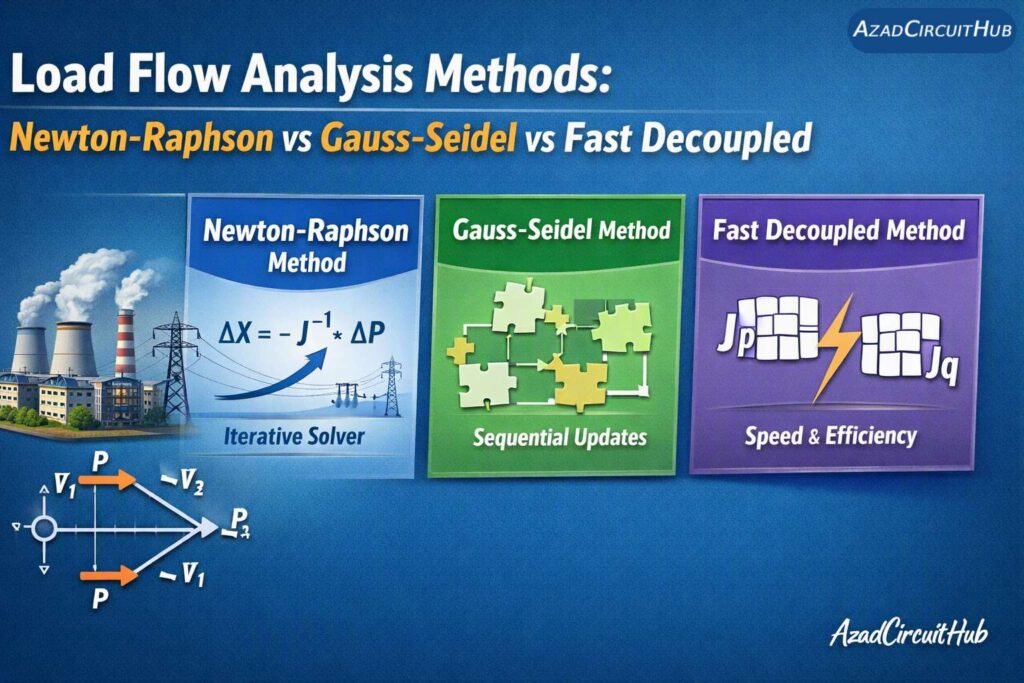
Table of Contents
Table of Contents
What Is Load Flow Analysis?
Load flow analysis calculates the steady-state operating condition of a power network. The input normally includes the network configuration, generator data, transformer parameters, line impedances, loads, and specified bus quantities.
The main unknowns are usually bus voltage magnitude and voltage angle.
A typical power-flow problem classifies buses into three types:
| Bus Type | Specified Quantities | Unknown Quantities |
|---|---|---|
| Slack bus | Voltage magnitude and angle | P and Q |
| PV bus | P and voltage magnitude | Q and angle |
| PQ bus | P and Q | Voltage magnitude and angle |
The nonlinear equations are commonly written as:
The selected numerical method repeatedly updates the unknown values until the power mismatch falls below the chosen tolerance.
For a broader introduction to load flow studies, engineers can also review the main power-system study concepts before moving into numerical solution techniques.
Newton-Raphson Load Flow Method
Newton-Raphson is widely used because of its strong convergence characteristics. It converts the nonlinear power-flow problem into a series of linear problems using a Jacobian matrix.
The basic correction equation is:
Here, the Jacobian contains partial derivatives of real and reactive power with respect to voltage angles and magnitudes.
Newton-Raphson Advantages
- Fast convergence near the solution
- Performs well for large networks
- Handles difficult operating conditions effectively
- Less sensitive to initial estimates than Gauss-Seidel
- Suitable for modern power-system software
Newton-Raphson Limitations
The main drawback is computational complexity. The Jacobian matrix must be formed and solved during each iteration. Large networks can therefore require significant memory and processing resources.
Gauss-Seidel Load Flow Method
Gauss-Seidel is one of the simplest iterative Load Flow Analysis Methods. It calculates a new bus voltage and immediately uses that updated value when calculating the next bus.
For a PQ bus, a commonly used voltage-update equation is:
The process continues until the calculated mismatch or voltage change reaches the specified tolerance.
Why Use Gauss-Seidel?
Gauss-Seidel has a major advantage: simplicity. It requires relatively little memory and is easy to implement manually or in basic computer programs.
However, convergence can become slow when the network is large or poorly conditioned. Voltage updates may also require acceleration factors to improve convergence.
| Characteristic | Gauss-Seidel |
|---|---|
| Algorithm complexity | Low |
| Memory demand | Low |
| Convergence rate | Relatively slow |
| Implementation | Easy |
| Large-network suitability | Limited |
| Educational value | High |
For students learning load flow analysis in power system engineering, Gauss-Seidel provides a useful way to understand iterative voltage calculations.
Fast Decoupled Load Flow Method
The Fast Decoupled method takes advantage of an important characteristic of high-voltage transmission systems. In many transmission networks, changes in real power are strongly related to voltage angle, while changes in reactive power are strongly related to voltage magnitude.
Therefore:
and
Instead of solving the complete Newton-Raphson Jacobian, the Fast Decoupled approach uses two smaller matrices.
This significantly reduces computational effort, especially for large transmission networks.
Fast Decoupled Advantages
- Very fast calculations
- Lower memory requirements than full Newton-Raphson
- Efficient for large transmission networks
- Useful when many load-flow cases must be solved
- Constant or slowly changing matrices can improve repeated calculations
Fast Decoupled Limitations
The assumptions behind decoupling are not equally valid for every power system. Networks with high resistance-to-reactance ratios, heavy voltage instability, or unusual operating conditions may reduce the accuracy or convergence performance of the method.
Newton-Raphson vs Gauss-Seidel vs Fast Decoupled
| Feature | Newton-Raphson | Gauss-Seidel | Fast Decoupled |
|---|---|---|---|
| Convergence | Very strong | Slow | Fast |
| Iterations | Usually few | Usually many | Few to moderate |
| Calculation per iteration | High | Low | Low |
| Jacobian | Full | Not required | Decoupled matrices |
| Memory | Higher | Low | Moderate |
| Large transmission network | Excellent | Poorer | Excellent |
| Initial guess sensitivity | Relatively low | Higher | Moderate |
| Implementation difficulty | Higher | Easy | Moderate |
| Voltage-stressed system | Generally suitable | May struggle | Can struggle |
| Repeated studies | Good | Less efficient | Excellent |
The choice among these Load Flow Analysis Methods depends on network size, system characteristics, required accuracy, and computational resources.
Which Method Should Engineers Use?
For a small network or classroom calculation, Gauss-Seidel can be useful because its equations are straightforward and the iterative process is easy to follow.
Newton-Raphson is often preferred when robust convergence is important. It is particularly useful for detailed studies involving larger networks and challenging operating conditions.
Fast Decoupled is attractive for large transmission systems where many power-flow cases need to be solved quickly.
A practical selection can be summarized as follows:
| Study Requirement | Suitable Method |
|---|---|
| Learning iterative power flow | Gauss-Seidel |
| Small network calculation | Gauss-Seidel |
| General industrial power-flow study | Newton-Raphson |
| Large transmission network | Newton-Raphson or Fast Decoupled |
| Large number of repeated cases | Fast Decoupled |
| Difficult nonlinear operating condition | Newton-Raphson |
Engineers studying load flow analysis power system applications should also consider the network’s R/X ratio, voltage profile, generator reactive limits, transformer taps, and convergence tolerance before selecting an algorithm.
Recommended Power System Analysis Textbooks
Two useful references for engineers and students are:
Power System Analysis by Hadi Saadat, 3rd Edition
Check the latest Amazon availability
Modern Power System Analysis by Kothari and Nagrath
Check the latest Amazon availability
These books cover power-flow calculations along with other important subjects such as fault analysis, stability, transmission systems, and power-system operation.
Convergence and Accuracy in Power Flow
Convergence tolerance is an important part of any numerical power-flow calculation. A solver may stop when the maximum active and reactive power mismatches fall below a specified value.
For example:
| Parameter | Typical Consideration |
|---|---|
| Power mismatch | Must fall below selected tolerance |
| Voltage magnitude | Checked after convergence |
| Voltage angle | Checked after convergence |
| Generator Q limit | Must be verified |
| Slack-bus power | Checked for system balance |
| Line losses | Verified after solution |
A mathematically converged solution should still be reviewed from an engineering perspective. A bus can have an acceptable numerical solution while operating outside an equipment voltage limit or generator reactive-power capability.
For a complete overview of load flow studies, it is useful to connect the numerical solution with voltage stability, contingency analysis, short-circuit studies, and equipment loading.
Frequently Asked Questions
1. Which load flow method is fastest?
Fast Decoupled is designed for high computational efficiency, particularly in large transmission networks. Newton-Raphson can also be very fast because it generally requires relatively few iterations, although each iteration involves more computation.
2. Why is Newton-Raphson better for large power systems?
Its strong convergence characteristics make it suitable for large and nonlinear networks. It can handle complex operating conditions more reliably than simpler iterative approaches, although the Jacobian calculation requires additional computational resources.
3. What is the main disadvantage of Gauss-Seidel load flow?
The main limitation is slow convergence. As the network becomes larger or more difficult to solve, the number of iterations can increase substantially.
4. Why is the Fast Decoupled method called decoupled?
It separates the power-flow corrections into two approximately independent relationships: active-power mismatch with voltage-angle correction and reactive-power mismatch with voltage-magnitude correction.
5. Are Newton-Raphson and Fast Decoupled equally accurate?
They can produce very similar results when the assumptions behind the Fast Decoupled method are appropriate. However, Fast Decoupled relies on simplifying assumptions, so its performance can deteriorate in networks where those assumptions are less valid.
Final Comparison
The three main Load Flow Analysis Methods solve the same fundamental power-flow problem using different numerical strategies. Gauss-Seidel emphasizes simplicity, Newton-Raphson emphasizes robust nonlinear convergence, and Fast Decoupled emphasizes computational efficiency.
Understanding these differences is more important than memorizing a single preferred method. In practical engineering work, the network characteristics and study objective should determine which calculation technique is appropriate.
Get new guides in your feed. Follow Electrical Insights on LinkedIn for new electrical standards guides, calculators and design tips from Azad Circuit Hub.
#LoadFlowAnalysis, #PowerSystemAnalysis, #NewtonRaphson, #GaussSeidel, #FastDecoupled, #PowerFlow, #ElectricalEngineering, #PowerSystems, #PowerSystemStudies, #GridAnalysis
