Klein 11055 vs 11054: Which Wire Stripper Should You Buy?
When comparing Klein 11055 vs 11054, the biggest difference is how each tool approaches wire stripping. Both come from Klein Tools and are aimed at electrical work, but they are not identical tools. The right choice depends on the wire sizes you work with, how often you strip conductors, and whether you prefer a self-adjusting mechanism or a more traditional stripping tool.
I have spent more than 15 years working in electrical engineering, including panel wiring, industrial automation, PLC systems, and electrical troubleshooting. In that work, a wire stripper needs to do more than remove insulation. It should make clean cuts, avoid conductor damage, feel comfortable during repeated use, and hold up in a busy tool bag.
Klein 11055 vs 11054 at a Glance
| Feature | Klein 11055 | Klein 11054 |
|---|---|---|
| Tool type | Self-adjusting wire stripper/cutter | Wire stripper/cutter |
| Stripping mechanism | Self-adjusting | Conventional |
| Best use | Fast repetitive stripping | Controlled manual stripping |
| Cutter | Integrated | Integrated |
| Application | Electrical wiring, panels, general installation | Electrical wiring and general stripping |
| Ideal user | Electricians needing speed | Users wanting traditional control |
| Brand | Klein Tools | Klein Tools |
If you want to see the 11055 in more detail before deciding, my Klein 11055 Wire Stripper Review covers its stripping mechanism, practical applications, and buying considerations.
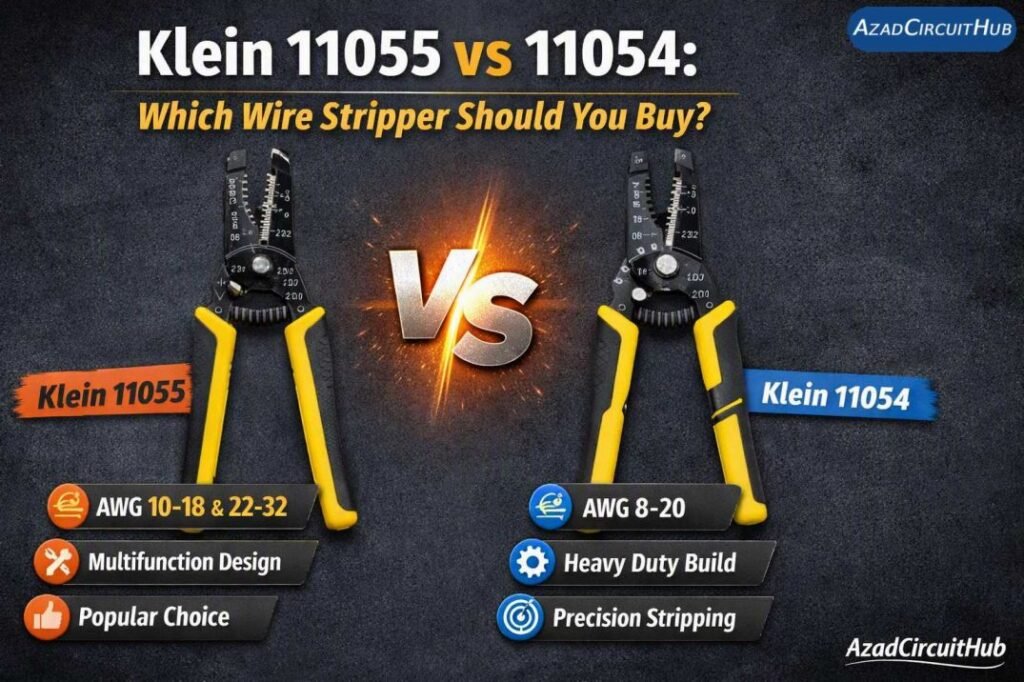
Table of Contents
Table of Contents
What Is the Klein 11055?
The Klein Tools 11055 is a self-adjusting wire stripper and cutter designed to make repetitive wire preparation faster. Instead of requiring the user to locate a specific stripping notch for every conductor, the tool automatically adjusts to the conductor size within its supported range.
That can be useful when terminating multiple wires in electrical panels, junction boxes, control cabinets, and other installations.
The self-adjusting mechanism is the main reason someone would choose the 11055 over a conventional wire stripper. When working with many conductors, reducing small repetitive movements can make a noticeable difference.
The integrated cutter also means you do not always need to switch tools when preparing conductors.
Check the Klein 11055 on Amazon: Buy Klein Tools 11055 Wire Stripper/Cutter
Klein 11055 vs 11054: Main Difference
The key difference in Klein 11055 vs 11054 is the stripping mechanism.
The 11055 uses a self-adjusting design. This allows the jaws to adapt to the conductor and remove insulation without requiring the user to select an individual stripping hole for every wire.
The 11054 represents a more conventional wire-stripping approach. Traditional strippers can offer excellent control because the user selects the appropriate gauge position manually.
For a technician doing occasional electrical work, the difference may not be significant. For an electrician stripping dozens or hundreds of conductors, the self-adjusting operation of the 11055 can be more convenient.
Stripping Performance and Wire Gauge Control
Wire gauge compatibility is one of the first specifications to check before buying any stripper. A professional tool should match the conductor sizes you regularly use.
The 11055 is particularly appealing for jobs where wire sizes vary. Its self-adjusting action reduces the need to repeatedly select individual stripping slots.
A conventional stripper such as the 11054 gives the user direct control over the stripping position. That can be useful when working on smaller conductors or when you want a familiar manual stripping process.
Regardless of which model you select, avoid forcing a stripper onto a conductor outside its intended range. Excessive pressure can nick copper strands or damage insulation.
Which Is Better for Electricians?
In a professional electrical environment, I would look at workflow rather than simply asking which tool has more features.
The 11055 makes more sense when speed is important. Panel builders, electricians, control technicians, and installers who repeatedly prepare conductors can benefit from the self-adjusting mechanism.
The 11054 can make sense for users who prefer a conventional stripper and want direct control over the stripping notch.
For repetitive panel wiring, I generally prefer tools that reduce unnecessary hand movements. That is where the self-adjusting design of the 11055 has a practical advantage.
If your work involves frequent wire preparation, you can also compare the tool with other electrician tools in my Klein 11055 Wire Stripper Review.
Ergonomics and Daily Use
A wire stripper can look excellent on a specification sheet but still become uncomfortable after extended use. Handle shape, spring action, grip, tool weight, and required hand force all affect productivity.
The 11055 is designed around faster stripping, making it particularly interesting for repetitive electrical work.
Traditional wire strippers have an advantage in familiarity. Most electricians learn to position the conductor in the correct gauge notch almost automatically.
For occasional home electrical projects, either approach may be sufficient. For daily professional use, however, the time saved during repetitive operations can add up.
Klein 11055 vs 11054: Pros and Cons
| Model | Pros | Cons |
|---|---|---|
| Klein 11055 | Self-adjusting, fast operation, integrated cutter, good for repetitive work | More mechanism than a basic stripper |
| Klein 11054 | Conventional operation, direct gauge selection, familiar design | Requires manual gauge selection |
Choose the Klein 11055 if:
- You strip many wires during a typical job.
- You want a self-adjusting mechanism.
- You work on electrical panels or control wiring.
- Speed is important.
- You prefer a multifunction wire stripping tool.
Choose the Klein 11054 if:
- You prefer traditional wire strippers.
- You want direct control over the stripping slot.
- You do not need a self-adjusting mechanism.
- Your wire stripping workload is relatively light.
Is the Klein 11055 Worth Buying?
For electricians who regularly strip multiple conductors, the 11055 can justify its price through convenience and workflow efficiency. A self-adjusting stripper is especially useful when wire sizes change frequently during an installation.
However, a self-adjusting design does not automatically make a tool better for every user. Some electricians prefer the feedback and control of a conventional stripping tool.
Before buying, consider the conductor sizes you use most often and whether you actually need automatic adjustment.
See the current Klein 11055 price on Amazon: Shop Klein Tools 11055 Wire Stripper
Klein 11055 vs 11054: Which One Should You Buy?
The better choice in Klein 11055 vs 11054 depends mainly on working style.
Choose the 11055 if your priority is speed, convenience, and repetitive wire preparation. Its self-adjusting mechanism makes it particularly attractive for electricians and technicians who strip a large number of conductors.
Choose the 11054 if you prefer the straightforward operation of a traditional stripper and want to select the stripping position yourself.
For professional panel wiring and control work, I would lean toward the 11055 because reducing repetitive hand movements can make a long wiring job easier.
Frequently Asked Questions
What is the main difference between Klein 11055 and 11054?
The primary difference is the stripping mechanism. The 11055 uses a self-adjusting design, while the 11054 uses a more traditional wire-stripping method.
Is the Klein 11055 good for electricians?
Yes. Its self-adjusting operation can be useful for electricians, panel builders, control technicians, and installers who strip many conductors during a job.
Is a self-adjusting wire stripper better than a manual stripper?
Not always. Self-adjusting strippers can save time during repetitive work, while manual strippers provide direct control over the stripping gauge. The better option depends on the user's workflow.
Can the Klein 11055 cut wire?
The 11055 includes an integrated wire cutter, allowing users to cut and strip conductors with the same tool.
Should I buy the Klein 11055 for occasional home electrical work?
It can be a good choice if you value convenience and expect to use the tool regularly. For occasional work, a conventional wire stripper may also provide everything you need.
Final Verdict
The comparison of Klein 11055 vs 11054 comes down to stripping method and workflow. The 11055 is the more compelling option for users who want self-adjusting stripping and faster repetitive wire preparation. The 11054 is better suited to users who prefer a traditional stripping approach with manual gauge selection.
For professional electrical work, especially panel wiring and control applications, I would choose the 11055 when the convenience of self-adjusting operation can save time across many conductors.
Before purchasing, check the exact specifications and supported conductor sizes for the model you intend to buy.
For a closer look at the tool before ordering, read my Klein 11055 Wire Stripper Review.
Get new guides in your feed. Follow Electrical Insights on LinkedIn for new electrical standards guides, calculators and design tips from Azad Circuit Hub.
#Klein11055, #Klein11054, #KleinTools, #WireStripper, #WireStrippers, #Klein11055vs11054, #ElectricianTools, #ElectricalTools, #WireStripping, #ToolComparison