How to Read Your LESCO Electricity Bill — A Complete Guide 2026
Electricity bills contain important information that many consumers overlook. Whether you are a homeowner, tenant, business owner, or commercial consumer, understanding your bill can help you monitor energy usage, verify charges, and avoid billing surprises. If you want to Read Your LESCO Electricity Bill correctly, you need to understand every section, including meter readings, unit consumption, tariff rates, taxes, and surcharges.
Many people only focus on the final payable amount. However, the bill contains valuable details that explain how that amount was calculated. Learning to Read Your LESCO Electricity Bill can help you identify unusual consumption patterns, estimate future expenses, and manage electricity costs more effectively.
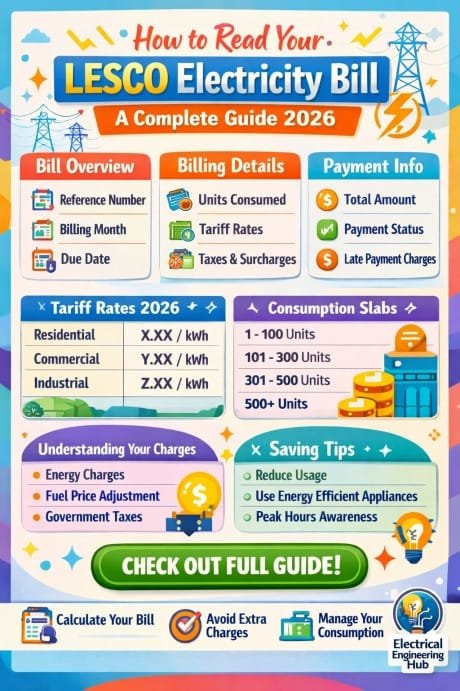
Table of Contents
Table of Contents
This complete 2026 guide explains every section of a LESCO bill in simple language so you can understand your monthly electricity charges with confidence.
What Is a LESCO Electricity Bill?
LESCO (Lahore Electric Supply Company) supplies electricity to Lahore and surrounding districts in Punjab. Every month, consumers receive a bill showing their electricity consumption and applicable charges.
The bill includes:
- Consumer information
- Meter details
- Billing period
- Previous and current meter readings
- Electricity units consumed
- Tariff category
- Government taxes
- Fuel adjustment charges
- Total payable amount
Understanding these details makes it easier to Read Your LESCO Electricity Bill accurately and avoid confusion regarding monthly charges.
Why Is It Important to Understand Your LESCO Bill?
Many consumers never review the details printed on their bills. As a result, they miss important information that may affect their electricity expenses.
Benefits include:
- Checking billing accuracy
- Monitoring electricity consumption
- Detecting unusual increases in usage
- Understanding taxes and surcharges
- Estimating future bills
- Improving energy efficiency
A better understanding of your bill also helps when filing complaints or discussing billing issues with customer support.
Main Sections of a LESCO Electricity Bill
A standard LESCO bill consists of several sections. The table below summarizes the key areas.
| Section | Purpose |
|---|---|
| Consumer Information | Identifies the account holder |
| Reference Number | Unique billing identification |
| Meter Information | Meter number and reading details |
| Billing Period | Duration covered by the bill |
| Units Consumed | Total electricity usage |
| Tariff Category | Applicable electricity rate |
| Taxes & Duties | Government charges |
| Fuel Price Adjustment | Variable fuel-related charges |
| Arrears | Outstanding balance from previous bills |
| Total Amount | Final payable amount |
When you Read Your LESCO Electricity Bill, reviewing each section individually helps you understand where your money is going.
LESCO Bill Check Online 2026
If you have misplaced your printed bill, you can use the LESCO bill check online 2026 service to instantly view and download a duplicate electricity bill. Simply enter your 14-digit reference number or customer ID on the official LESCO bill portal to access the latest bill, due date, and payable amount. This feature is available 24/7 and helps consumers avoid late payment charges.
| Feature | Details |
|---|---|
| Required Information | 14-digit Reference Number or Customer ID |
| Available Services | View, Download & Print Duplicate Bill |
| Cost | Free |
| Availability | 24/7 Online |
Tip: If you’re unsure where to find your reference number, use our LESCO Bill Calculator and bill-reading guide to identify it quickly while estimating your monthly electricity charges.
LESCO Bill EX Means
On a LESCO electricity bill, EX usually stands for Exempt. It indicates that a specific charge, tax, or surcharge does not apply to your electricity connection due to the applicable tariff category or government policy. The exact meaning can vary depending on the bill section, so always review it alongside the charge description.
| Bill Term | Meaning | Impact on Bill |
|---|---|---|
| EX | Exempt | No charge applied for that item |
| GST | General Sales Tax | Added if applicable |
| FPA | Fuel Price Adjustment | Varies monthly |
| QTR Tariff Adj. | Quarterly Tariff Adjustment | Applied as notified |
If you notice EX beside a tax or surcharge, it generally means you are not billed for that particular component.
LESCO Bill Reading Date
The LESCO bill reading date is the day when a meter reader records your electricity meter reading to calculate monthly consumption. Knowing this date helps you estimate your upcoming bill, track usage, and avoid surprises. You can usually find the reading date in the meter information section of your LESCO bill.
| Bill Detail | Description |
|---|---|
| Reading Date | Date when the electricity meter is read |
| Previous Reading | Last month’s recorded meter units |
| Current Reading | Latest recorded meter units |
| Billing Period | Duration between previous and current readings |
If you regularly monitor your meter around the LESCO bill reading date, you can estimate your monthly charges using a LESCO bill estimator before the official bill is generated. This also helps identify abnormal consumption or possible meter-related issues early.
What Are Fixed Charges in LESCO Bill?
Fixed charges in a LESCO electricity bill are monthly charges collected regardless of your electricity consumption. These charges help recover the cost of maintaining the power distribution network, infrastructure, transformers, and service availability. Even if your energy usage is low, eligible consumers may still see fixed charges on their bill based on their tariff category and sanctioned load.
| Charge Type | Purpose | Depends on Units? |
|---|---|---|
| Fixed Charges | Network and capacity cost recovery | No |
| Energy Charges | Cost of electricity consumed | Yes |
Check the Fixed Charges line item on your bill separately from energy charges. Reviewing this section helps you understand why your payable amount may remain high even during months with lower electricity consumption.
What Does CR Mean in Electricity Bill?
On a LESCO electricity bill, CR stands for Credit. It indicates that an amount has been credited to your account, reducing the total payable balance. Credits may result from bill adjustments, security deposit refunds, excess payments, or government subsidies applied after bill generation. If a credit exceeds your current charges, it may be carried forward to your next bill.
| Bill Term | Meaning | Effect on Bill |
|---|---|---|
| CR | Credit | Reduces payable amount |
| DR | Debit | Increases payable amount |
| Arrears | Unpaid Previous Balance | Added to current bill |
| Adjustment | Revised Charges | May be CR or DR |
Always verify the CR amount with the bill’s adjustment section or your LESCO online account to understand why the credit was applied.
Understanding Consumer Information
At the top of the bill, you will find basic customer details.
These usually include:
- Consumer name
- Address
- Customer ID
- Reference number
- Tariff type
- Subdivision
- Grid station information
The reference number is especially important because it is required for online bill checking, bill payment, complaint registration, and billing inquiries.
Always verify that your name and address are correct.
Understanding the Reference Number
The reference number is one of the most important identifiers on the bill.
A typical LESCO reference number consists of multiple digits and uniquely identifies your electricity connection.
You can use this number for:
- Checking duplicate bills
- Online bill verification
- Payment through banking apps
- Customer service inquiries
- Complaint registration
Many online electricity bill services use this number to retrieve billing information.
Want to calculate your electricity charges before your bill arrives? Try our LESCO Bill Calculator to get an instant estimate based on your monthly units and the latest LESCO tariff rates.
Billing Month and Due Date
The bill displays:
| Detail | Description |
|---|---|
| Billing Month | Month for which the bill is generated |
| Issue Date | Date when bill was issued |
| Due Date | Last date for payment |
| Payment Date | Date of payment (after payment) |
Paying before the due date prevents late payment surcharges.
Late payments often result in additional charges that increase the overall bill amount.
Meter Reading Information
The meter reading section determines how many units of electricity you have consumed.
You will typically see:
| Item | Meaning |
|---|---|
| Previous Reading | Last month’s recorded reading |
| Current Reading | Current month’s recorded reading |
| Reading Date | Date meter was checked |
| Units Consumed | Difference between readings |
Formula:
Units Consumed = Current Reading – Previous Reading
Example:
| Previous Reading | Current Reading | Units |
|---|---|---|
| 12,500 | 12,850 | 350 |
In this example, the consumer used 350 electricity units during the billing period.
This is one of the most important sections when you Read Your LESCO Electricity Bill because it directly affects your charges.
Understanding Connected Load
Connected load refers to the total electrical load approved for the connection.
Examples include:
- Fans
- Air conditioners
- Refrigerators
- Water pumps
- Electric heaters
- Industrial machinery
A higher connected load may place your connection under a different tariff category.
Consumers should ensure that the connected load mentioned on the bill matches their approved connection details.
Understanding Tariff Categories
Electricity rates vary according to consumer type.
Common tariff categories include:
| Tariff Type | Consumer Category |
|---|---|
| Domestic | Residential users |
| Commercial | Shops and businesses |
| Industrial | Factories and industries |
| Agricultural | Tube wells and farming operations |
| General Services | Public facilities |
Different categories have different electricity rates and billing structures.
When you Read Your LESCO Electricity Bill, always verify that the correct tariff category is applied.
Confused about how much your next electricity bill will be? Use our LESCO Bill Calculator to accurately estimate your bill, including applicable taxes and surcharges, in just a few seconds.
Understanding Electricity Units and Slabs
LESCO follows slab-based electricity pricing.
This means different unit ranges are charged at different rates.
Example illustration:
| Units Range | Rate Structure |
|---|---|
| First Slab | Lower rate |
| Middle Slab | Moderate rate |
| Higher Slab | Higher rate |
As electricity consumption increases, the applicable rate may also increase.
This system encourages efficient energy usage and helps manage electricity demand.
Energy Charges Explained
Energy charges represent the actual cost of electricity consumed.
The amount depends on:
- Total units consumed
- Applicable tariff
- Unit rates approved by regulators
Example:
| Units | Rate | Amount |
|---|---|---|
| 300 | Rs. X | Rs. XXXX |
Energy charges generally form the largest portion of the bill.
Fuel Price Adjustment (FPA)
Fuel Price Adjustment is an additional charge or credit applied based on fuel cost variations during electricity generation.
The amount changes periodically depending on:
- Global fuel prices
- Power generation mix
- Regulatory approvals
FPA can either increase or decrease your bill.
Many consumers notice bill fluctuations because of this adjustment.
Quarterly Tariff Adjustment (QTA)
Quarterly Tariff Adjustment is another regulatory charge applied to recover differences in electricity generation and distribution costs.
Key features:
- Applied periodically
- Approved by NEPRA
- May vary each quarter
- Can increase or reduce the bill
Understanding this component helps consumers interpret sudden billing changes.
Taxes and Duties on a LESCO Bill
Several taxes and duties may appear on your bill.
Common examples include:
| Tax/Duty | Purpose |
|---|---|
| GST | General Sales Tax |
| Electricity Duty | Provincial levy |
| TV Fee | Television fee collection |
| Neelum Jhelum Surcharge | Hydropower project recovery |
| Financing Cost Surcharge | Power sector financing costs |
These charges are generally imposed by government authorities and are not direct electricity consumption charges.
Arrears and Previous Balance
The arrears section shows unpaid amounts carried forward from previous bills.
You may see:
- Previous balance
- Outstanding charges
- Partial payments
- Adjustments
Always check this section carefully to ensure payment records are reflected correctly.
Understanding the Total Bill Amount
The final payable amount includes all applicable charges.
Typical calculation structure:
| Component | Included |
|---|---|
| Energy Charges | Yes |
| Taxes | Yes |
| FPA | Yes |
| QTA | Yes |
| Arrears | Yes |
| Adjustments | Yes |
The final figure represents the total amount due before the payment deadline.
How to Verify Unit Consumption
Consumers can manually verify usage by checking their meter.
Steps:
- Note the current meter reading.
- Compare it with the previous reading.
- Calculate the difference.
- Compare with the units shown on the bill.
This simple process helps identify possible billing discrepancies.
Anyone who wants to Read Your LESCO Electricity Bill accurately should perform this verification periodically.
How to Estimate Your Next Electricity Bill
Estimating future electricity expenses can help with budgeting.
Useful factors include:
- Average monthly units
- Seasonal usage
- Current tariff rates
- Fuel adjustments
- Applicable taxes
To simplify calculations, you can use our LESCO bill calculator to estimate your next bill and get a quick projection based on your expected electricity consumption.
Common Reasons for High Electricity Bills
Many consumers experience sudden increases in electricity expenses.
Common causes include:
- Increased air conditioner usage
- Electric heaters during winter
- Faulty appliances
- Additional household equipment
- Higher tariff slabs
- Fuel price adjustments
- Unpaid arrears
Reviewing your bill carefully can help determine the exact reason.
Tips to Reduce Electricity Consumption
Reducing energy use can lower monthly bills significantly.
Practical tips include:
- Use LED lighting
- Turn off unused appliances
- Maintain air conditioners regularly
- Avoid standby power consumption
- Use energy-efficient equipment
- Improve home insulation
- Monitor monthly unit usage
Small improvements often result in noticeable savings over time.
Common Mistakes Consumers Make
While reviewing bills, many consumers overlook important details.
Common mistakes include:
- Ignoring meter readings
- Missing due dates
- Not checking tariff categories
- Overlooking arrears
- Ignoring adjustment charges
- Failing to compare monthly consumption
Avoiding these mistakes can improve bill management and reduce disputes.
How to File a Billing Complaint
If you notice incorrect charges or unusual readings, you can file a complaint through LESCO.
Required information usually includes:
- Reference number
- Customer ID
- Copy of the bill
- Meter reading details
- Description of the issue
Keeping previous bills can help support your case during investigations.
Frequently Asked Questions
How can I Read Your LESCO Electricity Bill correctly?
Start by checking consumer information, meter readings, units consumed, tariff category, taxes, adjustments, and the final payable amount. Understanding each section helps you verify billing accuracy.
What is the reference number on a LESCO bill?
The reference number is a unique identification number assigned to every electricity connection. It is used for bill checking, online payments, and customer support.
Why does my LESCO bill change every month?
Bills may change due to variations in electricity usage, tariff slabs, fuel price adjustments, quarterly tariff adjustments, taxes, and outstanding balances.
What is Fuel Price Adjustment in a LESCO bill?
Fuel Price Adjustment is a charge or credit based on fluctuations in power generation fuel costs. It is approved by regulatory authorities and may vary each month.
How can I reduce my electricity bill?
You can lower your bill by using energy-efficient appliances, reducing unnecessary consumption, monitoring unit usage, maintaining electrical equipment, and avoiding peak consumption where possible.
Conclusion
Learning how to Read Your LESCO Electricity Bill is an important skill for every electricity consumer. A bill contains much more than just the payable amount. It provides detailed information about energy consumption, tariff categories, taxes, fuel adjustments, and regulatory charges.
By understanding meter readings, unit calculations, tariff structures, and additional charges, consumers can verify bill accuracy and make informed decisions about energy usage. Regularly reviewing your bill also helps identify unusual consumption trends and supports better household or business budgeting.
The more familiar you become with each section, the easier it becomes to Read Your LESCO Electricity Bill and manage your electricity expenses efficiently throughout 2026 and beyond.
Get new guides in your feed. Follow Electrical Insights on LinkedIn for new electrical standards guides, calculators and design tips from Azad Circuit Hub.
#HowToReadYourLESCOElectricityBill,#LESCOBillGuide,#LESCOBill2026,#ElectricityBillPakistan,#LESCOConsumerGuide,#BillReadingGuide,#LESCOCharges,#ElectricityBillExplanation,#PakistanElectricity,#LESCOBilling
