
FPL Rate Per kWh 2026: Current FPL Price, Residential Rates & Peak Hours
Electricity costs continue to rise across Florida, and many customers are now searching for the latest FPL Rate Per kWh to understand how much they are paying in 2026. If you use Florida Power & Light (FPL), knowing the exact energy rate can help you control your monthly bill and reduce unnecessary usage.
The FPL Rate Per kWh is one of the most important factors in your electricity bill. It directly impacts how much you pay for running air conditioners, water heaters, lights, and appliances. Since Florida homes often have high cooling demands, even small rate changes can affect your yearly expenses.
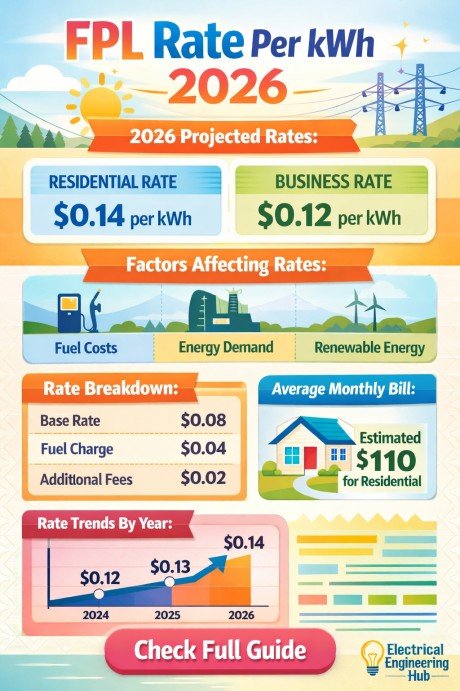
Table of Contents
Table of Contents
This guide explains the latest FPL price Per kWh in 2026, how FPL billing works, what charges are included, and practical ways to lower your energy bill.
What Is FPL Rate Per kWh in 2026?
The FPL Rate Per kWh in 2026 depends on several components, including fuel charges, base energy rates, storm recovery fees, and taxes. On average, residential customers are paying between $0.14 and $0.17 per kWh, depending on usage levels and billing adjustments.
Here is a quick breakdown.
| Charge Type | Average Cost Per kWh |
|---|---|
| Base Rate | $0.09 – $0.11 |
| Fuel Charge | $0.03 – $0.04 |
| Environmental Charge | $0.01 |
| Storm Protection Charge | $0.005 – $0.01 |
| Taxes and Fees | Variable |
| Total Estimated Rate | $0.14 – $0.17 |
This means if your home uses 1,000 kWh in a month, your estimated bill could range between $140 and $170.
Florida Power and Light Cost Per kWh
If you’re comparing electricity prices in Florida, knowing the current Florida Power and Light cost per kWh helps you estimate your monthly bill more accurately. FPL’s residential rate varies depending on your total monthly usage because the utility applies a tiered pricing structure along with fuel, storm recovery, and other regulatory charges.
| Monthly Usage | Estimated FPL Cost per kWh (2026) |
|---|---|
| First 1,000 kWh | Approximately 11.8¢–12.5¢/kWh |
| Above 1,000 kWh | Approximately 13.8¢–15.2¢/kWh |
| Average Residential Rate | Around 13¢–14¢/kWh |
Actual bills may vary due to taxes, rider adjustments, and seasonal fuel-cost changes approved by the Florida Public Service Commission (FPSC). Always cross check your latest FPL bill with our FPL bill calculator for the effective rate applied to your account.
FPL Residential Rate 2026: Cents per kWh
The FPL residential rate 2026 cents per kWh depends on monthly usage because FPL bills include energy charges, fuel costs, base charges, and other regulated adjustments. For a typical residential customer, the effective electricity cost is higher than the basic energy charge shown in the tariff.
| FPL Residential Rate 2026 | Approx. Cost |
|---|---|
| Energy charge | ~11–12¢/kWh |
| Typical effective residential cost* | ~14–15¢/kWh |
| 500 kWh usage | ~$70–$75 |
| 1,000 kWh usage | ~$140–$150 |
| 2,000 kWh usage | ~$280–$300 |
*Effective cost varies with fuel and other monthly billing adjustments.
For example, a home using 1,000 kWh per month may pay roughly $140–$150, before unusual credits, taxes, or other account-specific adjustments. FPL’s standard residential service is generally not a simple flat cents-per-kWh price because several tariff components are combined on the final bill.
When comparing the FPL residential rate 2026 cents per kWh, use the total bill divided by kWh consumed for the most realistic household electricity cost.
FPL Average Cost Per kWh
The fpl average cost per kwh depends on your monthly usage because FPL uses tiered residential rates and includes several fixed and regulatory charges. For a typical Florida residential customer, the effective price can be higher than the advertised base energy charge.
| Monthly Usage | Approx. Energy Rate | Typical Effective Cost* |
|---|---|---|
| 0–1,000 kWh | ~11.5¢/kWh | ~13–15¢/kWh |
| Over 1,000 kWh | ~13.5¢/kWh | ~14–16¢/kWh |
| 1,000 kWh bill | ~$115 energy charge | ~$135–$150 total |
*Effective cost varies with fuel, storm, tax, and other applicable charges. Rates can change, so check FPL’s current tariff for billing-period rates.
For a 1,000-kWh household, dividing the total bill by 1,000 gives the most practical fpl average cost per kwh for budgeting and comparing electricity prices.
How FPL Calculates Your Electricity Bill
Understanding the FPL price Per kWh becomes easier when you know how your bill is structured.
Your bill usually includes:
1. Energy Charge
This is the actual electricity you consume multiplied by the FPL Rate Per kWh.
Example:
If your usage is 1,200 kWh and the rate is $0.15:
1,200 × $0.15 = $180
2. Fuel Cost Recovery
FPL adjusts fuel charges based on natural gas and fuel market prices.
3. Minimum Base Bill
Some customers may see a minimum service charge regardless of usage.
4. Taxes and Government Fees
Local taxes and franchise fees can slightly increase your total amount.
If you want to estimate your monthly costs accurately, you can use the FPL Bill Calculator to quickly check your expected charges based on your energy usage.
FPL Peak Hours and Time-of-Use Rates (2026)
If you are enrolled in Florida Power & Light’s optional Time-of-Use (TOU) program, electricity costs more during weekday peak periods and less during off-peak hours. Most residential customers remain on the standard flat-rate plan, but TOU can benefit households that shift heavy appliance use.
| Time Period | Schedule | Approx. Energy Rate* |
|---|---|---|
| Peak Hours | Weekdays (business hours) | $0.18–$0.22/kWh |
| Off-Peak Hours | Nights, weekends & holidays | $0.06–$0.09/kWh |
*Rates vary slightly based on season and approved FPL tariffs.
Running EV chargers, dishwashers, water heaters, and laundry equipment during off-peak hours can significantly reduce monthly electricity costs. Compare your daily usage pattern before switching to the TOU plan to determine whether the lower off-peak pricing outweighs the higher fpl peak hours energy rates.
FPL Off Peak Hours Rates (2026)
Customers enrolled in Florida Power & Light’s Time-of-Use (TOU) program can reduce electricity costs by shifting high-energy activities to off-peak periods. Off-peak electricity is billed at a significantly lower rate than peak usage.
| Time Period | Approx. FPL TOU Rate (2026) |
|---|---|
| Off-Peak Hours | $0.08–$0.10 per kWh |
| Mid-Peak (where applicable) | $0.12–$0.15 per kWh |
| Peak Hours | $0.18–$0.22 per kWh |
The exact FPL off peak hours rates depend on your selected tariff, season, and approved Time-of-Use plan. Most residential customers on the standard rate pay a flat energy charge instead of TOU pricing.
If you own an EV or have flexible energy usage, running appliances, charging vehicles, and operating pool pumps during off-peak hours can noticeably reduce monthly electricity costs. Always verify current TOU schedules on your FPL bill or official tariff documents.
FPL Rate Per kWh Compared to Previous Years
Electricity rates have changed steadily over the years. Here is a comparison.
| Year | Average FPL Rate Per kWh |
|---|---|
| 2022 | $0.11 |
| 2023 | $0.13 |
| 2024 | $0.14 |
| 2025 | $0.15 |
| 2026 | $0.14 – $0.17 |
The increase is mainly due to:
- Fuel market volatility
- Grid modernization projects
- Storm hardening investments
- Inflation in maintenance costs
Even though rates are increasing, FPL still remains lower than the national average in many cases.
Why Is FPL Rate Per kWh Different for Every Customer?
Many people compare bills and notice different rates. That happens because FPL Rate Per kWh can vary based on several factors.
Usage Tier
Higher energy consumption may result in different billing structures.
Seasonal Demand
Summer months usually bring higher fuel costs due to increased demand.
Time of Use Programs
Customers enrolled in time-based plans may pay less during off-peak hours.
Location Charges
Some county taxes and local fees differ.
This explains why two homes using similar power may have different total bills.
Average Monthly Cost Based on Usage
The following table shows estimated monthly bills using the current FPL Rate Per kWh.
| Monthly Usage (kWh) | Estimated Cost |
|---|---|
| 500 kWh | $70 – $85 |
| 800 kWh | $112 – $136 |
| 1,000 kWh | $140 – $170 |
| 1,500 kWh | $210 – $255 |
| 2,000 kWh | $280 – $340 |
This table helps users estimate expenses before receiving the actual bill.
How to Lower Your FPL Bill in 2026
Knowing the FPL Rate Per kWh is only the first step. The next step is reducing your energy use.
Upgrade to Energy-Efficient Appliances
Old appliances consume more electricity. Look for ENERGY STAR-certified equipment.
Set Your AC Properly
Air conditioning is the biggest power consumer in Florida homes. Keep the thermostat at 76°F to 78°F.
Use Smart Thermostats
Smart thermostats adjust cooling automatically and save energy.
Reduce Peak-Time Usage
Avoid running heavy appliances during high-demand periods.
Switch to LED Lights
LED bulbs use up to 80% less power.
Monitor Consumption Regularly
Track your usage weekly using FPL’s online tools or use the FPL Bill Calculator for better planning.
Does Solar Reduce FPL Costs?
Many homeowners are switching to solar to offset rising FPL Rate Per kWh charges.
Here is a simple comparison.
| Energy Source | Average Cost Per kWh |
|---|---|
| FPL Grid Power | $0.14 – $0.17 |
| Solar Power | $0.06 – $0.10 |
Solar can lower dependency on grid electricity, especially during daytime.
However, installation costs and net metering policies should be reviewed before making a decision.
Florida Average Residential Electricity Price 2026 (EIA)
According to the latest U.S. Energy Information Administration (EIA) data, the average residential electricity price in Florida during 2026 is approximately 16.3¢ per kWh. This statewide average includes customers served by multiple utilities, while FPL rates may be slightly higher or lower depending on the selected rate plan, fuel charges, and applicable taxes.
Comparing the statewide average with the current FPL rate per kWh helps homeowners understand whether their electricity costs are above or below the Florida benchmark.
| Source | Average Residential Price (2026) |
|---|---|
| U.S. EIA Florida Average | 16.3¢/kWh |
| FPL Residential Rate* | Varies by plan and monthly usage |
*FPL’s effective price per kWh changes based on tariff, fuel adjustments, and customer consumption. Always refer to the latest FPL bill for your actual energy rate.
Key Factors Affecting Future FPL Rate Per kWh
Several things can influence rates in the future.
- Natural gas price changes
- Hurricane recovery expenses
- State energy regulations
- Grid expansion projects
- Renewable energy integration
Experts expect moderate fluctuations through 2027.
Key Takeaways
- The average FPL Rate Per kWh in 2026 ranges between $0.14 and $0.17.
- Fuel charges and taxes make up a large portion of the total bill.
- Higher monthly usage leads to larger bills quickly.
- Air conditioning is the biggest electricity consumer in Florida homes.
- Using tools like the FPL Bill Calculator can improve budget planning.
- Solar energy may help reduce long-term electricity costs.
Final Thoughts
The FPL Rate Per kWh in 2026 is an important number for every Florida resident. Even a small increase in rates can have a major impact on yearly expenses. Understanding your rate structure, tracking your monthly usage, and improving energy efficiency can help you stay in control.
Electricity bills are not just about how much power you use. They also depend on fuel prices, grid maintenance, and policy changes. Staying informed allows you to make smarter decisions.
FAQs
What is the current FPL Rate Per kWh in 2026?
The average FPL Rate Per kWh is between $0.14 and $0.17 depending on usage and billing components.
Why does my FPL bill change every month?
Your bill changes due to different energy usage, fuel adjustments, and taxes.
Is FPL cheaper than other Florida utility companies?
In many areas, FPL remains competitive and often below the national average.
How can I calculate my FPL bill?
Multiply your total kWh usage by the FPL Rate Per kWh and add taxes and fees. You can also use an FPL Bill Calculator.
Will FPL rates increase in the future?
Rates may increase depending on fuel prices, infrastructure upgrades, and storm-related costs.
Get new guides in your feed. Follow Electrical Insights on LinkedIn for new electrical standards guides, calculators and design tips from Azad Circuit Hub.
#FPLRatePerkWh2026,#FPLRates2026,#FloridaPowerRates,#ElectricityRates2026,#FPLBillCalculator,#EnergyCostsFlorida,#kWhRates2026,#UtilityBillSavings,#FPLEnergyGuide,#ElectricityPricing
