
Fluke 117 vs 87V: Which Multimeter Should You Buy? Best Guide
The Fluke 117 and Fluke 87V are both professional True-RMS multimeters, but they are built for different working environments. The 117 is designed with electricians in mind, while the 87V is a more advanced industrial multimeter for demanding troubleshooting, motor drives, and electrical systems.
As an electrical engineer with more than 15 years of field experience in electrical panels, industrial automation, PLCs, troubleshooting, and power systems, I look at a multimeter differently from a casual buyer. Safety category, low-impedance voltage measurement, accuracy, VFD testing, temperature measurement, and durability can matter more than simply counting features. Comparison tables for Fluke 117 vs 87V is as below.
Fluke 117 vs 87V Multimeter


Fluke 117 vs 87V Multimeter at a Glance
| Feature | Fluke 117 | Fluke 87V |
|---|---|---|
| Best for | Electricians | Industrial troubleshooting |
| True-RMS | Yes | Yes |
| LoZ voltage | Yes | Yes |
| VFD low-pass filter | No | Yes |
| Temperature measurement | No | Yes |
| DC voltage accuracy | About 0.5% | About 0.05% |
| Safety rating | CAT III 600V | CAT IV 600V / CAT III 1000V |
| Display | Backlit | Large backlit display |
| Min/Max/Avg | Yes | Yes |
| Best advantage | Simple electrical testing | Advanced diagnostics |
If you are shopping more broadly, my guide to the best multimeter for electricians compares other professional meters for electrical installation and service work.
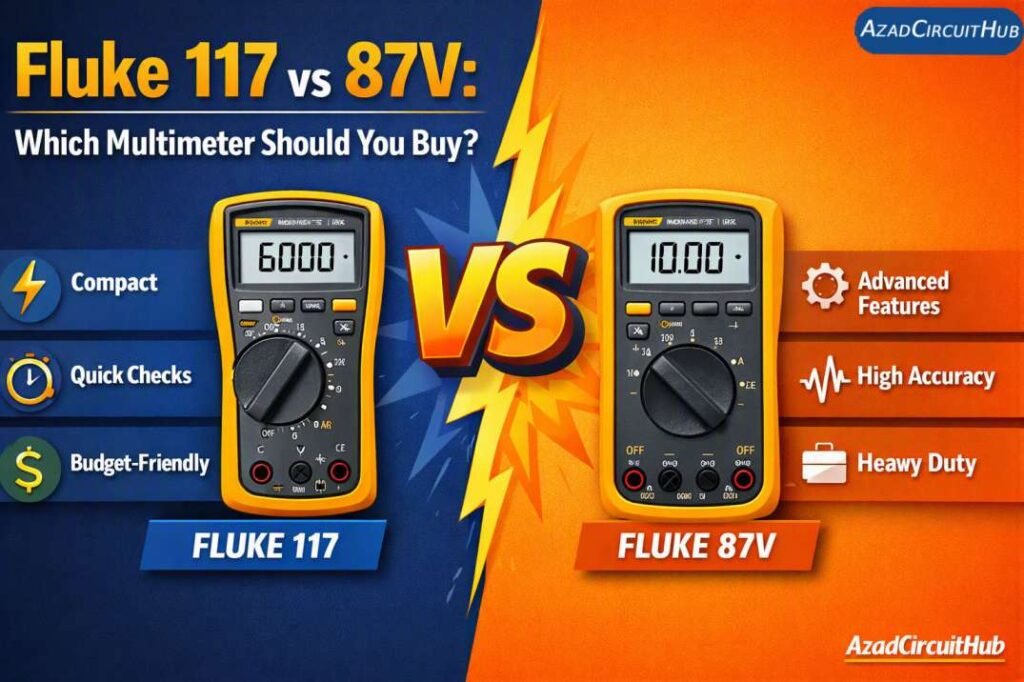
Fluke 117: Best for Electricians
The Fluke 117 is one of the most practical meters in Fluke’s lineup for electricians. Its True-RMS measurement makes it suitable for checking modern electrical loads where waveform distortion can make average-responding meters less reliable.
One of its most useful features is LoZ, or low-impedance voltage measurement. It helps reduce the risk of misleading ghost-voltage readings on certain electrical circuits.
The 117 also has a large backlit display, automatic and manual ranging, capacitance, frequency, continuity, resistance, and current measurement.
For electricians working mainly on distribution panels, receptacles, lighting, motors, and general commercial or residential systems, the 117 is often easier to justify than the more expensive 87V.
Check the Fluke 117 price on Amazon: Fluke 117 Electrician’s True-RMS Multimeter
The 117 is also worth considering if your work overlaps with HVAC electrical troubleshooting. My guide to Fluke 117 for HVAC Technicians explains where this meter fits into HVAC service work.
Fluke 87V: Better for Industrial Troubleshooting
The Fluke 87V is designed for a more demanding troubleshooting environment. It adds features that become valuable when working around variable-frequency drives, industrial motors, automation equipment, and complex electrical systems.
Its VFD low-pass filter is particularly useful when measuring voltage and frequency associated with motor drives. The 87V also supports temperature measurements with the appropriate thermocouple accessory and provides higher measurement accuracy than the 117.
In industrial maintenance, these additional functions can save time. Instead of carrying separate instruments for several diagnostic tasks, an 87V can handle a wider range of measurements.
For more detailed information, see my fluke 87v reviews guide.
Fluke 117 vs 87V: Which One Is More Accurate?
Accuracy is one of the clearest differences between these meters.
| Measurement Consideration | Fluke 117 | Fluke 87V |
|---|---|---|
| General voltage testing | Excellent | Excellent |
| Precision troubleshooting | Good | Better |
| Industrial diagnostics | Good | Excellent |
| VFD measurements | Limited | Excellent |
| Temperature | No dedicated function | Yes |
| Low-voltage electrical work | Excellent | Excellent |
For normal electrical installation work, the 117’s accuracy is usually more than adequate. For industrial troubleshooting where small measurement differences matter, the 87V offers a stronger specification.
Fluke 117 vs 87V for Safety
Both meters are designed for professional electrical work, but their safety ratings differ.
The 117 is rated CAT III 600V, making it suitable for many building-level electrical applications. The 87V provides CAT IV 600V and CAT III 1000V ratings, giving it a higher safety category for appropriate applications.
The meter alone does not make an electrical test safe. Test leads, accessories, PPE, work procedures, and the installation category all matter.
For electricians who primarily work inside distribution boards and building electrical systems, the 117 provides a strong combination of safety and simplicity.
Which Fluke Should You Buy?
Choose the Fluke 117 if you want a professional electrician’s multimeter for everyday electrical testing. Its LoZ function, True-RMS capability, simple interface, and robust construction make it a practical field tool.
Choose the Fluke 87V if you work with industrial machinery, VFDs, motor controls, automation systems, or troubleshooting where additional accuracy and diagnostic functions justify the higher price.
If you are building a professional electrical test kit, my best multimeter for electricians comparison can help you compare the 117 with other Fluke and competing meters.
Frequently Asked Questions
Is the Fluke 87V better than the 117?
The 87V has more advanced functions and higher measurement accuracy, so it is better suited to industrial troubleshooting. The 117 is often the better choice for general electrical work because it is simpler and typically costs less.
Can the Fluke 117 measure VFD output?
The 117 can measure electrical parameters associated with many applications, but it does not have the dedicated VFD low-pass filter found on the 87V. For frequent VFD troubleshooting, the 87V is the stronger choice.
Does the Fluke 117 have True-RMS?
Yes. The Fluke 117 is a True-RMS digital multimeter, making it suitable for measuring AC signals from many modern electrical and electronic loads.
Does the Fluke 87V measure temperature?
Yes. The 87V supports temperature measurement when used with the appropriate temperature accessory or thermocouple.
Is the Fluke 117 good for professional electricians?
Yes. The 117 was specifically designed for electricians and provides the core measurement functions needed for many residential, commercial, and light industrial electrical tasks.
Final Verdict
The choice between these two meters comes down to the type of work you actually perform.
The Fluke 117 is the better everyday electrician’s meter. It provides True-RMS measurement, LoZ voltage detection, a clear display, and the essential functions needed for routine electrical testing.
The Fluke 87V is the better industrial troubleshooting tool. Its higher accuracy, VFD filtering, temperature capability, broader safety ratings, and advanced diagnostic features make it more suitable for demanding maintenance environments.
For most electricians, the 117 offers the better balance of capability and price. For industrial engineers and technicians working regularly with drives, motors, automation panels, and difficult faults, the 87V is worth the additional investment.
Follow Us on Social:
Subscribe our Newsletter on Electrical Insights for latest updates from Azad Circuit Hub
#Fluke117, #Fluke87V, #Fluke117vs87V, #FlukeMultimeter, #DigitalMultimeter, #ElectricianTools, #ElectricalTesting, #MultimeterReview, #FlukeTools, #ElectricalTools
