
Fluke 117 Low Impedance Mode Ghost Voltage Explained
The fluke 117 low impedance mode ghost voltage feature is useful when troubleshooting circuits that show voltage even when no solid power source is present. The Fluke 117 uses a low-input-impedance function called Auto-V/LoZ to help reduce false voltage readings caused by capacitive coupling.
| Fluke 117 Feature | What It Does | Main Benefit |
|---|---|---|
| Auto-V/LoZ | Uses low input impedance when measuring AC voltage | Helps identify ghost voltage |
| True-RMS AC | Measures non-linear AC waveforms accurately | Better readings on modern loads |
| VoltAlert | Detects AC voltage without metal contact | Quick preliminary checks |
| Manual voltage ranges | Allows conventional voltage testing | Useful for controlled measurements |
| Continuity | Checks electrical paths | Faster troubleshooting |

- VoltAlert technology for non-contact voltage detection
- AutoVolt automatic AC/DC voltage selection. DC millivolts – Range : 600.0 mV, Resolution : 0.1 mV
- Low input impedance: helps prevent false readings due to ghost voltage
- Large white LED backlight to work in poorly lit areas
- True RMS for accurate measurements on non-linear loads. Operating temperature: -10°C to +50°C. Battery life: 400 hours t…
For electricians working on panels, control circuits, HVAC equipment, and branch wiring, understanding this function can make voltage troubleshooting much easier.
What Is Ghost Voltage?
Ghost voltage is a voltage reading that appears on a conductor that is not connected to an energized source through a low-impedance path. It commonly occurs when an energized conductor runs close to a disconnected or de-energized conductor.
The two conductors can form a small capacitive coupling. The energized wire transfers a small AC voltage onto the nearby conductor. A high-impedance digital multimeter can detect this voltage because it draws very little current.
For example, a disconnected wire running alongside an energized 120 V conductor may display a significant voltage on a standard high-impedance meter. However, that reading may collapse when the circuit is tested with a low-impedance meter.
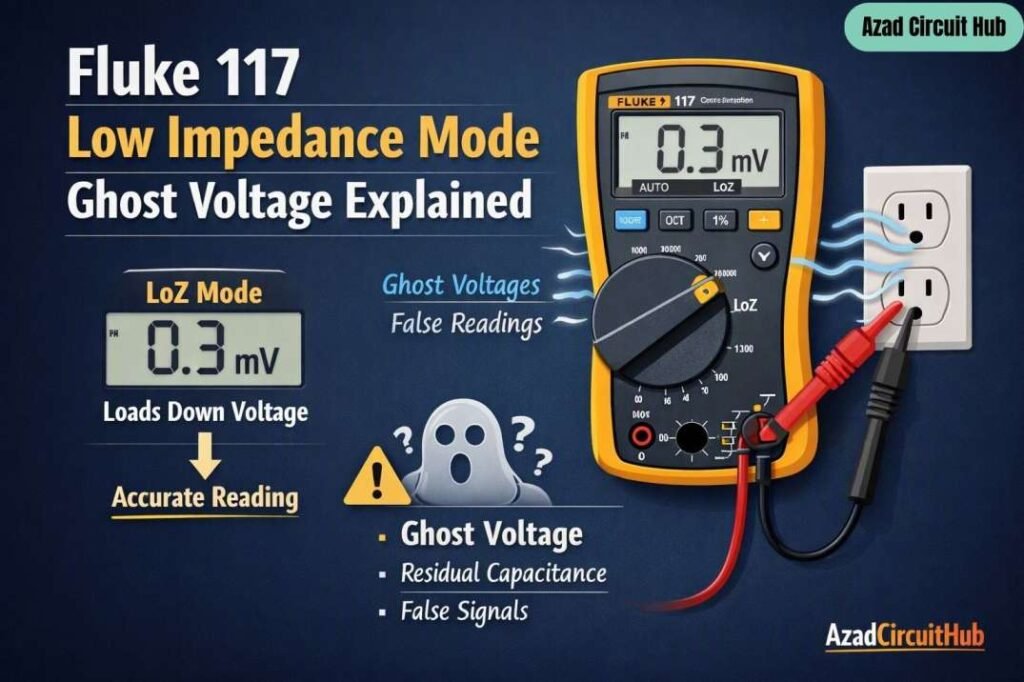
Table of Contents
Table of Contents
How the Fluke 117 LoZ Function Works
The fluke 117 low impedance mode ghost voltage function addresses this problem by placing a lower impedance across the test points during the voltage measurement.
This creates a greater load on the circuit. A genuine voltage source can normally maintain its voltage, while a weak capacitively coupled signal will often collapse toward zero.
| Measurement Condition | High-Z Meter | Fluke 117 Auto-V/LoZ |
|---|---|---|
| Solid energized circuit | Normal voltage | Normal voltage |
| Capacitive coupling | May show voltage | Reading usually collapses |
| Open/disconnected wire | May show ghost voltage | Helps distinguish ghost voltage |
| Troubleshooting panel wiring | Can require further testing | Useful for quick verification |
The low impedance mode should not be viewed as a substitute for a complete electrical safety procedure. Always follow the applicable lockout/tagout and verification requirements.
If you are comparing meters for field work, see Best Multimeter for Electricians for a broader comparison of professional electrical test instruments.
Why Ghost Voltage Happens
Ghost voltage is particularly common in installations containing long parallel conductors. Control panels, commercial buildings, industrial plants, and multi-wire cable runs can create conditions where capacitive coupling becomes noticeable.
Typical causes include:
- Long parallel cable runs
- Disconnected switch legs
- Open control circuits
- Unused conductors near energized wires
- Multi-conductor cables
- Electronic equipment and control circuits
- Induced voltage from nearby AC conductors
The amount of ghost voltage depends on factors such as conductor length, spacing, insulation, frequency, and the impedance of the measuring instrument.
Fluke 117 Auto-V/LoZ vs Standard Voltage Mode
The fluke 117 low impedance mode ghost voltage capability is especially helpful because the meter automatically selects the appropriate measurement behavior in Auto-V/LoZ mode.
A conventional high-input-impedance measurement can sometimes leave the technician wondering whether a displayed voltage is actually capable of delivering meaningful current.
| Test | High-Impedance Measurement | LoZ Measurement |
|---|---|---|
| Input impedance | High | Lower |
| Ghost voltage detection | Less reliable | Better suited |
| Circuit loading | Very low | Higher |
| Risk of affecting sensitive circuits | Lower | Higher |
| Troubleshooting induced voltage | Less effective | More useful |
Because LoZ measurement loads the circuit, technicians should understand the circuit before applying it. Sensitive electronic circuits may require a high-impedance measurement method instead.
For broader meter selection advice, Best Multimeter for Electricians covers features that matter when choosing a meter for daily troubleshooting.
Using the Fluke 117 in HVAC Work
HVAC technicians often encounter control wiring, transformers, contactors, disconnects, and long cable runs where induced readings can create confusion.
The Fluke 117 can be useful when checking whether an unexpected AC voltage is supported by a real source or is simply a coupled signal.
For HVAC-specific applications, see Fluke 117 for HVAC Technicians for practical testing considerations.
The meter should still be used with the correct test procedure and appropriate PPE. Never assume a low or zero reading means a circuit is safe without completing the required verification process.
Frequently Asked Questions
What is ghost voltage on a Fluke 117?
Ghost voltage is an apparent voltage caused mainly by capacitive coupling between conductors. The Fluke 117’s Auto-V/LoZ function helps identify it by using a lower input impedance.
Does the Fluke 117 eliminate ghost voltage?
It does not physically eliminate the coupled voltage. Instead, its low-impedance measurement places a load on the circuit, which can cause weak ghost voltage to collapse.
Why does my multimeter show voltage on a disconnected wire?
A nearby energized conductor can induce or capacitively couple AC voltage onto the disconnected wire. A high-impedance digital multimeter can detect this small coupled signal.
Is Fluke 117 LoZ safe for electronics?
LoZ measurements place additional load on the circuit and may not be suitable for every sensitive electronic circuit. Check the equipment requirements before using this mode.
How do I check for ghost voltage?
Measure the circuit using an appropriate low-impedance function such as the Fluke 117’s Auto-V/LoZ mode. If the voltage drops substantially under the loaded measurement, the original reading may have been ghost voltage.
For more practical meter guidance, Best Multimeter for Electricians is a useful starting point when comparing professional troubleshooting instruments.
Follow Us on Social:
Subscribe our Newsletter on Electrical Insights for latest updates from Azad Circuit Hub
#Fluke117, #Fluke117LoZ, #GhostVoltage, #LowImpedanceMode, #FlukeMultimeter, #ElectricalTesting, #ElectricianTools, #DigitalMultimeter, #VoltageTesting, #ElectricalSafety
