Electric Golf Cart Motor Testing: Advanced Diagnostic, Performance Evaluation & Fault Detection Guide for Reliable Maintenance
Electric Golf Cart Motor Testing is a crucial process for ensuring smooth performance, energy efficiency, and long-term reliability of electric vehicles used in golf courses, resorts, and light utility transport. Proper testing helps technicians identify performance issues, detect hidden electrical faults, and maintain motor health before major failures occur. Whether dealing with brushed DC motors or modern AC induction systems, accurate evaluation improves torque delivery, speed consistency, and battery utilization.
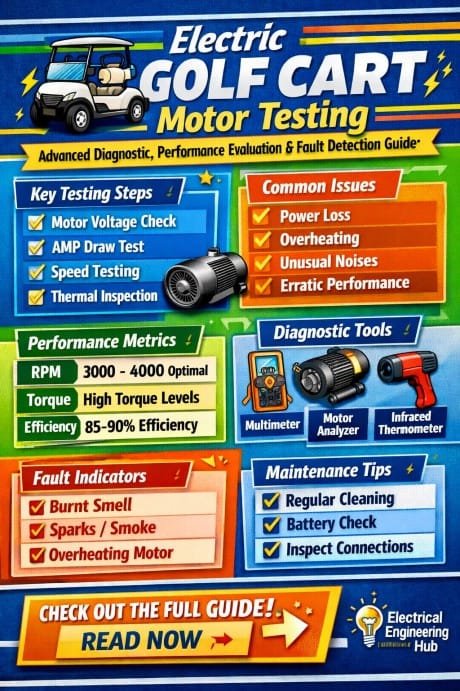
Table of Contents
Electric Golf Cart Motor Testing is widely used in preventive maintenance routines where early detection of wear, overheating, and electrical imbalance can save costly replacements. In real-world applications, motors are exposed to varying loads, terrain conditions, and charging cycles, making structured testing essential for operational safety and efficiency.
Understanding Electric Golf Cart Motor Behavior and System Components
A golf cart motor works in coordination with controllers, batteries, throttle sensors, and wiring harnesses. Any imbalance in these components can directly impact performance. Before beginning Electric Golf Cart Motor Testing, it is important to understand how voltage input, current draw, and load resistance interact within the system.
Know more about How does the star delta starter reduce starting current?
Electric motors generally show early warning signs such as reduced acceleration, irregular torque output, or unusual noise when internal wear begins. Technicians often use diagnostic tools like multimeters, clamp meters, and motor analyzers to evaluate system health.
Key components involved in motor operation
| Component | Function | Common Issue |
|---|---|---|
| Motor Armature | Converts electrical energy into mechanical motion | Brush wear, overheating |
| Controller | Regulates power flow | Signal failure, overheating |
| Battery Pack | Supplies DC power | Voltage drop, sulfation |
| Throttle Sensor | Controls speed input | Signal inconsistency |
| Wiring Harness | Connects system parts | Loose connections, corrosion |
Understanding these parts helps in structured Electric Golf Cart Motor Testing and reduces diagnostic errors during maintenance.
Voltage and Current Analysis for Performance Evaluation
One of the most important steps in Electric Golf Cart Motor Testing is analyzing voltage stability and current draw under load. A healthy motor maintains consistent voltage usage while drawing current proportional to terrain and weight conditions.
Know more about Motor Overload Protection Chart
When voltage drops significantly during acceleration, it may indicate battery degradation or internal motor resistance. Similarly, excessive current draw often signals mechanical binding or worn brushes in DC motors.
Technicians typically perform no-load and full-load tests to compare performance behavior. These readings help identify inefficiencies that are not visible during normal operation.
Temperature Monitoring and Thermal Stress Detection
Heat is one of the biggest indicators of motor health. During Electric Golf Cart Motor Testing, thermal scanning tools or infrared thermometers are used to detect abnormal temperature rises in motor housing and controller units.
Overheating may result from excessive load, poor ventilation, or internal friction. Continuous thermal stress can reduce winding insulation life and damage bearings. Monitoring temperature trends over time provides valuable insight into motor durability and helps schedule timely maintenance.
Common thermal behavior patterns
| Condition | Temperature Range | Interpretation |
|---|---|---|
| Normal operation | 40°C – 70°C | Stable performance |
| Moderate load stress | 70°C – 90°C | Acceptable but monitored |
| Overheating | Above 90°C | Immediate inspection required |
Know more about Thermal Overload Relay
Load Testing and Torque Output Evaluation
Load testing is a core part of Electric Golf Cart Motor Testing where the motor is evaluated under real-world operating conditions. This includes uphill driving simulation, passenger load testing, and acceleration response checks.
Torque consistency is a key performance factor. If the motor struggles under moderate load, it may indicate weak magnetic fields, worn internal components, or controller inefficiency. Advanced diagnostic systems measure RPM variations and torque curves to assess performance accuracy.
During Electric Golf Cart Motor Testing, uneven torque delivery is often linked to internal coil damage or commutator wear in brushed motors, while AC motors may show inverter-related inconsistencies.
Fault Detection Through Noise, Vibration, and Resistance Testing
Mechanical and electrical faults often reveal themselves through unusual noise or vibration patterns. A grinding sound may indicate bearing damage, while intermittent humming can suggest electrical imbalance.
Electric Golf Cart Motor Testing also includes resistance measurement across windings using an ohmmeter. Uneven resistance values between phases point toward internal short circuits or damaged coils.
Use our online tool Motor Overload Setting Calculator for Single and Three Phase Motors
Technicians also perform continuity checks and insulation resistance tests to ensure safe operation. These diagnostic methods help prevent sudden breakdowns and improve system reliability.
Common fault indicators
| Symptom | Possible Cause | Severity |
|---|---|---|
| Excess vibration | Bearing wear | Medium |
| Reduced speed | Voltage drop | High |
| Burning smell | Overheating windings | Critical |
| Jerky movement | Controller fault | High |
Controller and Sensor Synchronization Testing
Modern golf carts rely heavily on electronic controllers that regulate motor performance. During Electric Golf Cart Motor Testing, synchronization between throttle input and controller output is evaluated.
If response delay or irregular acceleration occurs, the issue may lie in sensor calibration or controller firmware. Hall sensors in AC motors are particularly sensitive and require precise alignment for accurate feedback.
Find more about Best Megger Insulation Tester for Industrial Motors
Testing involves signal tracing and voltage waveform analysis to ensure smooth communication between components. Any deviation can significantly affect motor efficiency and driving comfort.
Efficiency Optimization and Preventive Maintenance Strategies
A well-executed Electric Golf Cart Motor Testing process not only identifies faults but also improves long-term efficiency. Regular maintenance schedules help extend motor lifespan and reduce energy consumption.
Lubrication of bearings, cleaning of commutators, tightening electrical connections, and battery balancing are essential preventive measures. Additionally, monitoring charging cycles and avoiding deep discharge improves overall system health.
Technicians often recommend periodic performance benchmarking to track motor efficiency over time and detect gradual degradation early.
Know more about HT Motor Tan Delta Testing – Best Guide for High Voltage Motor Insulation Diagnostic & Preventive Maintenance
Diagnostic Comparison Table for Maintenance Decisions
| Test Type | Purpose | Tool Used | Outcome |
|---|---|---|---|
| Voltage Test | Battery and supply check | Multimeter | Power stability |
| Current Test | Load behavior | Clamp meter | Efficiency rating |
| Thermal Test | Heat detection | Infrared sensor | Safety evaluation |
| Resistance Test | Coil integrity | Ohmmeter | Fault identification |
| Load Test | Real-world performance | Diagnostic software | Torque analysis |
Conclusion
Electric Golf Cart Motor Testing plays a vital role in maintaining the reliability, safety, and efficiency of electric golf carts used in various environments. By combining electrical diagnostics, thermal analysis, load evaluation, and fault detection techniques, technicians can ensure consistent motor performance and reduce unexpected failures.
Use our online tool Short Circuit Current Calculator for Motors: Best Tool
Regular Electric Golf Cart Motor Testing not only enhances operational lifespan but also improves energy efficiency and driving experience. With proper diagnostic practices and preventive maintenance, electric golf cart systems can deliver stable torque, smooth acceleration, and long-term durability even under demanding conditions.
Get new guides in your feed. Follow Electrical Insights on LinkedIn for new electrical standards guides, calculators and design tips from Azad Circuit Hub.
#electricgolfcartmotortesting,#golfcartmotor,#electricmotorrepair,#evmaintenance,#golfcartdiagnostics,#motortesting,#electricvehiclemaintenance,#cartperformance,#motortroubleshooting,#golfcartrepair