Best 10 Circuit Breaker Analyzers | Professional High-Precision Testing Solutions for Power System Reliability & Industrial Maintenance
In modern electrical networks, reliability depends heavily on accurate diagnostics and preventive maintenance. One of the most critical tools used in this field is the circuit breaker analyzer, which plays a key role in evaluating the health, timing, and performance of protective switching devices. Without proper testing, power interruptions, equipment damage, and safety risks can increase significantly in industrial and utility systems.
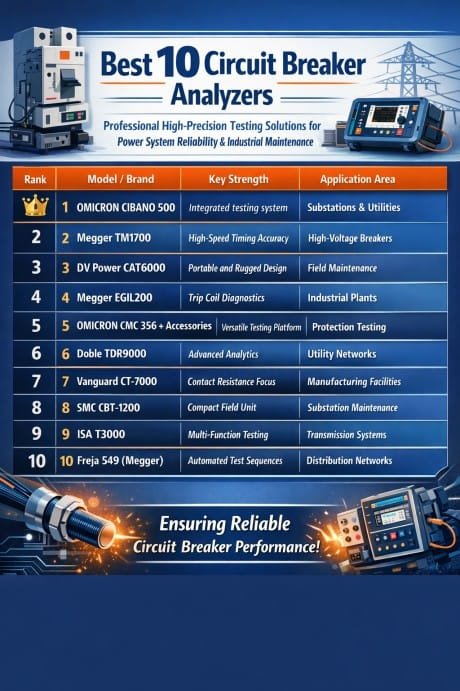
Table of Contents
A circuit breaker analyzer is designed to measure operating time, contact resistance, coil current, travel characteristics, and synchronization between poles. These parameters help engineers ensure that circuit breakers will function correctly during fault conditions. In high-voltage environments such as substations, power plants, and industrial grids, even a small delay in breaker operation can lead to system instability.
Over the years, testing technology has advanced significantly. Today’s circuit breaker analyzer systems offer digital precision, wireless control, automated test sequences, and cloud-based reporting. These improvements allow maintenance teams to perform faster diagnostics with higher accuracy and reduced downtime.
Know more about Top 20 Electrical Testing Tools Which You Must Have
Understanding the Role of Circuit Breaker Testing in Power Systems
A modern circuit breaker analyzer is essential for verifying the operational integrity of switching equipment in electrical networks. It ensures that breakers respond correctly under fault conditions and isolate damaged sections of the system efficiently. This helps prevent cascading failures and equipment damage.
Electrical utilities and industrial plants rely on periodic testing schedules. During these inspections, engineers evaluate mechanical wear, contact erosion, and timing deviations. A high-performance circuit breaker analyzer helps detect early signs of failure before they escalate into costly outages.
In many cases, predictive maintenance strategies are built around data collected from these tests. This allows operators to extend equipment lifespan while improving grid stability. Accurate measurement of trip time, close time, and reclose cycles is especially important in high-voltage substations.
Key Features of Modern Circuit Breaker Testing Equipment
Advanced diagnostic tools have transformed how engineers approach maintenance. A high-quality circuit breaker analyzer includes multiple measurement channels, high-resolution timing modules, and automated reporting features. These functions ensure reliable testing even in complex switchgear systems.
Know more about How to Use Megger Insulation Tester 1000V
Key capabilities include:
- Multi-channel timing analysis for simultaneous pole testing
- Digital coil current measurement for trip and close coils
- Dynamic resistance measurement (DRM)
- Travel curve analysis for mechanical movement
- Built-in safety interlocks and fault detection
- USB, Ethernet, and wireless data transfer options
These features allow technicians to perform comprehensive diagnostics in a single test cycle. As a result, downtime is reduced and system reliability improves significantly.
Know more about Difference Between GFCI and ELCB
Top 10 Circuit Breaker Analyzers for Professional Use
The market offers a wide range of testing solutions, but selecting the right equipment depends on accuracy, portability, and application needs. Below is a structured overview of widely used models in industrial and utility environments.
| Rank | Model / Brand | Key Strength | Application Area |
|---|---|---|---|
| 1 | OMICRON CIBANO 500 | Integrated testing system | Substations & utilities |
| 2 | Megger TM1700 | High-speed timing accuracy | High-voltage breakers |
| 3 | DV Power CAT6000 | Portable and rugged design | Field maintenance |
| 4 | Megger EGIL200 | Trip coil diagnostics | Industrial plants |
| 5 | OMICRON CMC 356 + accessories | Versatile testing platform | Protection testing |
| 6 | Doble TDR9000 | Advanced analytics | Utility networks |
| 7 | Vanguard CT-7000 | Contact resistance focus | Manufacturing facilities |
| 8 | SMC CBT-1200 | Compact field unit | Substation maintenance |
| 9 | ISA T3000 | Multi-function testing | Transmission systems |
| 10 | Freja 549 (Megger) | Automated test sequences | Distribution networks |
Each circuit breaker analyzer listed above is designed to meet different operational needs. Some prioritize portability for field use, while others focus on laboratory-grade precision for advanced diagnostics.
Know more about Ground Fault Protection vs Earth Leakage Protection
Selection Criteria for Reliable Testing Systems
Choosing the right equipment requires careful evaluation of technical and operational factors. A professional circuit breaker analyzer must meet both accuracy standards and environmental durability requirements.
Important selection factors include:
- Measurement accuracy and timing resolution
- Compatibility with different breaker types
- Portability and field usability
- Software interface and reporting features
- Compliance with IEC testing standards
- Data storage and integration capabilities
Engineers often select devices based on system voltage levels and breaker technology, such as SF6, vacuum, or air circuit breakers. A well-chosen circuit breaker analyzer can significantly reduce maintenance costs while improving operational safety.
Know more about Types of Circuit Breaker Testing
Applications in Industrial and Utility Environments
In real-world applications, a circuit breaker analyzer is used across multiple sectors including power generation, transmission, and heavy industries. It ensures that switching equipment performs reliably under load and fault conditions.
Common applications include:
- Substation commissioning and routine maintenance
- Power plant protection system testing
- Industrial electrical system diagnostics
- Railway electrification maintenance
- Renewable energy grid integration testing
In each of these scenarios, accurate breaker performance is essential for uninterrupted operations. Engineers rely on detailed reports generated by a circuit breaker analyzer to make informed maintenance decisions.
Importance of Preventive Maintenance and Diagnostics
Preventive maintenance strategies depend heavily on accurate test data. A circuit breaker analyzer helps identify mechanical wear, delayed tripping, and coil malfunction before failure occurs. This proactive approach reduces unplanned outages and improves system efficiency.
In high-demand environments such as industrial manufacturing or national grid networks, even a short interruption can lead to financial losses. Regular testing ensures that breakers remain within operational limits and comply with safety standards.
Know more about Circuit Breaker Sizing Guide for Electric Water Heaters
Modern systems also allow trend analysis, where historical data is compared with current performance. This helps engineers predict potential failures and schedule maintenance more effectively.
Technological Advancements in Testing Equipment
Recent advancements have significantly improved the capabilities of the circuit breaker analyzer. Digital signal processing, cloud integration, and AI-assisted diagnostics are now being integrated into modern systems.
Some notable improvements include:
- Wireless sensor integration for safer testing
- Automated test scripting for efficiency
- Real-time waveform analysis
- Cloud-based report generation
- AI-based fault prediction models
These innovations allow faster decision-making and more accurate fault detection. As power systems become more complex, the role of intelligent diagnostic tools continues to grow.
Know more about Residual Current Devices Examples
Conclusion
Electrical infrastructure depends on precision, safety, and reliability. A circuit breaker analyzer remains one of the most important tools for ensuring these standards are met across industrial and utility systems. From routine maintenance to advanced diagnostic testing, it provides engineers with the data needed to maintain system stability.
With continuous advancements in technology, modern testing equipment now delivers higher accuracy, faster processing, and improved usability. Whether used in substations, power plants, or industrial facilities, these tools play a vital role in preventing failures and ensuring uninterrupted power distribution.
Investing in the right circuit breaker analyzer ultimately leads to better system performance, reduced downtime, and improved operational safety across all levels of electrical infrastructure.
Know more about What is Residual Current and How it Arises? Important Concepts
Get new guides in your feed. Follow Electrical Insights on LinkedIn for new electrical standards guides, calculators and design tips from Azad Circuit Hub.
#Best10CircuitBreakerAnalyzers,#CircuitBreakerAnalyzer,#PowerSystemTesting,#ElectricalTestingEquipment,#HighVoltageTesting,#IndustrialMaintenance,#SubstationTesting,#BreakerTestingTools,#ElectricalSafety,#EnergyInfrastructure