Best Smart Plug That Work With Alexa: An Engineer’s Guide for 2026
Choosing the best smart plug that work with Alexa is simpler than most buying guides make it. I have spent more than 15 years in power systems, protection and control, PLC/SCADA and renewable energy projects, and the same rule applies at home and on site: match the device to the load, then keep the setup simple.
For an Alexa household, that points to the Amazon Smart Plug, a plug-in switch that needs no hub and works by voice, app or schedule. Below I explain how it works, what load it can switch safely and how to set it up in minutes. This post contains affiliate links, so please read my affiliate disclosure.

- Amazon Smart Plug works with the Alexa app and compatible Alexa devices to add voice control to any electrical outlet.
- Simple setup – No smart home hub required. Just plug it in, open the Alexa app and follow the stress-free directions to …
- Compatible with many lamps, fans, coffee makers, and other household devices with a physical on/off switch.
Table of Contents
Table of Contents
Why the Amazon Smart Plug Is the Best Smart Plug That Work With Alexa
Alexa support is not equal across brands. Some plugs need a separate skill, a cloud account or a bridge before they respond. The Amazon Smart Plug is made by the same company as Alexa, so it shows up in the Alexa app right after you plug it in and works with routines, groups and commands such as “Alexa, turn off the lamp.”
That tight integration is why I rate it the best smart plug that work with Alexa for beginners and for families who just want things to work.
The trade-off is simple. It works only with Alexa. If your home runs on Google Home or Apple Home, choose a different brand. If you already own Echo speakers, that limit rarely matters.
Amazon Smart Plug at a Glance
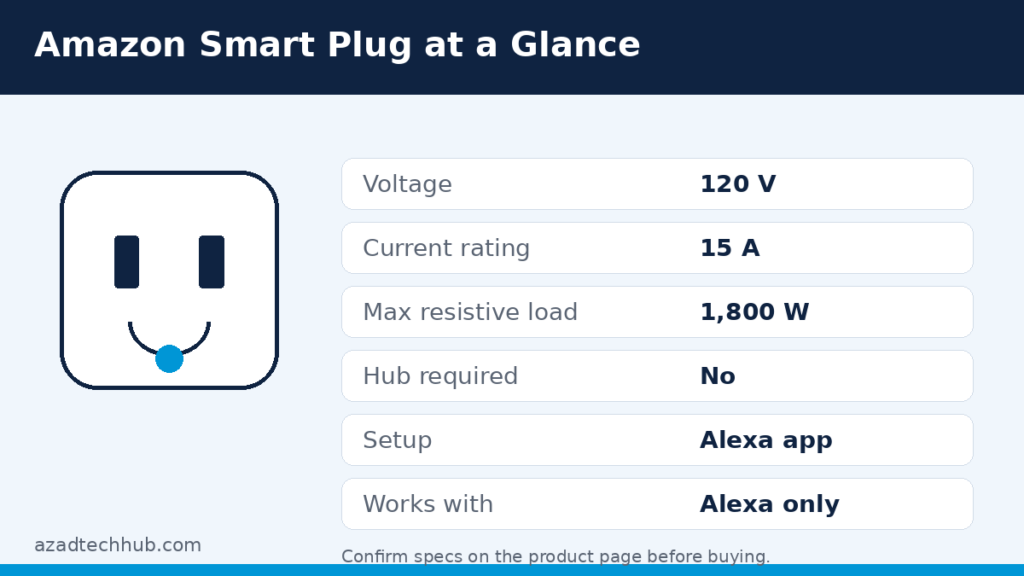
- Works with Alexa and Echo devices, no hub or bridge needed
- Setup through the Alexa app, usually in a few minutes
- Rated for 120 V, 15 A and 1,800 W resistive load (confirm on the product page before you buy)
- Voice control, schedules, routines and remote control from your phone
- Best for lamps, fans, coffee makers, holiday lights and chargers
If you want the current price and availability, check the Amazon Smart Plug on Amazon and compare it with the load you plan to control.
An Engineer’s View: Check the Load Before You Pick the Best Smart Plug That Work With Alexa
Every smart plug is a small relay in a plastic body. Its contacts and circuit board traces have a current rating, and that rating matters more than the app. In control panels I have commissioned, relay contacts sized for resistive loads wore out early when they switched motors or transformers, because inrush current can be several times the running current. A smart plug behaves the same way.
Use three simple checks:
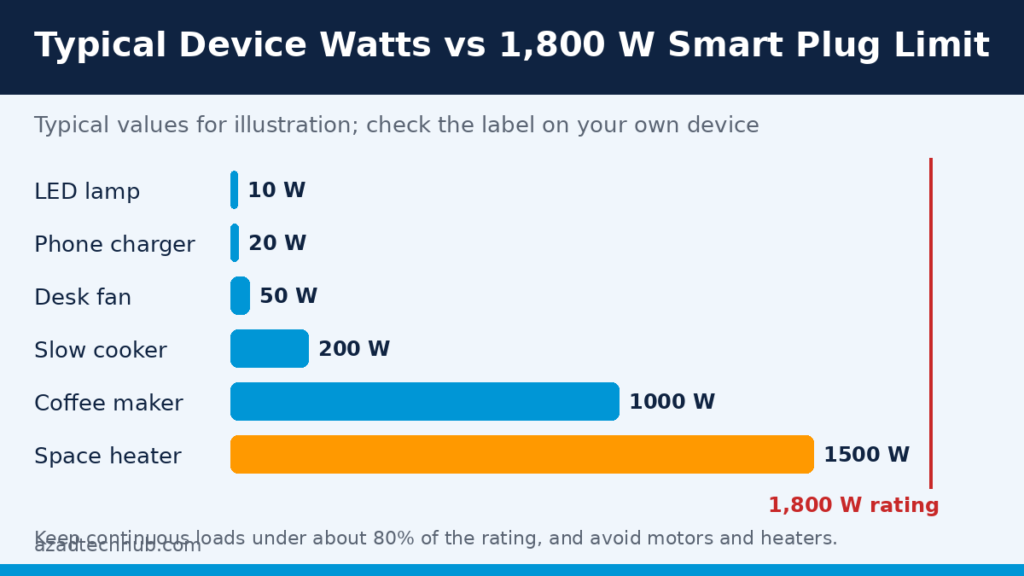
- Add up the watts of everything on the plug and stay well below 1,800 W. For anything that runs for hours, I keep the load under about 80 percent of the rating, the same continuous-load thinking used for breakers and conductors. My electrical calculators help you work out loads in other parts of your home.
- Prefer resistive or electronic loads such as lamps, LED strips, fans and chargers. Avoid compressors, pumps and large heaters.
- Never plug a power strip into a smart plug. The strip can hide a combined load that is higher than the plug can handle.
Inductive loads also carry a poor power factor, which means the apparent load is higher than the watts on the label. My guide on power factor and how to improve it explains why. If you want to understand how designers allow for loads that do not all run together, read demand factor and diversity factor.
What to Plug In and What to Leave Out
Good choices: table lamps, floor lamps, desk fans, phone and laptop chargers, Christmas lights, a slow cooker or a coffee maker with a modest heating element, and a router you want to restart remotely.
Leave these off: space heaters, window air conditioners, refrigerators, freezers, medical equipment and anything with a motor that starts under load. For high-power loads, use a properly rated hardwired control, not a plug-in device.
Before you add any smart plug to an older outlet, check that it is wired and grounded correctly. A non-contact voltage tester gives a quick live check, and the best multimeter for homeowners lets you confirm voltage properly. If you are unsure what the ground pin actually does, my guide on grounding vs bonding explains it in plain language. A full kit is covered in top 20 electrical testing tools.
How to Set Up the Best Smart Plug That Work With Alexa in Five Minutes
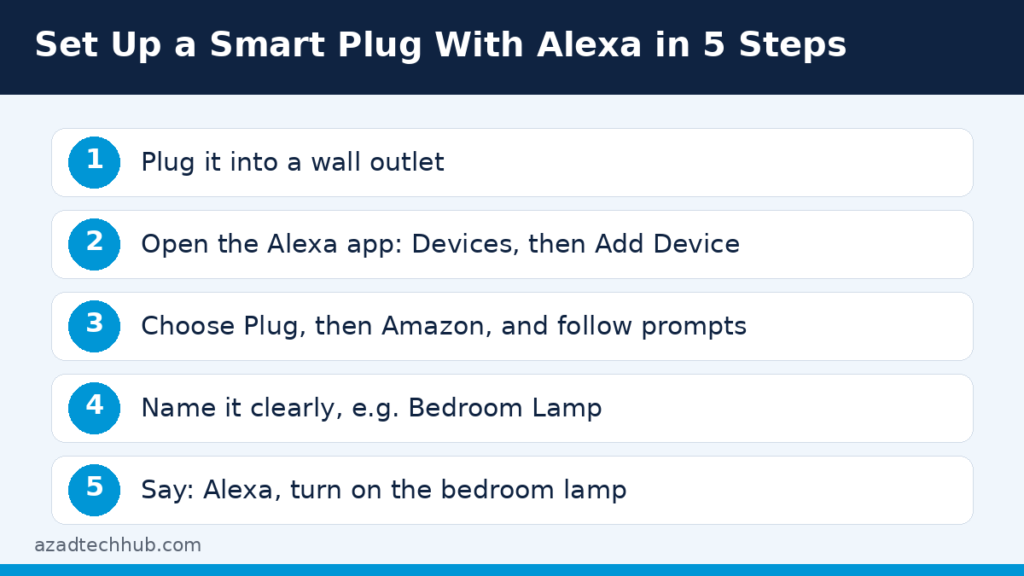
- Plug the Amazon Smart Plug into a wall outlet near your router or Echo device.
- Open the Alexa app on your phone and tap Devices, then the plus icon, then Add Device.
- Choose Plug, then Amazon, and follow the prompts. Keep Bluetooth and location on for your phone during setup.
- Name the plug clearly, for example Bedroom Lamp, so voice commands are easy.
- Plug your lamp or fan into the smart plug and say, “Alexa, turn on the bedroom lamp.”
- Build a routine for a schedule, such as lights on at sunset and off at 11 pm.
If Alexa cannot find the plug, move closer to the router, confirm your Wi-Fi band is supported, and reset the plug before trying again.
Can the Best Smart Plug That Work With Alexa Cut Your Power Bill?
Only a little, and only on the right devices. A smart plug saves money when it cuts standby power on TVs, game consoles, chargers and chargers left on all day. As an example, a device drawing 5 W in standby uses about 44 kWh per year. At 17 cents per kWh, that is roughly 7.50 dollars a year for one device. Across a media center, it adds up.
To see what your own rates mean, use my US utility bill calculators. Remember the plug itself draws a small amount of power, so do not put it on a device you use all day.
Pros and Cons of the Amazon Smart Plug
Here is how the best smart plug that work with Alexa stacks up in daily use.
Pros:
- Simple Alexa-first setup with no hub
- Voice control, routines and remote control
- Made by Amazon, so Alexa support is built in
- Good value for lamps, fans and small appliances
Cons:
- Works only with Alexa
- Not suitable for motors, heaters or high-power loads
- Designed for indoor use only
Who Should Buy It, and Who Should Skip It
Buy it if you own an Echo speaker, want voice control of lamps and small appliances, and prefer an easy, reliable setup. Skip it if you use Google Home or Apple Home, or if you need to switch a high-power load. For bigger jobs such as EV charging, use my EV charger load calculation tool and plan a dedicated circuit instead of a plug-in device.
FAQs
What is the best smart plug that work with Alexa for beginners?
The Amazon Smart Plug is my pick. It needs no hub, appears in the Alexa app right away and supports voice, schedules and routines.
Do all smart plugs work with Alexa?
No. Many do, but some need extra skills or bridges. Check Works with Alexa on the box or product page before buying.
Can I use a smart plug for a space heater?
No. Heaters draw close to the plug’s limit for long periods, which is the worst case for the contacts. Use the heater’s own thermostat and a wall outlet.
Can I use it outdoors?
The Amazon Smart Plug is made for indoor use. For outdoor lighting, pick a plug that is rated for outdoor conditions.
Final Verdict
The best smart plug that work with Alexa is the one that fits your load and your ecosystem. For Echo homes, the Amazon Smart Plug gives you simple setup, reliable voice control and good value for everyday loads like lamps, fans and chargers. Stay within the 1,800 W rating, keep motors and heaters away from it, and it will do its job quietly.
Ready to buy? See the Amazon Smart Plug on Amazon. For more recommendations from my own field experience, browse my product reviews.
Get new guides in your feed. Follow Electrical Insights on LinkedIn for new electrical standards guides, calculators and design tips from Azad Circuit Hub.