
Types of RCD: AC, A, F, B and S Explained
The different types of RCD protect electrical installations against earth leakage currents, but each type responds to different current waveforms. Choosing the correct residual current device (RCD) is important in homes, commercial buildings, industrial plants, and installations with electronic equipment.
Types of RCD include AC, A, F, B, and S. Each has a specific purpose, operating characteristic, and application. Understanding these differences helps electricians and engineers select suitable protection for lighting circuits, variable-speed drives, EV chargers, solar inverters, and other electrical loads.
Types of RCD Comparison Table
| RCD Type | Detectable Residual Current | Typical Applications | Key Feature |
|---|---|---|---|
| Type AC | Sinusoidal AC | Suitable legacy loads where permitted | Basic AC leakage protection |
| Type A | AC and pulsating DC | General circuits and electronic appliances | Handles pulsating DC leakage |
| Type F | AC, pulsating DC, and specified composite frequencies | Single-phase inverter-driven equipment | Improved response to mixed-frequency leakage |
| Type B | AC, pulsating DC, and smooth DC | Three-phase drives, some EV chargers, and PV systems | Detects smooth DC leakage |
| Type S | Depends on underlying AC or A characteristics | Selective upstream protection | Time-delayed operation |
Type S is a selective, time-delayed RCD characteristic, not a separate residual-current waveform category. Selective devices may be Type A S or Type B S, depending on their design and certification.
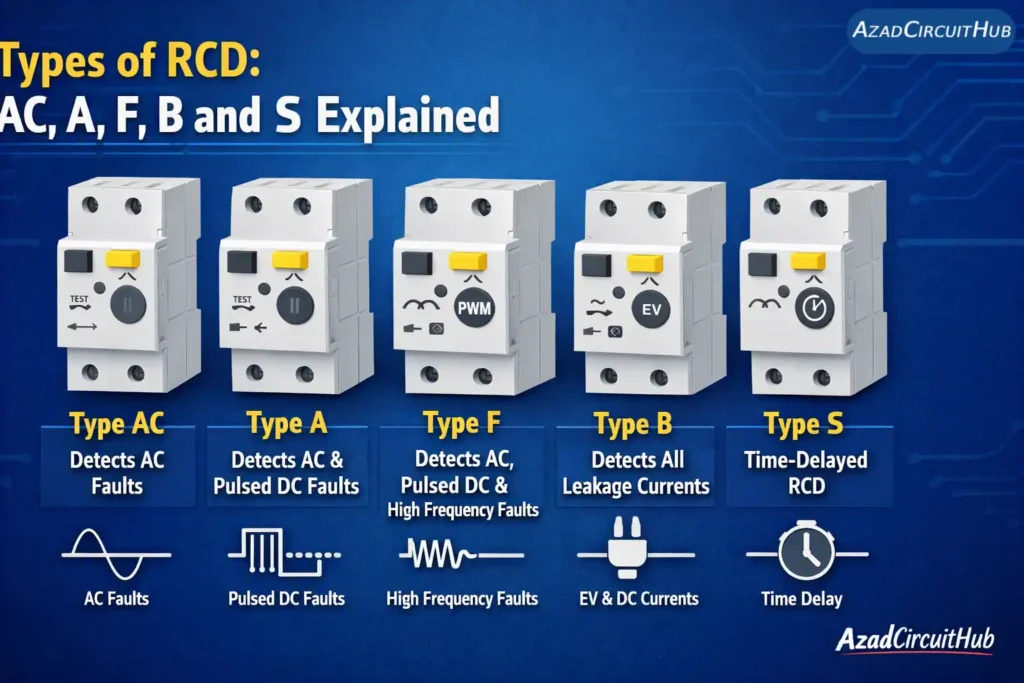
Table of Contents
Table of Contents
What Is an RCD?
A residual current device monitors the current flowing through the live conductors of a circuit. Under normal conditions, the outgoing and returning currents balance. If some current flows through an unintended path to earth, the device detects the difference and disconnects the supply when its operating conditions are met.
RCDs help reduce the risk of electric shock and electrical fires caused by earth leakage. However, they do not replace overcurrent protection unless the device also incorporates that function, as in an RCBO.
Common RCD standards include IEC 61008-1 for RCCBs and IEC 61009-1 for RCBOs. IEC 62423 covers additional requirements for Type F and Type B RCCBs and RCBOs.
Type AC RCD
Type AC RCDs detect sinusoidal alternating residual currents. They are designed for loads where leakage remains in this waveform.
Typical applications may include certain simple resistive loads and installations without equipment that produces pulsating DC leakage. However, electronic appliances can create more complex residual currents, making Type AC unsuitable for many modern circuits.
In new installations, check the applicable wiring regulations before selecting Type AC. For example, BS 7671 requirements may call for Type A or another suitable type where electronic equipment can produce pulsating DC residual current.
Type A RCD
Type A RCDs detect sinusoidal AC and pulsating DC residual currents. They are widely used for modern domestic and commercial circuits containing electronic power supplies.
Common applications include:
- Washing machines and dishwashers with electronic controls
- Computers and office equipment
- LED lighting with electronic drivers
- Single-phase electronic appliances
- Certain inverter-based equipment, where the manufacturer’s instructions permit Type A
Type A is often a practical choice for general circuits, but it does not provide universal protection against smooth DC leakage. Where equipment can produce smooth DC residual current, the required protection must be assessed carefully.
Type F RCD
Type F RCDs are designed for sinusoidal AC, pulsating DC, and specified composite residual currents with multiple frequencies. They also offer defined performance for certain residual-current conditions associated with single-phase frequency converters.
| Feature | Type A | Type F |
|---|---|---|
| Sinusoidal AC detection | Yes | Yes |
| Pulsating DC detection | Yes | Yes |
| Mixed-frequency residual currents | Limited by Type A requirements | Enhanced defined performance |
| Smooth DC detection | Not generally intended | Not generally intended |
| Common application | General electronic loads | Certain single-phase inverter-driven loads |
Type F is useful for some inverter-driven washing machines, air conditioners, and similar equipment. It is not a universal substitute for Type B. Always confirm the equipment manufacturer’s specified RCD type.
Type B RCD
Type B RCDs detect sinusoidal AC, pulsating DC, smooth DC, and specified residual currents over a wider frequency range. This makes them suitable for applications where smooth DC leakage may occur.
Typical applications include:
- Three-phase variable-frequency drives
- Certain industrial motor control systems
- EV charging equipment requiring Type B protection
- Solar photovoltaic inverter installations where specified
- Equipment with power converters capable of producing smooth DC residual currents
Not every EV charger or solar inverter requires a Type B RCD. Some equipment includes suitable built-in residual-current monitoring and may permit Type A protection when used with a compliant 6 mA DC detection system or another specified arrangement. Follow the relevant standard and manufacturer’s instructions.
Type S RCD
Type S RCDs have a time-delayed operating characteristic. This delay supports selectivity between upstream and downstream protective devices, helping the device closest to the fault disconnect first.
For example, a building may use a time-delayed upstream RCD and faster downstream RCDs on final circuits. Correct coordination depends on rated residual operating currents, time-current characteristics, and the relevant standard.
Type S does not mean the device detects smooth DC. Its waveform capability depends on whether it is designed as Type AC S, Type A S, Type B S, or another permitted configuration.
How to Choose the Correct RCD
Use the following guide as a starting point, then confirm the applicable wiring rules and equipment requirements.
| Application | Initial Selection Consideration |
|---|---|
| General household circuits | Usually Type A where required |
| Simple AC loads | Type AC only where permitted and suitable |
| Single-phase inverter-driven appliances | Type F or another manufacturer-approved type |
| Three-phase variable-speed drives | Type B or a specified alternative |
| EV charging | Follow EV charging standards and charger instructions |
| Solar PV inverter | Check inverter leakage characteristics and manufacturer requirements |
| Upstream selective protection | Suitable Type S device with coordinated downstream protection |
RCD selection is only one part of safe installation design. Earthing arrangements, fault-loop impedance, disconnection times, protective conductor sizing, and overcurrent protection must also be checked. For installations using a TN arrangement, review the requirements of the tn earthing system before finalizing the protection design.
Selection of RCD According to Circuits
Selecting the correct RCD depends on circuit type, expected leakage current, load characteristics, and required protection. Understanding the Types of RCD helps electricians choose suitable devices under IEC 61008-1, IEC 61009-1, and IEC 62423.
| Circuit / Application | Recommended RCD Type | Typical Sensitivity (IΔn) | Key Consideration |
|---|---|---|---|
| Lighting and socket circuits | Type A | 30 mA | Protects against AC and pulsating DC residual currents |
| Washing machines and dishwashers | Type A | 30 mA | Suitable for electronic controls |
| Single-phase inverter appliances | Type F or A | 30 mA | Check manufacturer leakage-current requirements |
| Variable-speed drives and EV charging | Type B, or specified alternative | 30 mA where required | Depends on smooth DC leakage and equipment design |
| EV chargers with 6 mA DC detection | Type A | 30 mA | Only where integrated DC detection is compliant |
| Fire protection / upstream distribution | Type S, where suitable | Typically 100–300 mA | Time-delayed selectivity; not a substitute for 30 mA additional protection |
RCD Rating Calculation
For a circuit carrying 32 A, select an RCD rated current In of at least 32 A, subject to coordination with the overcurrent protective device and manufacturer requirements. A common selection is 40 A, 30 mA, Type A for suitable domestic circuits.
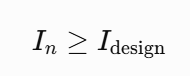
For additional protection, 30 mA is commonly used under IEC 60364-4-41. For general residual-current fire protection, 100 or 300 mA may be specified following the applicable design rules. Type selection must account for DC components, discrimination, and local wiring regulations.
Frequently Asked Questions
1. What are the main types of RCD?
The main residual-current waveform types are AC, A, F, and B. Type S refers to a selective time-delayed characteristic and may be combined with an appropriate waveform type.
2. What is the difference between Type A and Type AC RCD?
Type AC detects sinusoidal AC residual current. Type A also detects pulsating DC residual current, making it suitable for a wider range of modern electronic loads.
3. When is a Type B RCD required?
Type B may be required where equipment can produce smooth DC residual current, such as certain variable-frequency drives, EV charging systems, or solar installations. The exact requirement depends on the equipment and applicable standards.
4. Can I replace a Type AC RCD with Type A?
A Type A device may be a suitable replacement if its rated current, residual operating current, pole arrangement, and coordination are correct. Verify the installation requirements before making the change.
5. What does 30 mA mean on an RCD?
A 30 mA RCD has a rated residual operating current of 30 milliamperes. Such devices are commonly used for additional protection against electric shock, subject to the applicable wiring rules. They do not make contact with live parts safe.
Final Thoughts
Understanding the types of RCD helps engineers select protection that matches the residual currents an installation may produce. Type AC suits only appropriate sinusoidal AC applications, Type A covers pulsating DC, Type F supports specified mixed-frequency conditions, Type B handles smooth DC, and Type S provides time-delayed selectivity.
Before installation, check the manufacturer’s instructions, applicable IEC or national wiring standards, and the characteristics of the connected equipment. Also verify protective conductor sizing with an earth cable size calculator as part of the wider earthing and fault-protection design process.
Follow Us on Social:
Subscribe our Newsletter on Electrical Insights for latest updates from Azad Circuit Hub
#TypesOfRCD, #RCDTypes, #ResidualCurrentDevice, #TypeACRCD, #TypeARCD, #TypeFRCD, #TypeBRCD, #SelectiveRCD, #ElectricalProtection, #IECStandards
