
TN-C-S Earthing System: MEN (Australia) & PME (UK) Explained
The TN-C-S Earthing System is widely used in electrical distribution networks in the UK and Australia. It provides a low-impedance path for earth fault current, helping protective devices disconnect a faulty circuit quickly. In the UK, it is commonly called Protective Multiple Earthing (PME). In Australia, a related arrangement is known as Multiple Earthed Neutral (MEN).
Although both systems use an earthed supply neutral and a combined protective earth and neutral conductor in part of the distribution network, their national wiring rules and installation practices differ. Understanding these differences is essential for safe electrical design, inspection, and maintenance.
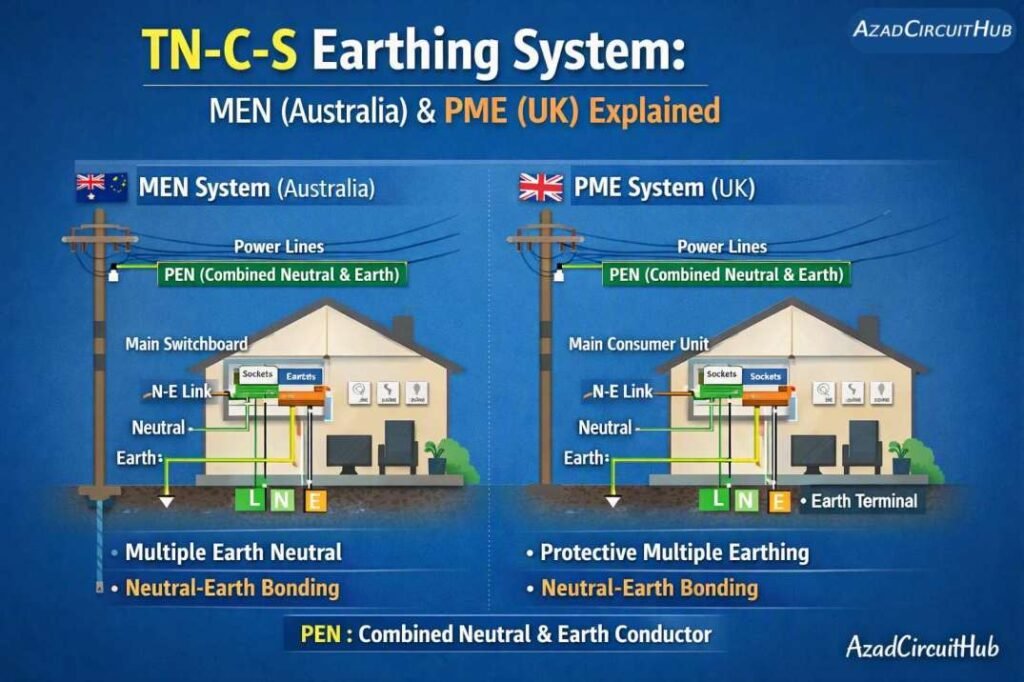
Table of Contents
Table of Contents
TN-C-S Earthing System: Quick Comparison
| Feature | UK PME | Australian MEN |
|---|---|---|
| Earthing arrangement | TN-C-S | TN-C-S-type arrangement |
| Main principle | Combined neutral and earth in part of the supply | Neutral earthed at multiple points |
| Supply conductor | PEN in the combined section | Combined neutral and earth function in the supply network |
| Consumer installation | Separate neutral and protective earth | Separate neutral and protective earth |
| Main UK standard | BS 7671 | AS/NZS 3000 in Australia |
| Earth fault protection | Overcurrent protection and RCDs where required | Overcurrent protection and RCDs where required |
| Main concern | Open PEN conductor | Broken or high-resistance neutral connection |
| Common applications | Domestic, commercial, and industrial supplies | Domestic, commercial, and industrial supplies |
The exact network arrangement depends on the local distributor and supply configuration. The terms PME and MEN are related, but they should not be treated as identical in every technical detail.
What Is a TN-C-S Earthing System?
A TN-C-S Earthing System combines the neutral and protective earth functions in part of the supply network and separates them within the consumer installation.
The designation has three parts:
- T: One point of the supply is directly connected to earth.
- N: Exposed conductive parts of the installation are connected to the earthed supply point.
- C-S: Neutral and protective earth functions are combined in one section and separated in another.
The combined conductor is called a protective earth and neutral conductor, or PEN conductor. At the service position, the protective earth and neutral connections are separated according to the applicable installation rules.
Under normal conditions, the neutral carries load current. The protective earth conductor provides a fault-current path and should not carry normal load current. Once the conductors are separated, they must not be reconnected downstream.
How PME Works in the UK
In the UK, Protective Multiple Earthing connects the supply neutral to earth at multiple points along the distribution network. The distributor provides an earthing terminal at the consumer’s intake position, subject to the supply arrangement.
If a live conductor contacts an exposed metal enclosure, fault current can return through the protective conductor and the supply’s earthing and neutral arrangement. This helps operate the fuse, circuit breaker, or other required protective device.
BS 7671 sets requirements for electrical installations, including protective conductors, automatic disconnection, and additional protection where applicable.
A key risk is a broken PEN conductor upstream. If this occurs, exposed metalwork connected to the installation’s earthing terminal can rise to a dangerous voltage. Bonded metal services may also provide an unintended path for current.
How MEN Works in Australia
The Australian MEN system uses multiple neutral-to-earth connections in the supply network and a main neutral-to-earth link at the consumer’s installation, as required by the applicable rules.
At the main switchboard, the main earthing conductor connects the installation’s earthing system to the designated MEN arrangement. Neutral and protective earth conductors are kept separate downstream of the permitted connection point.
The main requirements are covered by AS/NZS 3000, commonly known as the Australian and New Zealand Wiring Rules. Local supply authorities may also impose service requirements.
An MEN connection must be correctly located and sized. An additional neutral-to-earth link downstream of the permitted point can cause neutral current to flow through protective conductors and bonded metalwork. This can create shock risks and interfere with protective devices.
For a broader overview of the other arrangements, see our guide to the tn earthing system, which explains TN-S, TN-C, TN-C-S, TT, and IT configurations.
PME vs MEN: Key Technical Differences
| Technical point | UK PME | Australian MEN |
|---|---|---|
| Neutral earthing | Multiple points on the distribution network | Multiple earthing points in the supply arrangement |
| Consumer earth connection | Distributor-provided earthing terminal where applicable | Installation earthing system connected through the prescribed MEN arrangement |
| Neutral-earth link | Defined by the supply and installation design | Main MEN link at the designated point |
| Downstream neutral-earth links | Not permitted unless specifically designed and authorized under applicable rules | Not permitted beyond the prescribed MEN connection |
| Main governing rules | BS 7671 and distributor requirements | AS/NZS 3000 and supply authority requirements |
Both arrangements depend on a sound supply neutral, correctly sized conductors, effective bonding, and suitable fault protection. However, the installation must follow the requirements of the country and supply authority in question.
Earth Fault Protection and Bonding Requirements
A TN-C-S Earthing System must provide a reliable fault path so that protective devices can disconnect a dangerous fault within the required time.
Important checks include:
- Verify the supply earthing arrangement with the distributor.
- Confirm the main earthing conductor and protective bonding conductors are correctly sized.
- Check continuity of protective conductors and bonding connections.
- Verify fault-loop impedance where required.
- Confirm circuit breakers, fuses, and RCDs meet the applicable protection requirements.
- Inspect the main earthing terminal and permitted neutral-earth connection.
- Check for unauthorized neutral-to-earth links downstream.
The correct earth conductor size depends on the fault level, protective device, conductor material, installation conditions, and governing standard. Use an earth cable size calculator as a preliminary design aid, then verify the result against the relevant wiring rules and engineering requirements.
Advantages and Limitations
| Advantages | Limitations |
|---|---|
| Provides a low-impedance fault-current path | A broken PEN conductor can create dangerous touch voltages |
| Supports automatic disconnection of supply | Requires correct bonding and conductor connections |
| Widely used in distribution networks | Not suitable for every installation or site condition |
| Can reduce the need for a separate local earth electrode in some arrangements | Additional precautions may be required for certain outdoor and special installations |
A TN-C-S Earthing System does not remove the need for inspection, testing, or risk assessment. Special locations, generator supplies, EV charging installations, and other specific applications may require additional measures.
Frequently Asked Questions
1. Is TN-C-S the same as PME?
PME is the UK term for a distribution earthing arrangement commonly based on TN-C-S. The terms are closely related, but the exact supply arrangement must be confirmed with the distributor.
2. What does MEN mean in electrical earthing?
MEN stands for Multiple Earthed Neutral. It describes the Australian arrangement in which the supply neutral is earthed at multiple points and the installation has a prescribed main neutral-to-earth connection.
3. What happens if the PEN conductor breaks?
A broken PEN conductor can cause exposed conductive parts connected to the installation’s earthing system to rise to a dangerous voltage. This is a serious electrical safety hazard and requires urgent attention by qualified personnel.
4. Can neutral and earth be connected together in a distribution board?
They must only be connected at the point permitted by the applicable supply and installation arrangement. An unauthorized downstream link can cause current to flow through protective conductors and metalwork.
5. Does a TN-C-S system require an earth electrode?
Not every TN-C-S installation requires a local earth electrode. The requirement depends on the national rules, supply arrangement, and application. An electrode must not be treated as a substitute for a defective PEN conductor.
Conclusion
The TN-C-S Earthing System provides an effective method of earthing when correctly designed, installed, and maintained. UK PME and Australian MEN share important principles, including multiple neutral earthing points and a defined separation of neutral and protective earth functions.
The main priorities are a reliable supply neutral, correct conductor sizing, effective protective bonding, and verified fault disconnection. Always confirm the supply arrangement and follow BS 7671 in the UK or AS/NZS 3000 and local supply requirements in Australia.
Follow Us on Social:
Subscribe our Newsletter on Electrical Insights for latest updates from Azad Circuit Hub
#TNCSEarthingSystem, #MENEarthing, #PMEEarthing, #EarthingSystems, #ElectricalEarthing, #ElectricalSafety, #IEC60364, #AustralianElectricalStandards, #UKWiringRegulations, #ElectricalEngineering
