
How to Measure Refrigerator Power Consumption With a Watt Meter: Best Guide
If you want to know how much electricity your refrigerator actually uses, a plug-in watt meter is one of the easiest tools to use. Learning how to measure refrigerator power consumption with a watt meter lets you see watts, amps, voltage, kilowatt-hours, and the energy used over time instead of relying on the refrigerator’s nameplate rating.
As an electrical engineer with hands-on experience in electrical systems, control panels, troubleshooting, and energy measurements, I prefer measuring actual operating consumption. Refrigerators are a good example because the compressor cycles on and off, so a short wattage reading does not represent daily electricity use.
Best Watt Meter for Measuring Refrigerator Consumption
For this type of test, the P3 P4400 Kill A Watt Electricity Usage Monitor is a practical choice. It plugs directly into a standard outlet and provides several readings useful for appliance energy testing.
| Feature | P3 P4400 Kill A Watt |
|---|---|
| Type | Plug-in electricity usage monitor |
| Measures | Watts, amps, volts, kWh |
| Display | Large backlit display |
| Protection | Overload protection |
| Best use | Appliance energy monitoring |
| Refrigerator testing | Yes |
The P4400 is particularly useful because refrigerator consumption changes throughout the day. Instead of recording one compressor-start reading, you can monitor accumulated energy and calculate a more realistic daily or monthly electricity cost.
Check the P3 P4400 price on Amazon: P3 P4400 Kill A Watt Electricity Usage Monitor
For readers deciding between P3's popular meters, my Kill A Watt P4400 vs P4460 comparison explains the main differences and which type of user should consider each model.
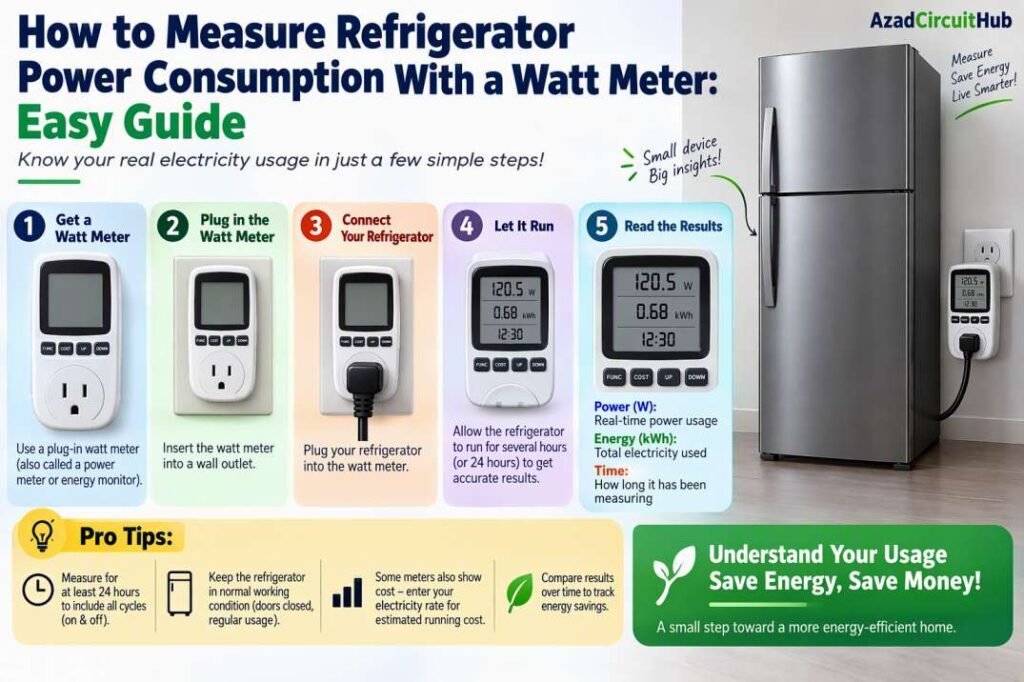
Table of Contents
Table of Contents
How to Measure Refrigerator Power Consumption With a Watt Meter
The process is straightforward. First, plug the watt meter into the wall outlet that normally supplies the refrigerator. Then plug the refrigerator into the meter.
Make sure the refrigerator is operating normally before recording measurements.
The meter can show instantaneous power in watts, voltage, and current in amps. More importantly, it can accumulate energy consumption in kilowatt-hours.
Follow these steps:
- Plug the watt meter into the wall outlet.
- Plug the refrigerator into the watt meter.
- Confirm the voltage reading is reasonable.
- Reset the accumulated kWh reading if required.
- Allow the refrigerator to operate normally.
- Record the kWh reading after 24 hours or several days.
- Use the accumulated energy to estimate daily and monthly consumption.
Do not open or modify the refrigerator's electrical wiring. The measurement should be made at the plug.
Why One Watt Reading Is Not Enough
A refrigerator does not normally consume the same amount of power all day. The compressor starts when cooling is required and shuts down after reaching the required temperature.
During compressor operation, power may rise significantly. When the compressor is off, the refrigerator may use much less electricity for controls, lighting, fans, or other functions.
This makes accumulated kWh more useful than simply looking at the instantaneous watt display.
For example, if a refrigerator temporarily shows 120W while the compressor is running, that does not mean it consumes 120W continuously for 24 hours.
How to Calculate Refrigerator Electricity Usage
Once the watt meter has recorded energy consumption, you can calculate the average daily and monthly usage.
If the refrigerator consumes 2.0 kWh during a 24-hour test:
| Measurement | Example |
|---|---|
| 24-hour energy | 2.0 kWh |
| Average daily use | 2.0 kWh |
| Estimated 30-day use | 60 kWh |
| Electricity rate | $0.20/kWh |
| Estimated monthly cost | $12 |
Your actual electricity cost depends on your utility tariff, taxes, fixed charges, and rate structure.
A longer test is often better because refrigerator cycling varies with room temperature, door openings, food load, and thermostat settings.
What Readings Should You Check?
A good watt meter can provide several useful measurements.
- Voltage: confirms the supply voltage.
- Amps: shows current drawn by the refrigerator.
- Watts: shows instantaneous power.
- kWh: measures accumulated energy consumption.
- Time: helps determine the test period.
For refrigerator energy monitoring, kWh is usually the most important number because it represents actual electrical energy consumed.
If you are comparing P3 meters, check my Kill A Watt P4400 vs P4460 guide before selecting a model.
Tips for Getting an Accurate Refrigerator Test
For a useful result, keep the refrigerator in normal operating conditions. Do not repeatedly open the doors simply to observe the compressor.
A 24-hour test provides a useful starting point, but a three-to-seven-day test can provide a better average.
Also consider seasonal conditions. A refrigerator may consume more energy during hot weather because the compressor has to remove more heat.
Other factors include:
- Ambient room temperature
- Refrigerator age
- Door-opening frequency
- Temperature setting
- Frost buildup
- Door gasket condition
- Condenser cleanliness
- Compressor condition
- Refrigerator size
The watt meter helps identify actual energy consumption, but it cannot by itself determine whether high usage is caused by a mechanical or refrigeration fault.
Frequently Asked Questions
Can I use a watt meter on a refrigerator?
Yes. A suitable plug-in electricity usage monitor can measure refrigerator voltage, current, instantaneous wattage, and accumulated energy consumption when used within its electrical rating.
How long should I leave a watt meter on a refrigerator?
A 24-hour test is a useful minimum. For a more representative result, measuring for several days can reduce the effect of compressor cycling and changes in usage.
How do I calculate refrigerator kWh from a watt meter?
Use the accumulated kWh displayed by the meter. If your meter only provides watts, you would need to account for compressor cycling and operating time, which makes direct estimation less accurate.
Why does my refrigerator wattage keep changing?
The compressor cycles on and off. Fans, controls, defrost functions, and other components can also change the refrigerator's instantaneous power consumption.
Is the P3 P4400 good for measuring appliance energy use?
The P3 P4400 is designed for plug-in electricity monitoring and provides voltage, current, wattage, and accumulated kWh readings. It is useful for testing household appliances such as refrigerators.
Final Verdict
The easiest way to understand refrigerator electricity consumption is to measure energy over time rather than relying on a single wattage reading. A plug-in meter such as the P3 P4400 makes this process simple because you can monitor watts, amps, voltage, and accumulated kWh without accessing the refrigerator's internal wiring.
For the most useful result, measure the refrigerator for at least 24 hours under normal conditions. A longer test gives an even better picture of average energy consumption.
Check the P3 P4400 Kill A Watt price on Amazon: P3 P4400 Kill A Watt Electricity Usage Monitor
Follow Us on Social:
Subscribe our Newsletter on Electrical Insights for latest updates from Azad Circuit Hub
#RefrigeratorPowerConsumption, #WattMeter, #EnergyConsumption, #ElectricityUsage, #RefrigeratorEnergy, #PowerMeter, #EnergyMonitoring, #ElectricityCost, #HomeEnergy, #EnergySaving
