
Kill A Watt Alternative for 240V Appliances: SURAIELEC Watt Meter Good Choice?
Finding a reliable kill a watt alternative for 240v appliances can be difficult because many popular plug-in electricity meters are designed around 120V North American outlets. If you need to measure voltage, current, watts, and energy consumption on a higher-voltage appliance, a meter with a wider input range is a better choice.
As an electrical engineer with practical experience in electrical panels, industrial equipment, troubleshooting, and energy monitoring, I look at more than the display. Voltage range, current measurement, overload protection, kWh tracking, and outlet compatibility all matter when selecting a plug-in power meter.
Kill A Watt Alternative for 240V Appliances
| Feature | SURAIELEC Watt Meter |
|---|---|
| Voltage range | 90–250V |
| Measures | Voltage, current, watts, kWh |
| Display | Large backlit LCD |
| Energy measurement | kWh |
| Protection | Overload protection |
| Application | 120V–240V equipment within rated limits |
| Best use | Appliance energy monitoring |
The wide 90–250V input range makes the SURAIELEC meter particularly interesting for users looking beyond standard 120V appliance monitoring.
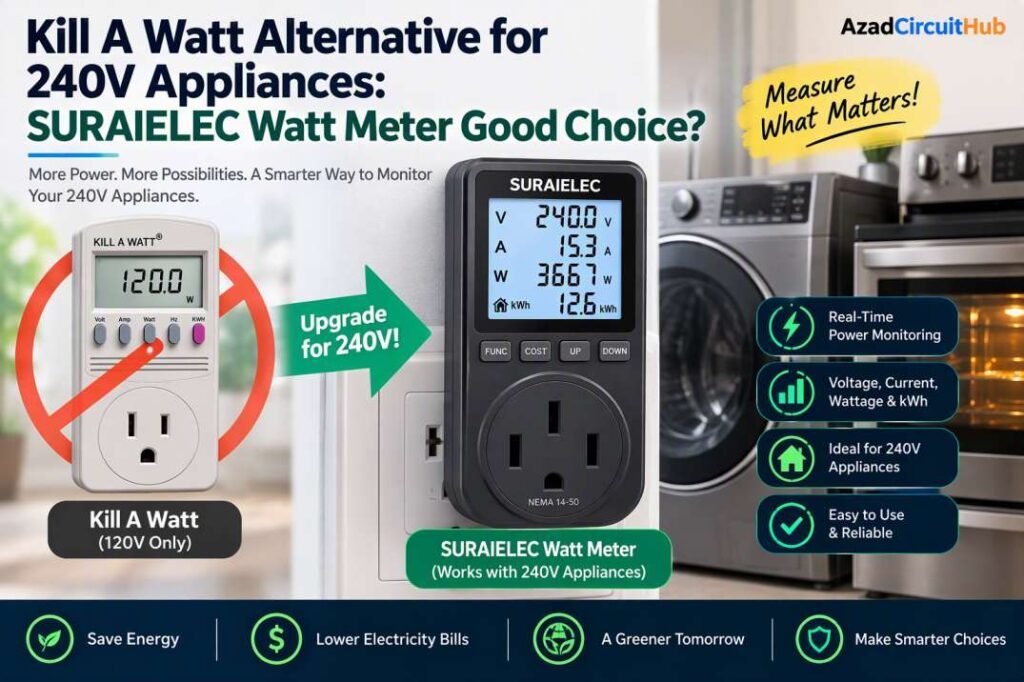
Table of Contents
Table of Contents
Why You Need a 240V Power Meter
A standard plug-in energy monitor may not be suitable for a 240V appliance. Using equipment outside its specified voltage range can create inaccurate readings and, more importantly, a safety concern.
A suitable electricity usage monitor should clearly state its operating voltage range. It should also provide useful measurements such as volts, amps, watts, and accumulated kilowatt-hours.
For appliances such as heaters, workshop equipment, pumps, and other higher-voltage loads, monitoring actual consumption can help identify operating costs and unexpected energy use.
SURAIELEC Outlet Watt Meter Review
The SURAIELEC Outlet Watt Meter is the featured product in this comparison because its stated 90–250V range covers a much wider voltage span than many basic plug-in power meters.
It measures voltage, amperage, wattage, and accumulated kWh, making it useful for both quick electrical checks and longer-term energy monitoring.
The large backlit display is another practical feature. When testing equipment in a workshop, utility room, or electrical area, being able to read the display clearly is useful.
Check the SURAIELEC Watt Meter on Amazon: SURAIELEC Outlet Watt Meter
What Can You Measure?
A useful appliance electricity monitor should provide several measurements rather than only displaying instantaneous watts.
| Measurement | Why It Matters |
|---|---|
| Voltage | Shows supply voltage |
| Amps | Indicates load current |
| Watts | Shows instantaneous power |
| kWh | Tracks accumulated energy |
| Cost | Helps estimate operating expense |
The kWh reading is particularly useful when you want to compare actual energy consumption over several hours or days.
For example, a 2,000W load operating continuously for one hour would theoretically consume about 2 kWh, although real equipment may cycle on and off.
Is It Suitable for Every 240V Appliance?
Not necessarily. Voltage compatibility is only one part of the specification.
Before using any plug-in watt meter, check the meter's maximum current, plug and receptacle configuration, and the appliance's electrical rating. Some high-power 240V appliances draw considerably more current than a small plug-in meter can safely handle.
Do not use a plug-in energy meter as a substitute for properly rated electrical test equipment on circuits that exceed its specifications.
As an electrical engineer, I would also avoid using a plug-in monitor on permanently wired equipment unless the device is specifically designed and approved for that application.
When a Plug-In Energy Monitor Makes Sense
A plug-in watt meter is most useful when the appliance connects through a compatible receptacle and its electrical load falls within the meter's ratings.
Typical applications include:
- Workshop equipment
- Space heaters
- Pumps
- Portable HVAC equipment
- Battery chargers
- Office equipment
- Laboratory equipment
- Selected 240V appliances
The meter can help answer a simple question: how much electricity is this equipment actually using?
If you are comparing dedicated Kill A Watt models and their capabilities, my Kill A Watt P4400 vs P4460 comparison is a useful next step.
How to Measure Appliance Energy Consumption
Using the SURAIELEC meter is straightforward when the appliance and receptacle are compatible.
- Confirm the voltage and current ratings.
- Plug the meter into the appropriate outlet.
- Connect the appliance through the meter.
- Check the voltage and current reading.
- Record the instantaneous wattage.
- Leave the appliance connected for longer-term kWh measurement.
- Compare consumption during different operating conditions.
For appliances with thermostats or variable loads, longer measurement periods provide a more useful picture than a quick wattage reading.
Frequently Asked Questions
Can a Kill A Watt meter measure 240V appliances?
The original Kill A Watt P4400 is primarily associated with standard 120V North American applications. For 240V equipment, always verify the exact model's voltage and current specifications before connecting it.
What is a good alternative to Kill A Watt for 240V?
The SURAIELEC Outlet Watt Meter is an option to consider because its stated 90–250V operating range covers 240V applications within its rated limits. Always verify the appliance connection and maximum current before use.
Can a watt meter measure kWh?
Yes. The SURAIELEC meter listed here provides accumulated kilowatt-hour measurement, allowing you to monitor energy consumption over time.
Does a power meter measure amps and watts?
The SURAIELEC model measures voltage, amperage, wattage, and kWh. These readings can help you understand both instantaneous electrical load and longer-term energy consumption.
Is a plug-in watt meter safe for high-power appliances?
Only when the meter is specifically rated for the appliance's voltage, current, plug configuration, and load. Never exceed the manufacturer's electrical ratings.
Final Verdict
For users searching for a kill a watt alternative for 240v appliances, the SURAIELEC Outlet Watt Meter is worth considering because its stated 90–250V range provides flexibility for higher-voltage applications.
Its combination of voltage, current, wattage, and kWh measurements makes it useful for appliance energy monitoring and electricity cost analysis. The large backlit display and overload protection add practical value.
However, always check the maximum current and connection requirements before using any plug-in electricity monitor. A 240V appliance can represent a significant electrical load, so the meter must be correctly rated for the application.
Check the latest SURAIELEC Watt Meter price on Amazon: SURAIELEC Outlet Watt Meter
Follow Us on Social:
Subscribe our Newsletter on Electrical Insights for latest updates from Azad Circuit Hub
#KillAWattAlternative, #240VWattMeter, #SURAIELEC, #WattMeter, #PowerMeter, #EnergyMonitor, #ElectricityUsage, #240VAppliances, #EnergyMeter, #ElectricalTesting
