
Autel MaxiCharger vs ChargePoint Home Flex: Which Level 2 EV Charger Is Better?
Choosing a home EV charger is not only about finding the highest amperage. The electrical installation, vehicle charging limit, cable length, smart controls, weather rating, and daily driving pattern all affect which charger makes more sense.
In this autel maxicharger vs chargepoint home flex comparison, I am looking at two popular 50A-class Level 2 EV chargers: the Autel MaxiCharger and ChargePoint Home Flex. Both support J1772 vehicles and offer smart charging features, but they take slightly different approaches to the home charging experience.
As an electrical engineer with more than 15 years of field experience in electrical panels, industrial automation, power systems, and troubleshooting, I pay close attention to the installation side of EV chargers. A 50A EVSE is a continuous electrical load, so the charger should always be matched with the branch circuit, breaker, conductors, and available service capacity.
Autel MaxiCharger vs ChargePoint Home Flex at a Glance
| Feature | Autel MaxiCharger | ChargePoint Home Flex |
|---|---|---|
| Charger type | Level 2 EVSE | Level 2 EVSE |
| Maximum current | Up to 50A | Up to 50A |
| Voltage | 240V | 240V |
| Connector | J1772 | J1772 |
| Installation | Hardwired | Hardwired |
| Cable length | 25 ft | 23 ft |
| Smart connectivity | Wi-Fi + Bluetooth | Wi-Fi |
| Indoor/Outdoor | Yes | Yes |
| App control | Yes | Yes |
| Best for | Feature-rich home charging | Established smart charging ecosystem |
For drivers still comparing other residential charging stations, my guide to the best level 2 ev charger options covers different amperage ratings, connector types, and installation styles.
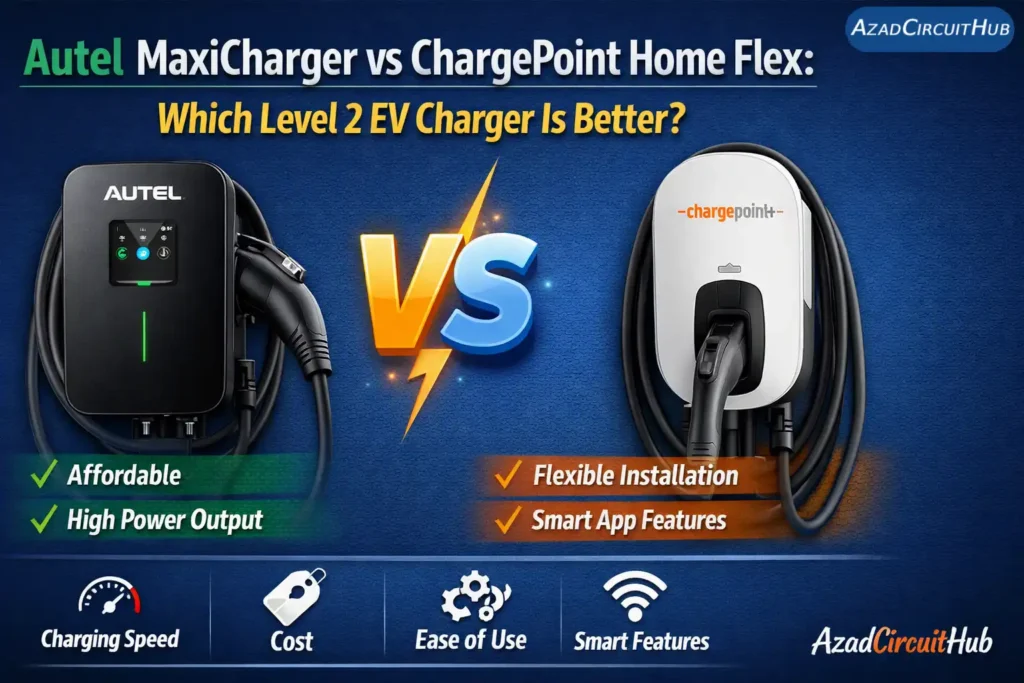
Table of Contents
Table of Contents
Autel MaxiCharger 50A Review
The Autel MaxiCharger featured here is a 50A, 240V hardwired Level 2 EV charger with a J1772 connector. One of its strongest practical features is the 25-foot charging cable.
That extra cable length can matter more than it looks on paper. Depending on where the electrical panel and parking space are located, a longer EV charging cable can make everyday charging much easier.
The charger also supports Wi-Fi and Bluetooth connectivity. This allows users to interact with the charger through smart features rather than treating it as a basic plug-and-charge EVSE.
For buyers who want a high-current home charger with smart connectivity and a long cable, the Autel is an interesting option.
Buy the Autel MaxiCharger on Amazon: Autel MaxiCharger 50A Level 2 EV Charger
For a deeper look at this model, see my autel maxicharger home review covering its features, charging capability, and home installation considerations.
ChargePoint Home Flex 50A Review
ChargePoint Home Flex is one of the better-known smart home EV chargers. The model listed here supports adjustable charging from 16A to 50A and uses a J1772 connector.
Its adjustable current is useful when the home's electrical capacity or vehicle charging requirements do not justify running the charger at its maximum setting.
The Home Flex also provides Wi-Fi connectivity and app-based control. ChargePoint's established charging network and software ecosystem are additional advantages for drivers who already use ChargePoint services.
The supplied cable is 23 feet long, which is sufficient for many residential garages and driveways.
Buy the ChargePoint Home Flex on Amazon: ChargePoint Home Flex 50A Level 2 EV Charger
If you want a model-specific breakdown, my chargepoint home flex review covers its charging performance, smart features, installation, and practical ownership considerations.
Charging Speed Comparison
Both chargers can operate at up to 50A when installed correctly and when the vehicle can accept that charging rate.
At 240V:
| Current | Approx. Charging Power |
|---|---|
| 16A | 3.8 kW |
| 24A | 5.8 kW |
| 32A | 7.7 kW |
| 40A | 9.6 kW |
| 48A | 11.5 kW |
| 50A | 12.0 kW |
Actual charging speed depends on the EV's onboard AC charger. If your vehicle is limited to 32A or 40A AC charging, moving to a 50A EVSE will not automatically make it charge at 50A.
The benefit of a higher-rated EVSE is often more noticeable with vehicles capable of accepting higher AC power.
Cable Length: Autel Has an Advantage
Cable length is an easy specification to overlook when comparing home EV chargers.
The Autel model in this comparison includes a 25-foot cable, while the ChargePoint Home Flex listed here has a 23-foot cable.
That two-foot difference may not matter in a compact garage, but it can be useful when the parking position is farther from the charger.
A longer cable can reduce the need to park precisely beside the charging station. It can also make driveway charging more convenient.
For installations where the charger is mounted near the front of a garage and the vehicle's charging port is at the opposite end, cable reach should be part of the buying decision.
Smart EV Charging Features
Both products move beyond basic Level 2 charging by offering connected features.
The Autel MaxiCharger supports Wi-Fi and Bluetooth. ChargePoint Home Flex uses Wi-Fi connectivity and integrates with the ChargePoint ecosystem.
Smart charging can provide useful functions such as monitoring charging activity, checking charging status, and managing charging sessions.
However, smart features should not be the only buying factor. A reliable electrical installation and correct charger configuration matter more to daily operation than having the largest list of app features.
Installation and Electrical Requirements
Both chargers in this comparison are hardwired models. This means the installation should be planned as a permanent electrical circuit rather than simply adding a receptacle.
A 50A charging setting can represent approximately 12 kW at 240V. Because EV charging is a continuous load, the circuit must be designed according to applicable electrical requirements.
Before installation, check:
- Electrical service capacity
- Available breaker space
- Branch-circuit rating
- Conductor size
- Grounding requirements
- Charger mounting location
- Indoor or outdoor exposure
- Vehicle charging capacity
- Local electrical code
I would not recommend selecting a 50A charger first and asking an electrician to make the electrical system fit afterward. The home's available capacity should be checked before purchasing the equipment.
Which One Is Better for Outdoor Installation?
Both listed chargers are designed for indoor and outdoor use. Still, the mounting location deserves attention.
Outdoor installations should protect the EVSE from unnecessary physical damage and allow enough clearance around the unit. The charging cable should also be routed so it does not become a trip hazard or sit where vehicles can run over it.
If your charger will be mounted outdoors, consider cable management, weather exposure, sunlight, drainage, and the distance from the electrical panel.
Autel MaxiCharger vs ChargePoint Home Flex: Which Should You Buy?
The better option depends on what you value most.
| If You Prioritize | Better Fit |
|---|---|
| Longer charging cable | Autel MaxiCharger |
| Wi-Fi + Bluetooth | Autel MaxiCharger |
| Adjustable 16–50A charging | ChargePoint Home Flex |
| ChargePoint ecosystem | ChargePoint Home Flex |
| 50A maximum charging | Both |
| J1772 compatibility | Both |
| Permanent installation | Both |
| Outdoor use | Both |
The Autel is particularly attractive if you want a 25-foot cable and both Wi-Fi and Bluetooth connectivity.
ChargePoint is compelling if you prefer its established app and charging ecosystem and want adjustable current settings from 16A to 50A.
For a wider selection of residential EVSE products, compare both models with my best level 2 ev charger guide before making a purchase.
Final Verdict
The key takeaway from this autel maxicharger vs chargepoint home flex comparison is that neither charger is universally better.
The Autel MaxiCharger stands out with its 25-foot cable, Wi-Fi and Bluetooth connectivity, and 50A charging capability. It is a strong option for homeowners who want flexible cable reach and a feature-rich connected EVSE.
The ChargePoint Home Flex is an excellent alternative for drivers who value adjustable charging current and the ChargePoint smart charging ecosystem. Its 16–50A range can also make it easier to configure around different electrical and vehicle requirements.
For either model, have the electrical circuit evaluated before installation. A well-sized 40A or 48A charging setup can be more practical than a 50A charger if the home's service capacity is limited.
Frequently Asked Questions
Is Autel better than ChargePoint Home Flex?
Neither is automatically better. Autel offers a longer 25-foot cable and Wi-Fi plus Bluetooth connectivity, while ChargePoint Home Flex offers adjustable 16–50A charging and integration with the ChargePoint ecosystem.
Can both chargers provide 50A charging?
Yes. The Autel and ChargePoint models compared here support up to 50A when properly installed and when the vehicle supports the available charging power.
Which has the longer cable?
The Autel MaxiCharger listed here has a 25-foot cable, compared with the 23-foot cable supplied with the ChargePoint Home Flex model.
Are these chargers suitable for outdoor installation?
Both listed models are designed for indoor and outdoor use. Proper mounting, electrical protection, cable management, and installation according to local requirements are still important.
Does a 50A charger charge every EV at 50A?
No. The EV's onboard AC charging capability controls how much power the vehicle can actually accept. A higher-rated EVSE does not override the vehicle's charging limit.
Follow Us on Social:
Subscribe our Newsletter on Electrical Insights for latest updates from Azad Circuit Hub
#AutelMaxiCharger, #ChargePointHomeFlex, #AutelVsChargePoint, #EVChargerComparison, #Level2EVCharger, #EVChargerReview, #HomeEVCharging, #SmartEVCharger, #EVCharging, #ElectricVehicle
