
Fluke 117 vs 115 Multimeter: Key Differences, Features & Which One to Buy
The Fluke 117 and Fluke 115 are both popular true-RMS digital multimeters, but they are designed with different users and working conditions in mind. The biggest difference is that the Fluke 117 adds features aimed at electricians, including non-contact voltage detection and LoZ ghost-voltage protection.
In this Fluke 117 vs 115 comparison, I will explain the practical differences rather than simply comparing specifications. I have a background in electrical engineering with more than 15 years of field experience in electrical panels, industrial automation, PLCs, SCADA systems, and troubleshooting. From that perspective, a multimeter needs to be judged by how useful it is during real electrical work, not just by the number of functions printed on the box.
Fluke 117 vs 115: Quick Comparison
| Feature | Fluke 117 | Fluke 115 |
|---|---|---|
| Best for | Electricians and electrical troubleshooting | General electrical and electronics work |
| AC/DC voltage | Yes | Yes |
| True RMS | Yes | Yes |
| Current measurement | Up to 10A | Up to 10A |
| Resistance | Yes | Yes |
| Continuity | Yes | Yes |
| Frequency | Yes | Yes |
| Capacitance | Yes | Yes |
| Non-contact voltage detection | Yes | No |
| LoZ low-impedance mode | Yes | No |
| Min/Max/Average | Yes | Yes |
| Auto-ranging | Yes | Yes |
| Display | 6,000 counts | 6,000 counts |
| Typical advantage | More electrician-focused features | Simpler, compact general-purpose meter |
If your work involves troubleshooting energized circuits, control panels, receptacles, switches, motors, or building wiring, the additional functions of the 117 can be valuable.
For a wider comparison of professional meters, see my guide to the best multimeter for electricians before deciding which model fits your toolbox.
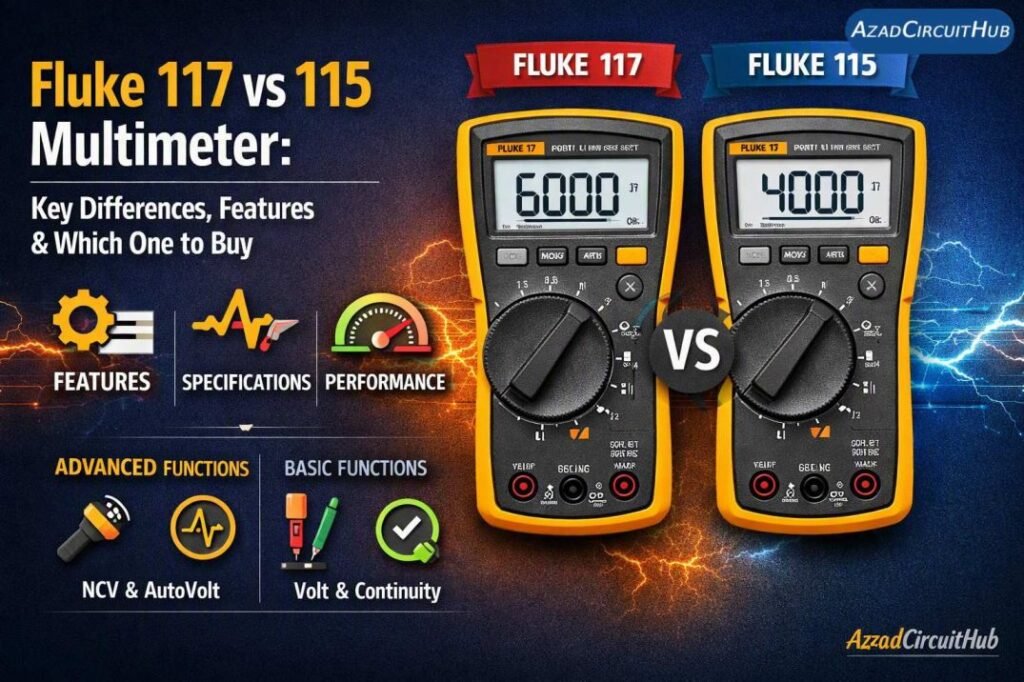
Table of Contents
Table of Contents
Fluke 117 vs 115: Main Difference
The most important difference between these two meters is the Fluke 117's combination of VoltAlert non-contact voltage detection and LoZ mode.
VoltAlert allows an electrician to check for the presence of AC voltage without immediately making direct electrical contact with the conductor. It is useful for initial checks, although it should never replace proper contact testing when confirming whether a circuit is safe.
The LoZ function is equally useful in troubleshooting. It reduces the chance of misleading voltage readings caused by ghost voltage or capacitive coupling. This can be particularly helpful when working around multiple energized conductors in panels, conduit, and control circuits.
The Fluke 115 does not include these electrician-focused features.
Fluke 117 Features for Electrical Troubleshooting
The Fluke 117 is designed around common electrical maintenance tasks. It measures AC and DC voltage, resistance, continuity, frequency, and capacitance, while also providing Min/Max/Average recording.
Its true-RMS measurement capability is important when measuring non-linear loads. Modern electrical systems can contain variable-frequency drives, switching power supplies, LED drivers, computers, and other electronic equipment that may produce distorted waveforms.
The meter also uses automatic ranging, which makes everyday measurements faster. The large display and ergonomic design are useful when working inside electrical panels or carrying out repetitive service calls.
Another feature worth considering is its low-input-impedance voltage mode. It can help distinguish actual energized voltage from readings caused by coupled or induced voltage.
Fluke 115 Features and Applications
The Fluke 115 is a straightforward true-RMS digital multimeter aimed at general electrical and electronic troubleshooting.
It measures AC/DC voltage, current, resistance, continuity, frequency, and capacitance. Its 6,000-count display provides enough resolution for most routine electrical maintenance work.
The 115 is especially attractive when you do not need non-contact voltage detection or LoZ measurements. It can be used for residential electrical work, equipment maintenance, electronics service, control circuits, and general troubleshooting.
For someone who already owns a separate voltage tester and wants a reliable true-RMS multimeter, the 115 can be a sensible choice.
You can also read my detailed fluke 115 multimeter review if you want a closer look at its operation, specifications, and practical applications.
Which Meter Is Better for Electricians?
For professional electricians, I generally favor the Fluke 117.
The reason is not simply its additional functions. The combination of non-contact voltage detection and LoZ mode can save time during troubleshooting. When working through a panel or electrical system, reducing unnecessary steps can make a noticeable difference.
For example, ghost voltage can sometimes appear on a disconnected circuit because of capacitive coupling with nearby energized conductors. A conventional high-impedance meter can display a voltage that looks concerning even though the circuit cannot deliver meaningful current. LoZ measurement helps reduce this type of confusing reading.
That does not make the Fluke 115 a poor meter. It simply means the 117 is better equipped for electrical field work.
If most of your work involves residential wiring, commercial maintenance, or service calls, compare the 117 with other options in my best multimeter for electricians guide.
Fluke 117 vs 115 for HVAC Technicians
HVAC technicians often need to measure voltage, resistance, continuity, capacitance, and other electrical parameters during equipment troubleshooting.
The Fluke 117 can be particularly useful because HVAC systems frequently involve motors, contactors, relays, control transformers, capacitors, and long conductor runs where unexpected voltage readings can occur.
Its capacitance function is useful when checking motor-run and motor-start capacitors, although the capacitor must be safely isolated and discharged according to proper procedures before testing.
For technicians who regularly troubleshoot HVAC electrical circuits, the additional functionality makes the 117 a strong option.
For this specific application, see Fluke 117 for HVAC Technicians for a focused guide to using the meter around HVAC equipment.
Fluke 117 vs 115: Which One Should You Buy?
The buying decision becomes fairly simple when you consider your work.
| If You Need... | Better Choice |
|---|---|
| Non-contact AC voltage detection | Fluke 117 |
| LoZ ghost-voltage troubleshooting | Fluke 117 |
| Electrical service work | Fluke 117 |
| HVAC troubleshooting | Fluke 117 |
| General electrical testing | Either |
| Basic electronics troubleshooting | Fluke 115 |
| A simpler professional meter | Fluke 115 |
| Maximum electrician-focused functionality | Fluke 117 |
If you are buying your first professional multimeter and expect to work on electrical installations, panels, motors, HVAC equipment, or industrial systems, I would choose the 117.
Buy the Fluke 117 on Amazon
The Fluke 117 is the better choice if you want one professional meter that combines true-RMS measurement with electrician-focused features.
Check the Fluke 117 on Amazon for current price and availability
If your requirements are more basic, the Fluke 115 remains a capable alternative. However, the additional features of the 117 provide more flexibility for field troubleshooting.
Safety Features and Practical Considerations
A professional multimeter should not be selected on measurement functions alone. CAT safety ratings, test leads, fuse protection, build quality, and correct measurement procedures are equally important.
Always select the correct measurement function and range before connecting test leads. Never measure resistance or capacitance on an energized circuit. When checking current, make sure the leads are connected to the correct input terminal and that the meter is configured appropriately.
The Fluke 117's non-contact voltage detector should also be treated as a preliminary detection tool. For proving a circuit dead, use an appropriate contact measurement procedure and follow the applicable electrical safety rules.
Why True RMS Matters
True-RMS measurement is one reason both the Fluke 117 and 115 are more useful than many inexpensive basic multimeters.
A simple average-responding meter can produce inaccurate readings when the waveform is not a clean sine wave. True-RMS instruments are better suited to modern electrical environments containing electronic loads.
This matters when testing variable-speed drives, electronic power supplies, LED systems, UPS equipment, and other nonlinear loads.
For general maintenance, the difference may not always be obvious. During industrial troubleshooting, however, accurate measurement can make diagnosing a problem much easier.
Frequently Asked Questions
Is the Fluke 117 better than the Fluke 115?
For electricians, the Fluke 117 is generally the better choice because it adds non-contact voltage detection and LoZ functionality. The Fluke 115 remains a strong option for general electrical and electronics troubleshooting.
What is the main difference between Fluke 117 and 115?
The main practical difference is the Fluke 117's VoltAlert non-contact voltage detection and low-impedance voltage mode. These features are particularly useful for electricians troubleshooting electrical circuits.
Is Fluke 115 good for electricians?
Yes. The Fluke 115 is capable of measuring the core electrical parameters needed for many jobs. However, electricians who frequently encounter ghost voltage or want non-contact voltage detection may find the 117 more useful.
Is Fluke 117 good for HVAC?
Yes. The 117 is well suited to HVAC electrical troubleshooting because it measures voltage, current, resistance, continuity, frequency, and capacitance. Its LoZ function can also help with confusing voltage readings.
Which Fluke multimeter should I buy for professional electrical work?
For many electricians, the Fluke 117 is a strong all-around choice. It combines true-RMS measurement with features specifically useful for electrical troubleshooting. Your exact choice should still depend on the CAT rating, measurement requirements, current ranges, and type of work you perform.
Final Verdict
The Fluke 117 wins this comparison for most professional electricians because it adds useful field-troubleshooting features without becoming complicated to operate.
The Fluke 115 is still an excellent professional multimeter when you want dependable true-RMS measurements without the additional electrician-oriented functions.
For panel work, electrical maintenance, HVAC troubleshooting, and general service calls, I would spend the extra money on the 117 if the price difference is reasonable. Its LoZ function and non-contact voltage detection can be genuinely useful in day-to-day troubleshooting.
Check the Fluke 117 on Amazon before buying if you want the more versatile electrician-focused option.
For readers comparing several professional meters, my best multimeter for electricians guide provides a broader selection based on electrical testing requirements and field applications.
Follow Us on Social:
Subscribe our Newsletter on Electrical Insights for latest updates from Azad Circuit Hub
#Fluke117, #Fluke115, #Fluke117vs115, #FlukeMultimeter, #MultimeterComparison, #DigitalMultimeter, #ElectricianTools, #ElectricalTesting, #FlukeTools, #Multimeter
