
Underground Pull Box Sizing: Requirements & Best Practices
Underground pull box sizing is an important part of designing safe and code-compliant electrical raceway systems. While many electricians focus on conduit size and conductor fill, the dimensions of the pull box directly affect cable pulling tension, installation efficiency, and future maintenance.
The National Electrical Code (NEC) applies the same pull box sizing rules whether the installation is above ground or below grade. However, underground installations introduce additional considerations such as burial depth, drainage, groundwater protection, and cover load ratings.
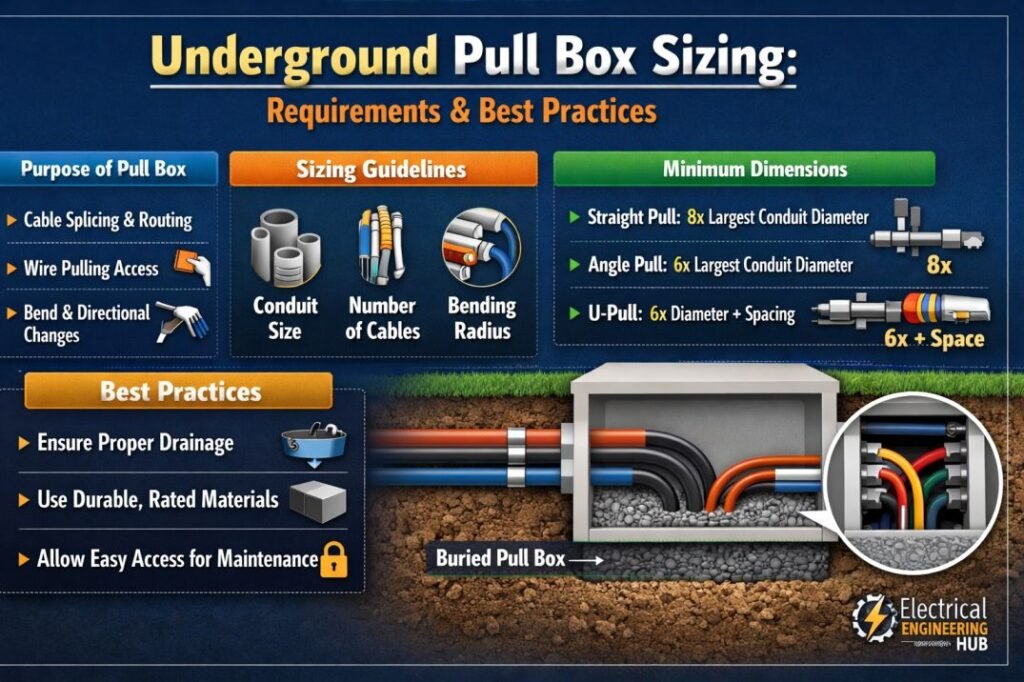
Table of Contents
Table of Contents
A Pull Box Sizing Calculator helps determine the minimum box dimensions required by NEC 314.28. Once the code-required size is established, installers must evaluate site conditions to ensure the underground installation remains durable and accessible throughout its service life. This guide explains both the NEC sizing rules and the practical installation factors that influence underground pull box performance.
Does NEC 314.28 Apply to Underground Pull Boxes?
Yes. NEC 314.28 applies to underground pull boxes just as it does to above-ground pull boxes. The code does not create separate sizing formulas based on installation location. Instead, it focuses on how conductors enter and leave the enclosure.
Whether a pull box is installed inside a building, outdoors, or below grade, the same rules for straight pulls, angle pulls, and U-pulls determine the minimum internal dimensions. The difference lies in the enclosure design rather than the sizing calculation. Underground boxes are typically built with stronger materials, weather-resistant covers, and construction suitable for soil loading and moisture exposure.
For a complete explanation of the code formulas, see our guide on NEC 314.28 Pull Box Sizing Requirements. You can also calculate the required dimensions instantly using our Pull Box Sizing Calculator before selecting an underground enclosure.
| Installation Type | NEC 314.28 Sizing Rules | Additional Requirements |
|---|---|---|
| Indoor Pull Box | Yes | Accessibility and working space |
| Outdoor Pull Box | Yes | Weather protection |
| Underground Pull Box | Yes | Burial depth, drainage, vault construction, cover rating |
Additional Considerations for Underground Installations
Meeting NEC pull box sizing requirements is only one part of a successful underground installation. The enclosure must also withstand environmental conditions throughout its service life.
Unlike indoor pull boxes, underground installations are exposed to groundwater, changing soil conditions, vehicle loads, and seasonal temperature variations. Proper planning minimizes maintenance costs while protecting conductors from moisture and mechanical damage.
Before purchasing an enclosure, verify both the required pull box sizing dimensions and the environmental requirements for the installation site.
Burial Depth Requirements
The burial depth of underground conduits is governed by NEC Table 300.5 rather than NEC 314.28. This means the conduit depth and the pull box dimensions are determined by different code requirements.
When selecting an underground pull box, ensure the enclosure can accommodate:
- Required conduit burial depth
- Proper conduit entry elevation
- Minimum conductor bending space inside the box
- Future maintenance access
If several conduits enter from different elevations, the vault must provide sufficient internal space without violating the minimum pull box sizing requirements.
| Item | Governed By |
|---|---|
| Pull box dimensions | NEC 314.28 |
| Conduit burial depth | NEC Table 300.5 |
| Raceway protection | NEC Chapter 3 |
| Working space during maintenance | Installation practices |
Drainage and Water Infiltration
Water is one of the biggest challenges in underground electrical systems. Even weatherproof underground pull boxes may collect water from rainfall, groundwater, or condensation over time.
Good drainage practices include:
- Installing a compacted gravel base beneath the box
- Providing drainage openings where permitted
- Using sump provisions in larger vaults
- Maintaining proper grading around the installation
- Preventing conduit entries from becoming water collection points
Standing water can increase corrosion, accelerate deterioration of cable jackets, and make future maintenance more difficult. Proper drainage significantly extends the service life of underground electrical infrastructure.
For installations in flood-prone areas, additional waterproofing methods may also be necessary depending on local regulations.
Vault Access and Cover Load Rating
Not every underground pull box requires the same cover strength. The load rating depends entirely on where the enclosure will be installed.
Boxes located in landscaped areas typically require lighter-duty covers, while installations beneath roads, parking lots, or driveways require traffic-rated covers capable of supporting vehicle loads.
Common installation locations include:
| Installation Area | Typical Cover Requirement |
|---|---|
| Landscaped area | Non-traffic-rated |
| Sidewalk | Pedestrian-rated |
| Parking lot | Traffic-rated |
| Driveway | Heavy-duty traffic-rated |
| Industrial yard | Heavy-load rated |
Using the wrong cover rating creates both safety hazards and long-term maintenance issues. Always verify manufacturer load classifications before installation.
In addition to load ratings, choose covers that provide easy access for inspections while maintaining secure locking mechanisms where public safety is a concern.
Common Underground Pull Box Configurations
Underground electrical systems are installed in many different layouts, but the sizing principles remain consistent. The arrangement of conduits entering the enclosure determines which NEC 314.28 calculation applies.
Typical configurations include:
- Straight conduit runs between two handholes
- Angle pulls where underground feeders change direction
- U-pulls in confined routing situations
- Multiple conduit entries feeding distribution equipment
- Large utility vaults with several raceway entrances
Although the physical installation differs from above-ground systems, the calculation method remains unchanged. Straight pulls still require dimensions based on conduit diameter, while angle pulls and U-pulls require additional spacing between raceway entries.
For a complete comparison of these layouts, read our guide on Straight Pull vs. Angle Pull. Before finalizing your enclosure, use the Pull Box Sizing Calculator to verify the minimum code-compliant dimensions.
| Configuration | Typical Application | Applicable NEC Rule |
|---|---|---|
| Straight Pull | Long underground feeder | Straight pull calculation |
| Angle Pull | Direction change | Angle pull calculation |
| U-Pull | Raceway reversal | U-pull calculation |
| Multiple Raceway Entries | Distribution vault | Largest raceway plus spacing rules |
Mistakes That Cause Underground Pull Box Failures
Many underground pull box problems are caused by installation practices rather than code calculations. Avoiding these common mistakes improves reliability and reduces future repair costs.
- Selecting the minimum size without allowing room for future conduit additions.
- Ignoring multiple raceway entries on the same wall during pull box sizing calculations.
- Installing the enclosure too shallow or too deep relative to conduit elevations.
- Providing inadequate drainage, allowing water to accumulate inside the vault.
- Using non-traffic-rated covers beneath driveways or parking areas.
- Poor soil compaction that allows the enclosure to settle over time.
- Improper conduit alignment, creating excessive cable pulling stress.
- Failing to leave adequate working space for maintenance and cable replacement.
Reviewing these factors during design helps prevent expensive excavation and reconstruction later.
Size Your Underground Pull Box Correctly
Accurate underground pull box sizing begins with NEC 314.28 calculations. Once the minimum dimensions are known, evaluate the installation environment to ensure the enclosure meets practical field requirements such as burial depth, drainage, and cover strength.
Our Pull Box Sizing Calculator quickly determines the required minimum dimensions for straight pulls, angle pulls, and U-pulls. After confirming the code-required size, you can confidently select an underground pull box or vault designed for the site’s environmental conditions and future maintenance needs.
Frequently Asked Questions
Is an underground pull box sized differently than an above-grade box?
No. Underground pull box sizing follows the same NEC 314.28 requirements as above-grade installations. Only the enclosure construction, burial requirements, and environmental protection differ.
How deep should an underground pull box be buried?
The pull box itself is positioned to match the required conduit depth. Burial depth is determined by NEC Table 300.5 and depends on the wiring method, voltage, and installation location.
Do underground pull boxes need drainage?
Yes, in most installations drainage is recommended to prevent standing water. Gravel bases, drainage openings where permitted, or sump provisions help reduce water accumulation and protect conductors.
What cover rating do I need for a pull box under a driveway?
A pull box installed beneath a driveway should use a traffic-rated cover designed to withstand vehicle loads. Always select a cover that matches the expected loading conditions and the manufacturer’s specified load rating.
Follow Us on Social:
Subscribe our Newsletter on Electrical Insights for latest updates from Electrical Engineering Hub
#UndergroundPullBoxSizing, #PullBoxSizing, #ElectricalDesign, #NECCompliance, #ConduitSystems, #ElectricalEngineering, #CableInstallation, #PowerDistribution, #ElectricalContractor, #EngineeringGuide
