EV Charging Station Design Standards: Complete Guide to Safe, Efficient & Compliant EV Infrastructure Development
Electric vehicles are becoming a major part of modern transportation systems, and the demand for reliable charging infrastructure is increasing quickly. Cities, businesses, and highway authorities are investing in charging networks that are safe, scalable, and efficient. In this evolving landscape, EV Charging Station Design Standards play a central role in ensuring that every installation meets safety, performance, and regulatory expectations while supporting long-term usability and grid stability.
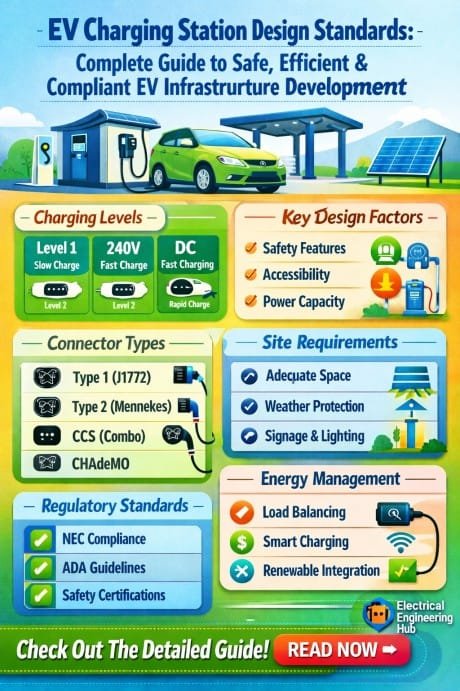
Table of Contents
A properly designed charging station is not just about placing chargers in a parking area. It involves electrical planning, user accessibility, load management, and compliance with international safety codes. Without structured design standards, charging infrastructure can face issues like overheating, power instability, and poor user experience.
Importance of EV Charging Infrastructure Planning
The foundation of modern EV ecosystems depends heavily on EV Charging Station Design Standards because they ensure consistency in installation and operation. These standards help engineers and developers create stations that can handle varying load demands while maintaining safety and efficiency.
Find all about EV Charging Station Code Requirements
Another important aspect is interoperability. With different EV manufacturers and charging protocols in the market, standardized design ensures compatibility across multiple vehicle types. It also supports future expansion, so charging networks can scale without major redesign or cost escalation.
In addition, EV Charging Station Design Standards help reduce operational risks such as electrical faults, fire hazards, and voltage fluctuations. This makes them essential for public charging stations, commercial parking lots, and highway fast-charging hubs.
Core Components of a Charging Station
A charging station consists of multiple integrated systems that work together to deliver safe and efficient charging. The EV Charging Station Design Standards define how each component should be selected and installed.
The main components include:
- Charging units (AC Level 2 and DC fast chargers)
- Power distribution systems
- Communication modules
- Safety protection devices
- Energy metering systems
These components must be carefully integrated to ensure stable operation under varying load conditions. Proper grounding, surge protection, and thermal management are also essential parts of system design.
The EV Charging Station Design Standards also specify requirements for ventilation, weather protection, and cable management. This ensures long-term durability and reduces maintenance costs.
Know more about ChargePoint Charging Station Cost
Key Component Overview Table
| Component | Function | Design Consideration |
|---|---|---|
| EV Charger Unit | Supplies electrical energy to vehicles | Compatibility, power rating |
| Power Distribution Board | Manages electrical flow | Load balancing, protection |
| Communication System | Data exchange & monitoring | Network stability, protocols |
| Safety Devices | Prevent faults & overloads | Circuit breakers, RCDs |
| Energy Meter | Tracks consumption | Accuracy, compliance |
Site Selection and Layout Planning
Choosing the right location is a critical step in EV Charging Station Design Standards. The site must be accessible, visible, and capable of supporting electrical infrastructure upgrades.
Ideal locations include shopping centers, highways, office complexes, and residential communities. The layout should ensure smooth vehicle movement, easy parking alignment, and safe pedestrian access.
Proper spacing between charging units is important to avoid congestion. Designers must also consider future expansion by reserving additional space for more chargers or higher capacity systems.
Environmental conditions such as flooding risk, temperature variations, and sunlight exposure also influence site planning decisions.
Know more about Electric Vehicle Charging Station Cost
Electrical and Safety Requirements
Electrical design is one of the most important aspects of EV Charging Station Design Standards because it directly affects safety and performance. The system must be capable of handling high loads without voltage drops or overheating.
Key requirements include:
- Proper grounding and earthing systems
- Overcurrent and short-circuit protection
- Surge protection devices for lightning safety
- Load balancing across multiple chargers
- Adequate cable sizing based on load demand
Safety is equally important in both public and private installations. Emergency shutoff systems, fire-resistant materials, and insulation standards must be implemented according to global electrical codes.
Thermal management is another critical factor. Poor heat dissipation can reduce charger efficiency and increase equipment failure rates.
Charger Types and Technical Specifications
EV charging systems are generally categorized into three main types: Level 1, Level 2, and DC fast charging. Each type serves different user needs and installation environments.
Use our online tool EV Charger Load Calculation Tool
EV Charging Station Design Standards ensure that these charger types are deployed appropriately based on expected traffic and charging duration.
Charger Types Comparison Table
| Charger Type | Power Output | Charging Time | Typical Use Case |
|---|---|---|---|
| Level 1 AC | 1.4–3 kW | 8–12 hours | Residential use |
| Level 2 AC | 7–22 kW | 3–6 hours | Commercial parking |
| DC Fast Charger | 50–350 kW | 15–60 minutes | Highways & fleet hubs |
Fast charging stations require advanced cooling systems and high-capacity transformers. On the other hand, AC chargers are more cost-effective and suitable for long-duration parking areas.
The EV Charging Station Design Standards also define communication protocols such as OCPP (Open Charge Point Protocol), which enables smart charging and remote monitoring.
Compliance and Global Standards
Regulatory compliance is a key pillar of EV Charging Station Design Standards. Different regions follow specific guidelines, but most align with international frameworks such as IEC, ISO, and SAE standards.
Know more about Best 12 Electric Vehicle Charging Stations in New York
Compliance ensures that charging stations operate safely within electrical limits and environmental regulations. It also helps in obtaining government approvals and subsidies for infrastructure development.
In many countries, grid interconnection rules must be followed to avoid power instability. These rules define how charging stations interact with local utilities and manage peak load demand.
The EV Charging Station Design Standards also encourage cybersecurity measures for connected charging systems. Since modern chargers use cloud-based monitoring, protecting data integrity is essential.
Cost and Performance Considerations
The financial aspect of EV infrastructure plays a major role in project planning. EV Charging Station Design Standards help optimize cost by guiding efficient equipment selection and layout design.
Initial investment includes chargers, transformers, civil work, and installation. Operational costs involve maintenance, electricity tariffs, and network management.
Cost Breakdown Table
| Cost Element | Description | Impact Level |
|---|---|---|
| Equipment Cost | Chargers and electrical gear | High |
| Installation | Civil and electrical setup | Medium |
| Grid Upgrade | Transformer and power line upgrade | High |
| Maintenance | Regular servicing and repairs | Medium |
| Software Systems | Monitoring and billing platforms | Low to Medium |
Efficient design reduces long-term operational costs by improving energy distribution and minimizing downtime. Smart charging systems also help optimize electricity usage during off-peak hours.
Know more about Best 12 Electric Vehicle Charging Stations in Illinois
Future Trends in EV Charging Infrastructure
The future of EV infrastructure is shifting toward smart, connected, and renewable-integrated systems. EV Charging Station Design Standards are evolving to support ultra-fast charging, wireless charging, and vehicle-to-grid (V2G) technology.
Solar-integrated charging stations are becoming more common, reducing dependency on grid electricity. Battery storage systems are also being added to manage peak loads and improve energy efficiency.
Artificial intelligence is increasingly used for load forecasting and predictive maintenance. This helps operators reduce downtime and improve customer satisfaction.
As EV adoption grows, standardization will become even more important to ensure seamless integration across different networks and regions.
Use our online tool for free EV Charger Breaker and Wire Size Calculator
Conclusion
Modern transportation systems rely heavily on structured and reliable EV infrastructure. EV Charging Station Design Standards provide the foundation for building safe, efficient, and scalable charging networks that can support growing electric vehicle adoption.
From electrical safety to site planning and compliance, every aspect of charging station development depends on these standards. As technology continues to evolve, these guidelines will further shape the future of sustainable mobility and energy distribution systems. Use our online tool ev battery degradation calculator
Follow Us on Social:
Subscribe our Newsletter on Electrical Insights for latest updates from Electrical Engineering Hub
#EvChargingStationDesignStandards,#EVCharging,#ChargingStationDesign,#EVInfrastructure,#ElectricVehicle,#EVSE,#GreenEnergy,#SustainableTransport,#SmartCharging,#EVStandards