
IEEE Standard for Generator Testing: Best Compliance, Procedures & Performance Guide
The ieee standard for generator testing plays a critical role in ensuring that electrical generators operate safely, efficiently, and reliably across different applications. Whether used in industrial plants, commercial facilities, or power generation stations, generators must meet strict testing benchmarks to guarantee performance under varying load conditions. Understanding these standards is essential for engineers, technicians, and business owners who rely on uninterrupted power supply.
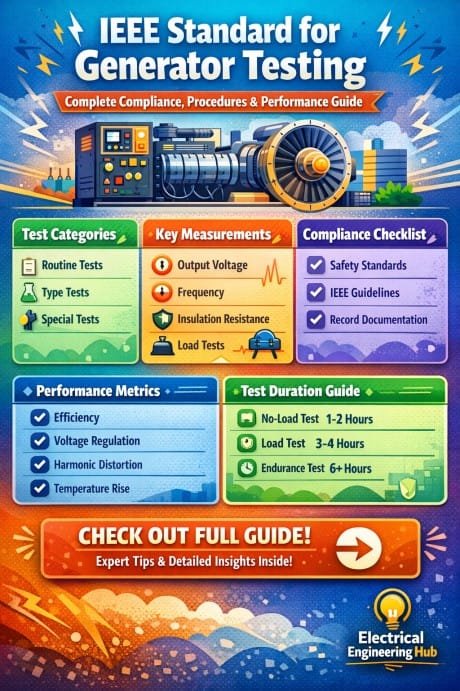
Table of Contents
This guide explains the compliance requirements, testing procedures, and performance parameters defined under the ieee standard for generator testing, helping you apply them practically in real-world scenarios.
Understanding IEEE Standards for Generator Testing
The Institute of Electrical and Electronics Engineers (IEEE) has developed comprehensive standards that define how generators should be tested, evaluated, and maintained. These standards ensure uniformity, safety, and reliability across the electrical industry.
Discover our Electrical Cable Sizing Tools, a great resource for all types of cable calculations. It includes cable calculators for generators, transformers, earthing, and more.
The ieee standard for generator testing primarily focuses on synchronous generators, though many principles apply to other types as well. Common IEEE standards related to generator testing include:
| Standard Number | Description |
|---|---|
| IEEE 115 | Test procedures for synchronous machines |
| IEEE 43 | Insulation resistance testing |
| IEEE 62 | Diagnostic testing for rotating machinery |
| IEEE 112 | Efficiency testing methods |
These standards collectively define how to measure performance, identify faults, and verify compliance before commissioning or during maintenance.
Importance of Following IEEE Generator Testing Standards
Adhering to the ieee standard for generator testing is not just a technical requirement. It directly impacts operational efficiency and safety.
Key benefits include:
- Ensures accurate performance validation
- Reduces risk of unexpected failures
- Improves equipment lifespan
- Supports regulatory compliance
- Enhances safety for personnel and equipment
Learn more about types of generator protection relays
In industries like manufacturing and power generation, even a minor generator fault can lead to costly downtime. Proper testing minimizes such risks.
Pre-Testing Requirements and Preparation
Before conducting any test under the ieee standard for generator testing, proper preparation is essential. Skipping this step can lead to inaccurate results or equipment damage.
Key preparation steps
- Visual inspection of generator components
- Verification of nameplate data
- Calibration of testing instruments
- Checking grounding and connections
- Ensuring safe environmental conditions
Safety checklist
| Parameter | Requirement |
|---|---|
| Insulation condition | Must be dry and clean |
| Grounding | Properly connected |
| Temperature | Within safe operating range |
| Personnel safety | PPE must be used |
These preparatory steps align with industry best practices and ensure accurate test outcomes.
Explore all about Best Surge Protector for Generator: Top Picks to Keep Your Power Safe & Appliances Protected
Types of Generator Tests as per IEEE Standards
The ieee standard for generator testing categorizes tests into several types based on purpose and application.
1. Routine Tests
Routine tests are conducted during manufacturing or installation.
- Winding resistance test
- Insulation resistance test
- No-load test
- Phase sequence verification
2. Type Tests
Type tests validate design performance and are usually done on prototype units.
- Temperature rise test
- Short-circuit test
- Efficiency measurement
- Voltage regulation test
3. Special Tests
These tests are conducted based on specific project requirements.
- Partial discharge testing
- Noise level measurement
- Harmonic analysis
- Vibration analysis
Use our online tool Generator Power Consumption Calculator – Accurate Tool to Estimate Fuel and Load Usage
Summary Table of Test Types
| Test Type | Purpose | Frequency |
|---|---|---|
| Routine | Basic verification | Every unit |
| Type | Design validation | Prototype stage |
| Special | Custom performance analysis | As required |
Step-by-Step Generator Testing Procedure
Following a structured approach is essential when applying the ieee standard for generator testing. Below is a simplified procedure that aligns with IEEE 115 guidelines.
Step 1: Visual Inspection
Check for physical damage, loose connections, and contamination. This step ensures the generator is ready for testing.
Step 2: Insulation Resistance Test
Measure insulation using a megger. Values should meet IEEE 43 recommendations.
Step 3: Winding Resistance Measurement
Measure resistance across windings to detect imbalances or faults.
Use our online tool Generac Generator Size Calculator – Find the Right Generator Size
Step 4: No-Load Test
Run the generator without load to observe voltage stability and core losses.
Step 5: Load Test
Apply gradual load and monitor:
- Voltage regulation
- Current stability
- Temperature rise
Step 6: Efficiency Calculation
Efficiency is calculated using input and output power measurements.
Step 7: Final Evaluation
Compare results with IEEE limits to confirm compliance.
Key Performance Parameters in Generator Testing
The ieee standard for generator testing defines several performance indicators that must be evaluated.
Important parameters
- Voltage regulation
- Efficiency
- Temperature rise
- Insulation resistance
- Power factor
- Frequency stability
Use our online free tool Generator Size Calculator for Homes in KVA: Best Tool
Performance Benchmark Table
| Parameter | Acceptable Range (Typical) |
|---|---|
| Insulation Resistance | > 1 MΩ per kV |
| Voltage Regulation | ±5% |
| Efficiency | 90% – 98% |
| Temperature Rise | As per insulation class |
Monitoring these parameters ensures that generators meet operational expectations.
Common Challenges in Generator Testing
Even when following the ieee standard for generator testing, certain challenges may arise.
Frequent issues
- Inaccurate readings due to poor calibration
- Environmental factors like humidity
- Aging insulation systems
- Improper grounding
- Human error during testing
Addressing these challenges requires proper training, equipment maintenance, and adherence to procedures.
Use our free online tool Generator Sizing Calculator for VFD Motors
Best Practices for IEEE Compliance
Maintaining compliance with the ieee standard for generator testing requires consistent effort and disciplined processes.
Recommended practices
- Use calibrated and certified instruments
- Maintain detailed test records
- Conduct periodic testing and maintenance
- Train personnel regularly
- Follow safety protocols strictly
Maintenance Schedule Example
| Activity | Frequency |
|---|---|
| Insulation testing | Every 6 months |
| Load testing | Annually |
| Visual inspection | Monthly |
| Full performance testing | Every 2–3 years |
These practices help ensure long-term reliability and compliance.
Role of Testing in Generator Lifecycle Management
The ieee standard for generator testing is not limited to initial commissioning. It plays a vital role throughout the generator lifecycle.
Lifecycle stages
- Manufacturing testing
- Installation and commissioning
- Periodic maintenance
- Fault diagnosis
- End-of-life assessment
Consistent testing helps detect issues early, reducing repair costs and preventing catastrophic failures.
Practical Applications Across Industries
The ieee standard for generator testing is widely applied across multiple sectors.
Calculate your generator size using our free online tool Generator Sizing Calculator for Pumps
Key industries
- Power generation plants
- Oil and gas facilities
- Manufacturing units
- Hospitals and data centers
- Commercial buildings
Each of these industries relies heavily on uninterrupted power, making generator testing a critical requirement. Know more about Top 20 Electrical Testing Tools Which You Must Have
Conclusion
The ieee standard for generator testing provides a structured and reliable framework for evaluating generator performance, safety, and efficiency. By following these standards, organizations can ensure compliance, reduce operational risks, and extend equipment life.
From routine inspections to advanced diagnostic tests, every step in the testing process contributes to overall system reliability. Whether you are commissioning a new generator or maintaining an existing one, applying the ieee standard for generator testing ensures that your equipment performs at its best under all conditions.
Find all about Best Megger Insulation Testers 5000V
Get new guides in your feed. Follow Electrical Insights on LinkedIn for new electrical standards guides, calculators and design tips from Azad Circuit Hub.
#IEEEStandardForGeneratorTesting, #GeneratorTestingStandards, #IEEEGeneratorTesting, #PowerSystemTesting, #ElectricalStandards, #GeneratorPerformanceTest, #IEEECompliance, #IndustrialTesting, #ElectricalEngineering, #GeneratorInspection
