
JuiceBox vs ChargePoint Home Flex: Which Level 2 EV Charger Should You Buy?
When comparing home EV chargers, two names that often come up are Enel X JuiceBox and ChargePoint Home Flex. In this JuiceBox vs ChargePoint Home Flex comparison, I am looking at the practical differences that matter when installing a Level 2 charger at home, including charging speed, installation, smart features, connector compatibility, and everyday usability.
As an electrical engineer with more than 15 years of experience working with electrical panels, industrial automation, controls, and power systems, I look at EV chargers from both the product and electrical-installation side. A charger can have excellent software, but it still needs to match the vehicle, circuit, breaker, and available electrical capacity.
JuiceBox 40 vs ChargePoint Home Flex at a Glance
| Feature | Enel X JuiceBox 40 | ChargePoint Home Flex |
|---|---|---|
| Charger type | Level 2 AC | Level 2 AC |
| Maximum current | Up to 40A | Up to 50A |
| Typical voltage | 240V | 240V |
| Maximum output | About 9.6 kW | Up to 12 kW |
| Connector | J1772 | J1772 |
| Installation | Plug-in / hardwired depending on version | Plug-in / hardwired depending on configuration |
| Smart charging | Yes | Yes |
| Mobile app | Yes | Yes |
| Best suited for | 32–40A home charging | Flexible higher-current charging |
| EV compatibility | J1772-compatible EVs | J1772-compatible EVs |
Specifications can vary by specific generation and installation configuration, so verify the product listing before purchasing.
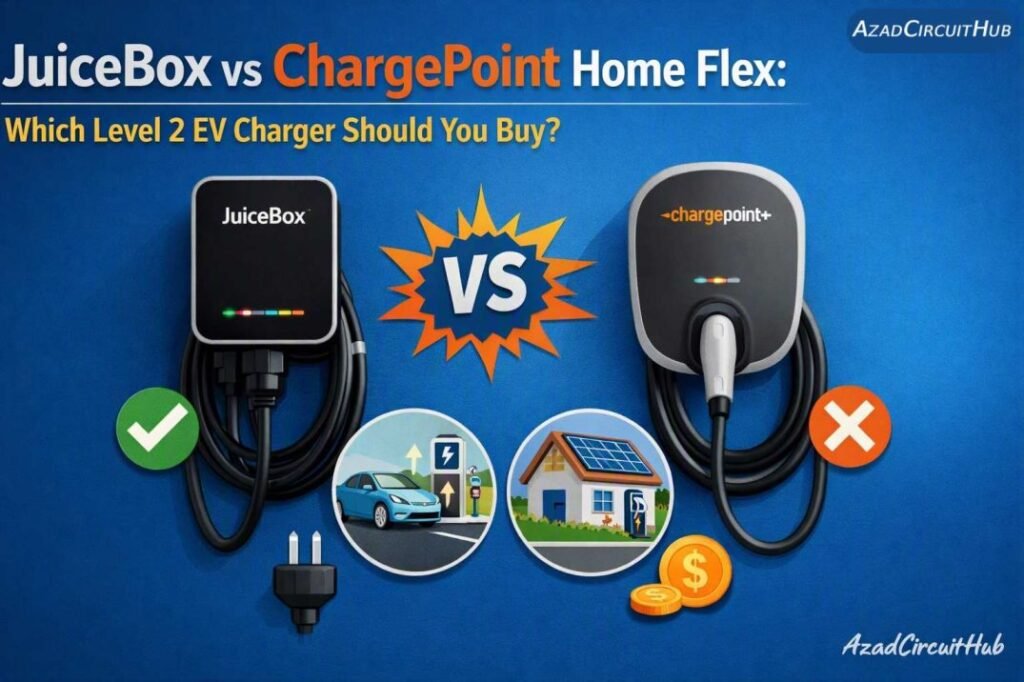
Table of Contents
Table of Contents
JuiceBox 40: What You Get
The Enel X JuiceBox 40 has been a popular home charging option because it combines Level 2 charging with connected features. Its 40A output can provide approximately 9.6 kW at 240V when the vehicle and electrical installation support the full output.
The J1772 connector makes it suitable for many North American EVs and plug-in hybrids. The unit also provides app-based controls and charging information, which can be useful for monitoring charging sessions.
For a homeowner who already has a properly installed 240V circuit and does not need more than 40A, the JuiceBox 40 offers a straightforward charging solution.
Amazon buying option: Check Enel X JuiceBox 40 price on Amazon
If you are comparing more connected chargers, my guide to emporia ev charger vs chargepoint covers another popular smart-charging alternative and explains where the two approaches differ.
ChargePoint Home Flex: What Makes It Different?
The ChargePoint Home Flex is designed around adjustable charging current, allowing the installation to be configured for different circuit capacities. Depending on the installation and vehicle, it can provide substantially more charging power than a 40A JuiceBox. Read complete chargepoint home flex ev charger review here.
At 50A and 240V, the theoretical output is approximately 12 kW. However, the actual charging rate is limited by the EV's onboard AC charger. If your vehicle can accept only 7.2 or 9.6 kW, installing a higher-capacity EVSE will not automatically increase its charging speed.
ChargePoint's mobile ecosystem is another important part of the product. Users can monitor charging, schedule sessions, and manage charging settings through the company's connected platform.
Amazon buying option: Check ChargePoint Home Flex price on Amazon
For buyers who want to compare several popular smart chargers instead of just two models, see my best level 2 ev charger guide for additional options.
Charging Speed Comparison
The charging-current difference is one of the clearest distinctions in this JuiceBox vs ChargePoint Home Flex comparison.
A 40A charger operating at 240V can theoretically supply about 9.6 kW. A 50A charger at the same voltage can provide approximately 12 kW.
| Charging Current | Approx. Power at 240V |
|---|---|
| 32A | 7.7 kW |
| 40A | 9.6 kW |
| 48A | 11.5 kW |
| 50A | 12.0 kW |
These figures represent electrical output, not guaranteed battery charging speed. The EV's onboard charger, battery condition, temperature, state of charge, and charging strategy can all affect actual results.
For many drivers, 40A is already enough to replenish a large amount of driving range overnight.
Installation and Electrical Requirements
This is where I would pay particular attention as an electrical engineer.
EV charging is a continuous electrical load. The branch circuit, overcurrent protection, conductor size, receptacle, and installation method must be selected accordingly and in accordance with the applicable electrical code.
A 40A EV charger should not simply be connected to an undersized circuit because the receptacle physically fits. Likewise, a higher-current configuration of the ChargePoint Home Flex requires an electrical installation capable of supporting that load.
Before installation, check:
- Main service capacity
- Available breaker positions
- Branch-circuit rating
- Conductor size and installation method
- Receptacle rating if using a plug-in configuration
- Charger configuration
- Vehicle charging capacity
- Local electrical requirements
If you are upgrading from a standard outlet, have the circuit evaluated rather than assuming the existing wiring is suitable.
Smart Charging and App Features
Both products are more than simple power supplies. They are EVSE units with connected features designed to help homeowners monitor and manage charging.
Smart charging can be useful when you want to schedule charging during particular hours, monitor energy use, or receive charging notifications.
The value of these features depends heavily on how you use your EV. Someone who plugs in every evening and leaves the vehicle overnight may not need extensive scheduling. A driver trying to coordinate charging with time-of-use electricity rates may find the connected features more useful.
For another detailed comparison, my tesla vs chargepoint vs emporia guide looks at how three popular charging ecosystems compare for home EV owners.
Connector Compatibility
Both the JuiceBox 40 and ChargePoint Home Flex are commonly associated with J1772 charging connections. This makes them suitable for a wide range of EVs and plug-in hybrids equipped with a J1772 AC inlet.
Tesla owners and drivers of newer vehicles should check the exact connector arrangement before purchasing. Depending on the vehicle, an appropriate adapter may be required.
Connector compatibility should be checked before looking at charging amperage. A 50A charger is not useful if the connection arrangement does not suit your vehicle.
Which One Makes More Sense for Your Home?
The right choice in this JuiceBox vs ChargePoint Home Flex comparison depends on your electrical system and charging needs.
The JuiceBox 40 is a sensible option if 40A charging is sufficient and you prefer a connected Level 2 charger with a straightforward current rating.
The ChargePoint Home Flex provides more flexibility because its configurable current settings can accommodate different electrical installations. It can also provide higher charging output when the vehicle and circuit support it.
If your EV can charge at only 32A, buying a higher-current EVSE may offer little practical benefit. On the other hand, drivers with a higher-capacity onboard charger may appreciate the additional capability of the Home Flex.
JuiceBox vs ChargePoint Home Flex: Buying Advice
Before buying, compare the total installation rather than the charger price alone. A higher-current charger may require electrical upgrades that substantially increase the installed cost.
Also consider the location of the charger, cable reach, outdoor exposure, Wi-Fi availability, connector type, warranty, and your future EV plans.
If you are still deciding between major charging brands, my emporia ev charger vs chargepoint comparison provides another useful reference before you purchase.
For buyers who want more alternatives across different amperage levels and features, check the best level 2 ev charger guide before choosing a final model.
Frequently Asked Questions
Is JuiceBox 40 better than ChargePoint Home Flex?
The two products target somewhat different requirements. JuiceBox 40 provides up to 40A charging, while ChargePoint Home Flex offers configurable current settings and can support higher output when correctly installed. The better fit depends on the vehicle and electrical system.
How many kW does a 40A EV charger provide?
At 240V, a 40A charger can provide approximately 9.6 kW of electrical output. Actual vehicle charging power can be lower depending on the onboard charger and charging conditions.
Can ChargePoint Home Flex charge faster than JuiceBox 40?
It can, when configured for a higher current and connected to a vehicle capable of accepting that power. The vehicle's onboard AC charger ultimately limits how much power reaches the battery.
Are JuiceBox and ChargePoint compatible with Tesla?
Compatibility depends on the specific vehicle, connector, and adapter arrangement. Always check the current vehicle and charger specifications before purchasing.
Do I need a 50A circuit for ChargePoint Home Flex?
The required circuit depends on the selected charging-current configuration. The charger should be configured according to the installed circuit and applicable electrical requirements. A qualified electrician can determine the appropriate circuit and protection.
Final Thoughts
The main difference highlighted by this JuiceBox vs ChargePoint Home Flex comparison is flexibility. The JuiceBox 40 is a 40A Level 2 charging solution, while the ChargePoint Home Flex can accommodate different current settings and potentially higher charging output.
For a home that already has a suitable 40A charging circuit, the JuiceBox 40 can provide plenty of overnight charging capacity. The Home Flex becomes more interesting when you want adjustable current or have an EV and electrical service capable of using higher charging power.
Before ordering either product, confirm the connector, maximum vehicle charging rate, circuit capacity, installation type, and current configuration. Those details will have a much greater effect on your real-world charging experience than the advertised maximum number alone.
For a broader three-way comparison before buying, read tesla vs chargepoint vs emporia to see how these charging options differ across the wider home EV charger market.
Get new guides in your feed. Follow Electrical Insights on LinkedIn for new electrical standards guides, calculators and design tips from Azad Circuit Hub.
#JuiceBoxVsChargePoint, #JuiceBoxEVCharger, #ChargePointHomeFlex, #EVChargerComparison, #Level2EVCharger, #HomeEVCharging, #EVCharging, #ElectricVehicle, #SmartEVCharger, #EVCharger
