
How to Perform Ttr Test Of Transformer | Complete Transformer Turns Ratio Testing Guide
Transformers are one of the most important components in electrical power systems. Their efficiency and reliability directly affect the stability of industrial plants, substations, and distribution networks. One of the most essential diagnostic procedures used during transformer commissioning and maintenance is the Ttr Test Of Transformer. This test helps engineers verify whether the transformer winding ratio matches the design specifications and ensures proper voltage transformation.
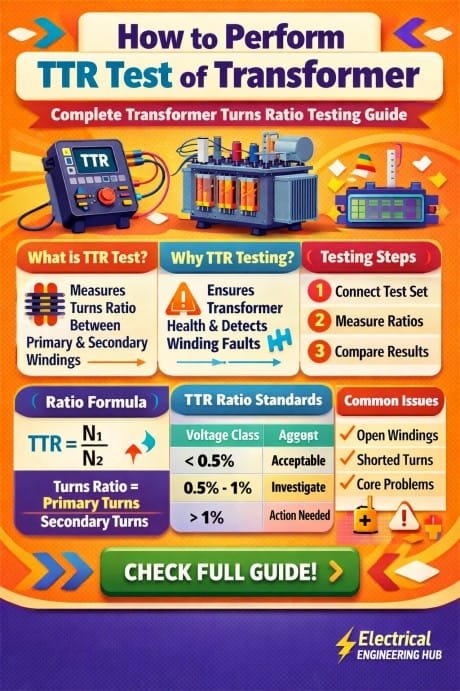
Table of Contents
A Ttr Test Of Transformer is performed to identify winding faults, shorted turns, incorrect tap connections, and manufacturing defects. Regular testing improves transformer reliability and helps prevent unexpected failures in power systems.
In this complete guide, you will learn the purpose, working principle, equipment required, testing procedure, precautions, calculations, and interpretation of transformer turns ratio test results.
What is TTR Test of Transformer
The transformer turns ratio test is an electrical test used to measure the ratio between the primary winding turns and secondary winding turns of a transformer. Since transformer voltage is directly proportional to the number of winding turns, this test confirms whether the transformer can provide the required output voltage.
Explore details on largest transformer manufacturer in usa
The Ttr Test Of Transformer compares the measured voltage ratio with the nameplate ratio. If the deviation exceeds acceptable limits, it may indicate winding damage or tap changer problems.
Basic Transformer Ratio Formula
| Parameter | Formula |
|---|---|
| Turns Ratio | N1 / N2 |
| Voltage Ratio | V1 / V2 |
| Ideal Relation | N1/N2 = V1/V2 |
Where:
- N1 = Primary winding turns
- N2 = Secondary winding turns
- V1 = Primary voltage
- V2 = Secondary voltage
Purpose of TTR Testing
The transformer turns ratio test is performed for several important reasons during installation and preventive maintenance.
Main Objectives of TTR Testing
| Purpose | Description |
|---|---|
| Verify winding ratio | Confirms transformer ratio matches design |
| Detect shorted turns | Identifies damaged winding insulation |
| Check tap changer operation | Ensures proper tap position functionality |
| Identify connection issues | Finds incorrect internal connections |
| Confirm manufacturing accuracy | Validates factory specifications |
A properly conducted Ttr Test Of Transformer improves equipment safety and reduces the risk of transformer breakdown.
Get complete information about transformer manufacturers in uk
Equipment Required for TTR Test
Before starting the test, ensure all necessary instruments and safety equipment are available.
Required Tools and Equipment
| Equipment | Purpose |
|---|---|
| TTR Test Kit | Measures transformer turns ratio |
| Test leads | Connect tester to transformer terminals |
| Transformer nameplate data | Compare measured ratio |
| Safety gloves | Electrical protection |
| Insulation mat | Operator safety |
| Earthing cable | Proper grounding |
Modern transformer ratio meters are digital and provide automatic calculations with high accuracy.
Principle of Transformer Turns Ratio Testing
The Ttr Test Of Transformer works on the principle of electromagnetic induction. A low AC voltage is applied to one winding, and the induced voltage is measured on the other winding.
The test instrument calculates the turns ratio using the measured voltages. The measured value is then compared with the theoretical ratio from the transformer design data.
If the measured ratio significantly differs from the expected value, it may indicate:
Learn more about best power transformer manufacturer in south africa
- Shorted winding turns
- Open circuits
- Tap changer defects
- Incorrect winding connections
- Internal transformer damage
Safety Precautions Before TTR Testing
Safety is extremely important during transformer testing. Always follow standard electrical safety procedures before beginning the test.
Important Safety Measures
- Ensure the transformer is completely de-energized
- Isolate all incoming and outgoing connections
- Discharge stored electrical energy
- Properly ground the transformer body
- Use insulated gloves and tools
- Verify no residual voltage exists
Ignoring safety precautions may lead to electrical shock or equipment damage.
Read in detail about transformer manufacturers in egypt
Step-by-Step TTR Test Procedure
The Ttr Test Of Transformer should be performed carefully to obtain accurate and reliable results.
Step 1: Collect Transformer Information
Before testing, record the transformer details from the nameplate.
Important Nameplate Information
| Parameter | Example |
|---|---|
| Rated Voltage | 11kV / 415V |
| Vector Group | Dyn11 |
| Tap Positions | ±5% |
| Frequency | 50 Hz |
This information helps determine the expected turns ratio.
Step 2: Isolate the Transformer
Disconnect the transformer from the power system and ensure complete isolation.
Isolation Checklist
- Open circuit breakers
- Disconnect cables
- Apply lockout/tagout procedure
- Ground transformer terminals
Step 3: Connect TTR Test Kit
Connect the transformer ratio tester according to the transformer winding configuration.
Typical Connection Process
| Winding Side | Tester Connection |
|---|---|
| High Voltage Side | H terminals |
| Low Voltage Side | X terminals |
Double-check all cable connections before energizing the test instrument.
Know more about Top Dry Type Transformer Manufacturers in the USA
Step 4: Apply Test Voltage
The TTR tester applies a low AC excitation voltage to the transformer winding.
The secondary voltage generated by induction is measured automatically by the instrument.
Modern digital testers display:
- Measured turns ratio
- Phase angle deviation
- Excitation current
- Percentage error
Step 5: Record the Test Results
Compare the measured ratio with the theoretical ratio from the transformer nameplate.
Example Calculation
| Parameter | Value |
|---|---|
| HV Voltage | 11000 V |
| LV Voltage | 415 V |
| Expected Ratio | 26.5 |
| Measured Ratio | 26.4 |
Know more about Best Transformer Testing Companies in Canada
Percentage Error Formula
| Formula | Description |
|---|---|
| ((Expected – Measured) / Expected) ×100 | Ratio deviation |
A small variation is acceptable within industry standards.
Acceptable Limits for TTR Test
The acceptable tolerance for Ttr Test Of Transformer usually depends on manufacturer recommendations and testing standards.
Standard Acceptable Limits
| Condition | Acceptable Variation |
|---|---|
| Power Transformer | ±0.5% |
| Distribution Transformer | ±0.5% to ±1% |
If the measured ratio exceeds permissible limits, further inspection is required.
Find all about Transformer Disconnect Sizing
Common Problems Identified During TTR Testing
The transformer turns ratio test helps detect several internal faults.
Common Faults
| Fault Type | Possible Cause |
|---|---|
| Incorrect ratio | Tap changer issue |
| High deviation | Shorted winding turns |
| Unstable readings | Loose internal connections |
| No ratio reading | Open circuit winding |
Early fault detection prevents transformer failure and costly downtime.
Importance of Tap Changer Testing
Transformers with on-load or off-load tap changers require ratio testing at every tap position.
The Ttr Test Of Transformer verifies that each tap produces the correct voltage ratio. Any abnormal reading may indicate worn contacts or faulty tap changer mechanisms.
Tap Testing Benefits
- Maintains voltage regulation
- Detects contact wear
- Ensures proper tap operation
- Improves transformer efficiency
Advantages of Transformer Turns Ratio Testing
Transformer ratio testing provides several operational and maintenance benefits.
Key Advantages
| Benefit | Description |
|---|---|
| Fast diagnosis | Quickly identifies winding problems |
| Non-destructive testing | No damage to transformer |
| Improves reliability | Reduces failure risk |
| Preventive maintenance | Detects issues early |
Regular TTR testing increases transformer service life and minimizes unexpected outages.
Know all about Transformer Sizing for EV Charger
Best Practices for Accurate TTR Testing
To achieve reliable test results, follow proper testing practices.
Recommended Practices
- Perform testing in dry conditions
- Use calibrated instruments
- Clean transformer bushings before testing
- Verify correct tap position
- Repeat measurements for confirmation
Accurate testing ensures proper transformer condition assessment.
Conclusion
The Ttr Test Of Transformer is an essential maintenance and commissioning test used to verify transformer winding integrity and voltage ratio accuracy. It helps identify shorted turns, tap changer problems, incorrect winding connections, and internal transformer defects before major failures occur.
Explore all about Transformer Bond Sizing
By following the correct testing procedure, maintaining safety precautions, and comparing measured values with design specifications, technicians can ensure reliable transformer performance and longer equipment life.
Routine transformer turns ratio testing is a critical part of predictive maintenance programs in substations, industries, and power distribution systems. A properly executed Ttr Test Of Transformer improves operational efficiency, reduces downtime, and protects valuable electrical assets.
Get new guides in your feed. Follow Electrical Insights on LinkedIn for new electrical standards guides, calculators and design tips from Azad Circuit Hub.
#HowToPerformTtrTestOfTransformer,#TransformerTTRTest,#TransformerTesting,#TurnsRatioTest,#PowerTransformer,#ElectricalTesting,#TransformerMaintenance,#SubstationTesting,#ElectricalEngineering,#TransformerDiagnostics
