
How to Perform Sfra Transformer Test | Complete Transformer Diagnostics & Analysis Guide
Power transformers are among the most critical assets in any power system. Their internal condition directly affects system reliability, operational safety, and maintenance costs. One of the most trusted methods for identifying winding movement and mechanical damage is the Sfra Transformer Test. This diagnostic method helps engineers detect internal faults that are often invisible during routine electrical testing.
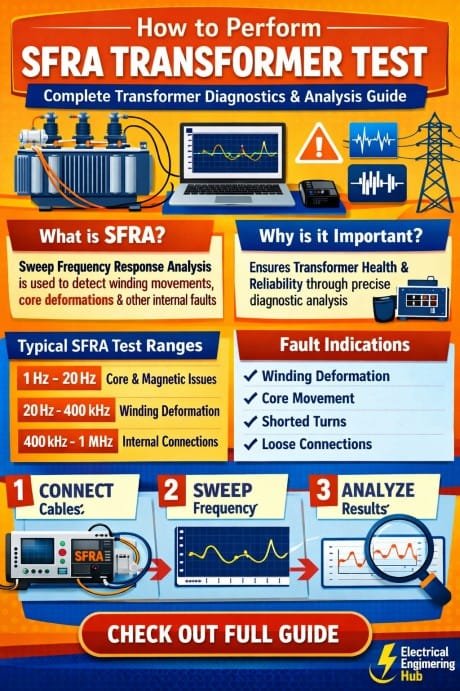
Table of Contents
The Sfra Transformer Test is widely used after transportation, short-circuit incidents, seismic activity, or major fault conditions. It compares the transformer’s frequency response against reference signatures to identify abnormalities inside the winding structure and magnetic core.
This guide explains the complete testing procedure, equipment requirements, interpretation methods, and best practices for accurate transformer diagnostics.
Use our online tool for free Transformer Neutral Current Calculator – Accurate Neutral Current Estimation
What is Sfra Transformer Test?
Sfra Transformer Test stands for Sweep Frequency Response Analysis Transformer Test. It is a non-destructive diagnostic technique used to evaluate the mechanical integrity of transformer windings, core, and clamping structures.
The test works by injecting low-voltage signals across a wide frequency range into transformer windings and measuring the response. Every transformer has a unique electrical fingerprint. If winding displacement, deformation, looseness, or core movement occurs, the response pattern changes.
Utilities and maintenance teams use this method for:
- Detecting winding deformation
- Identifying core displacement
- Checking transportation damage
- Verifying transformer mechanical integrity
- Evaluating short-circuit impact
- Monitoring aging transformers
Find more about Best Medium Voltage Transformers for Solar Plants
Why Sfra Transformer Test is Important
Mechanical faults inside transformers may not appear during insulation resistance or turns ratio testing. However, even minor winding displacement can lead to severe insulation failure under operating conditions.
The Sfra Transformer Test helps identify hidden problems before they become catastrophic failures.
Key Benefits
| Benefit | Description |
|---|---|
| Early Fault Detection | Finds winding and core issues before failure |
| Non-Destructive Method | No damage to transformer during testing |
| Accurate Diagnostics | Detects even small mechanical changes |
| Preventive Maintenance | Reduces unexpected outages |
| Post-Fault Assessment | Confirms transformer condition after faults |
Principle of Sfra Transformer Test
The transformer winding behaves like a complex electrical network made of inductance, capacitance, and resistance. When frequency changes, the impedance characteristics also change.
During the Sfra Transformer Test, a sinusoidal signal is applied over a frequency range typically from 20 Hz to several MHz. The analyzer records the response and creates a frequency response curve.
Any physical movement inside the transformer changes electrical parameters, which alters the response signature.
Get started with our free online tool Transformer Efficiency Calculator – Calculate Power, Losses & Performance Instantly
Frequency Zones and Fault Indications
| Frequency Range | Main Component Evaluated |
|---|---|
| Low Frequency | Core condition and grounding |
| Medium Frequency | Axial and radial winding movement |
| High Frequency | Leads, connections, and local deformation |
Equipment Required for Sfra Transformer Test
Proper testing equipment ensures accurate and repeatable results.
Common Equipment List
- SFRA test set or analyzer
- Coaxial test cables
- Grounding cables
- Laptop with analysis software
- Transformer drawings and previous records
- Personal protective equipment
Modern analyzers provide automatic sweep functions, graphical plotting, and comparison tools for easier diagnostics.
Transformer Preparation Before Testing
Correct preparation is essential for reliable results. The transformer must be completely isolated and safely grounded before testing begins.
Use our online tool without paying anything Transformer Impedance Calculation Tool – Accurate Transformer Impedance Calculator for Engineers
Pre-Test Checklist
| Inspection Item | Requirement |
|---|---|
| Transformer Isolated | Yes |
| Bushings Cleaned | Yes |
| Grounding Applied | Yes |
| Test Connections Verified | Yes |
| Previous Records Available | Recommended |
Important Safety Precautions
- Disconnect all external connections
- Ensure complete de-energization
- Follow lockout and tagout procedures
- Use proper grounding techniques
- Avoid nearby electromagnetic interference
How to Perform Sfra Transformer Test
The testing procedure must follow a consistent sequence to avoid measurement variations.
Step 1: Isolate the Transformer
Disconnect the transformer from all incoming and outgoing connections. Remove surge arresters, CT connections, and neutral grounding links if required by the test standard.
Step 2: Ground the Transformer Properly
Proper grounding minimizes electrical noise and improves measurement stability. Use short and secure grounding connections.
Test our online tool for free Transformer Full Load Current Calculator – Accurate Load & Current Calculation Tool for Transformers
Step 3: Connect SFRA Test Equipment
Connect the analyzer leads to the selected transformer terminals according to the test configuration.
Common Test Configurations
| Configuration | Purpose |
|---|---|
| End-to-End Open Circuit | Winding integrity |
| End-to-End Short Circuit | Leakage reactance evaluation |
| Capacitive Inter-Winding | Insulation structure analysis |
Step 4: Run Frequency Sweep
The analyzer injects signals through the transformer winding over a broad frequency range. Measurements are recorded automatically.
The sweep may take several minutes depending on the frequency range and resolution settings.
Step 5: Save and Label Test Results
Store all response curves with proper identification including:
- Transformer serial number
- Date of testing
- Phase identification
- Test configuration
- Environmental conditions
Proper documentation is critical for future comparison.
Start using our online tool today — it’s free Transformer Short Circuit Calculator – Accurate Fault Current & Transformer Protection Tool
Step 6: Compare Frequency Response Curves
The final step of the Sfra Transformer Test involves comparing the measured traces against reference data.
Comparison methods include:
- Phase-to-phase comparison
- Sister transformer comparison
- Historical fingerprint comparison
Differences in response curves may indicate internal mechanical issues.
Interpreting Sfra Transformer Test Results
Accurate interpretation requires experience and knowledge of transformer design. Small deviations may be acceptable, while major shifts often indicate serious problems.
Common Fault Indicators
| Response Variation | Possible Issue |
|---|---|
| Low-frequency deviation | Core movement or grounding issue |
| Mid-frequency shift | Winding displacement |
| High-frequency changes | Lead movement or local faults |
| Large amplitude difference | Severe deformation |
Engineers should analyze trends rather than relying on a single observation.
Know more about 11kV to 415V Transformer Design & Specification – Ratings, Losses, Cooling and Practical Selection Guide
Common Causes of Transformer Winding Deformation
Several operational conditions can damage transformer windings.
Main Causes
- External short circuits
- Transportation shocks
- Earthquakes and vibration
- Fault current stress
- Improper lifting
- Aging insulation structures
Routine Sfra Transformer Test programs help identify these problems early.
Best Practices for Accurate SFRA Measurements
Testing consistency is extremely important for reliable diagnostics.
Recommended Practices
| Practice | Benefit |
|---|---|
| Use same test setup every time | Improves comparison accuracy |
| Maintain identical grounding | Reduces measurement variation |
| Keep cables short | Minimizes interference |
| Test in dry conditions | Improves signal quality |
| Save reference fingerprints | Enables trend analysis |
Know more about HVDC Transformer Working Principle Explained – How Converter Transformers Handle Extreme DC Power
Difference Between SFRA and Other Transformer Tests
Many electrical tests evaluate transformer condition, but each serves a different purpose.
| Test Type | Main Purpose |
|---|---|
| Insulation Resistance Test | Insulation health |
| Transformer Turns Ratio Test | Ratio verification |
| Winding Resistance Test | Connection integrity |
| Dissolved Gas Analysis | Oil fault diagnosis |
| Sfra Transformer Test | Mechanical integrity |
Combining multiple diagnostic methods provides a complete transformer health assessment.
Applications of Sfra Transformer Test
The test is widely used across power generation, transmission, and industrial facilities.
Typical Applications
- Factory acceptance testing
- Post-transport inspection
- Preventive maintenance programs
- Short-circuit event analysis
- Transformer refurbishment evaluation
- Condition-based monitoring
Utilities increasingly rely on SFRA analysis to reduce failure risk and improve asset management.
Challenges in SFRA Analysis
Although the method is highly effective, interpretation can sometimes be complex.
Common Challenges
- Lack of reference data
- Inconsistent testing methods
- Electrical noise interference
- Limited operator experience
- Transformer design variations
Know more about HVDC Transformer Working Principle Explained – How Converter Transformers Handle Extreme DC Power
Proper training and standardized procedures significantly improve diagnostic accuracy.
Conclusion
The Sfra Transformer Test is one of the most powerful techniques for detecting internal mechanical problems in power transformers. It provides valuable insight into winding condition, core stability, and structural integrity without dismantling the transformer.
By following proper testing procedures, maintaining consistent connections, and comparing frequency response signatures carefully, maintenance teams can identify hidden faults before they lead to major failures.
Modern power utilities and industrial facilities increasingly depend on the Sfra Transformer Test as part of advanced transformer condition monitoring programs. When combined with other electrical and oil diagnostics, it becomes an essential tool for improving transformer reliability, extending service life, and reducing costly downtime. Explore details on largest transformer manufacturer in usa
Follow Us on Social:
Subscribe our Newsletter on Electrical Insights for latest updates from Electrical Engineering Hub
#HowtoPerformSfraTransformerTest,#SFRATransformerTest,#TransformerTesting,#ElectricalMaintenance,#PowerTransformer,#SFRAAnalysis,#TransformerDiagnostics,#ElectricalEngineering,#ConditionMonitoring,#TransformerHealth
