How to Perform PDMA Motor Testing | Complete Industrial Motor Diagnostics Guide
Industrial motors are the backbone of manufacturing plants, water treatment systems, HVAC applications, refineries, and production facilities. A single motor failure can stop operations, increase maintenance costs, and reduce productivity. This is why PDMA Motor Testing has become an essential part of predictive maintenance programs across industries.
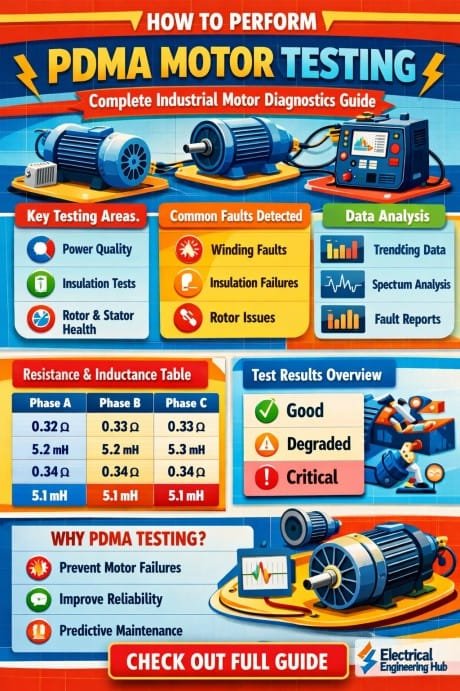
Table of Contents
PDMA testing helps maintenance teams detect electrical and mechanical faults before they become major failures. By analyzing motor health using advanced electrical signature analysis, technicians can identify insulation problems, rotor defects, winding issues, power quality disturbances, and circuit imbalances without dismantling the motor.
This guide explains how PDMA Motor Testing works, the equipment required, testing procedures, common motor faults, and best practices for accurate industrial motor diagnostics.
What is PDMA Motor Testing?
PDMA Motor Testing is a motor diagnostic method used to evaluate the condition of electric motors and related components. It uses specialized test instruments to analyze electrical characteristics and detect hidden defects in motors, generators, transformers, and motor-driven systems.
Use our free online tool Generator Sizing Calculator for VFD Motors
The testing process combines static and dynamic analysis techniques to evaluate motor reliability. Static testing is performed while the motor is de-energized, while dynamic testing is conducted when the motor is running under load conditions.
Industries use PDMA technology to improve equipment reliability, reduce downtime, and extend motor lifespan.
Why PDMA Motor Testing is Important
Industrial motors often fail due to insulation degradation, contamination, overheating, voltage imbalance, or bearing damage. Traditional inspection methods may not detect these problems early enough.
PDMA Motor Testing provides several advantages:
| Benefit | Description |
|---|---|
| Early Fault Detection | Identifies problems before motor failure occurs |
| Reduced Downtime | Prevents unexpected shutdowns |
| Lower Maintenance Cost | Helps plan repairs efficiently |
| Improved Reliability | Maintains motor performance |
| Energy Efficiency | Detects power quality and efficiency issues |
| Safety Enhancement | Reduces electrical hazards |
A well-implemented motor testing program can significantly improve plant maintenance strategies.
Uncover insights on motor generator transformer manufacturers
Types of PDMA Motor Testing
PDMA testing generally includes two major categories.
Static Motor Testing
Static testing is performed when the motor is disconnected from power. It evaluates the condition of windings, insulation systems, and electrical circuits.
Common static tests include:
- Resistance imbalance testing
- Insulation resistance testing
- Inductance measurement
- Phase angle analysis
- Rotor influence check
- Surge comparison testing
Static testing helps detect faults such as:
- Turn-to-turn shorts
- Loose connections
- Ground faults
- Winding contamination
- Insulation deterioration
Dynamic Motor Testing
Dynamic testing is conducted while the motor is operating. This allows technicians to evaluate motor performance under actual load conditions.
Dynamic tests typically analyze:
- Voltage balance
- Current signature
- Rotor condition
- Air gap eccentricity
- Power quality
- Torque performance
Dynamic analysis is useful for identifying operational issues that may not appear during static testing.
Access our powerful online calculator now star delta motor cable size calculator
Equipment Required for PDMA Motor Testing
Technicians use specialized motor diagnostic instruments for accurate analysis.
| Equipment | Purpose |
|---|---|
| PDMA Motor Analyzer | Main testing and diagnostic device |
| Insulation Tester | Measures insulation resistance |
| Clamp Meter | Measures current flow |
| Voltage Probes | Monitors voltage conditions |
| Laptop or Software Interface | Stores and analyzes test results |
| PPE Safety Equipment | Ensures technician safety |
Modern testing systems also generate detailed reports for maintenance documentation and trend analysis.
Step-by-Step Process for PDMA Motor Testing
Proper testing procedures are essential for reliable results.
Step 1: Perform Safety Inspection
Before starting any motor diagnostics:
- Follow lockout/tagout procedures
- Disconnect power supply if performing static testing
- Wear appropriate PPE
- Inspect cables and terminals
- Verify motor nameplate information
Safety should always be the first priority during industrial motor testing.
Use our online tool for free Wire Size Calculator for Motors – Accurate Motor Cable Sizing Tool for Electric Loads
Step 2: Conduct Visual Inspection
A visual inspection helps identify obvious mechanical and environmental issues.
Check for:
- Dirt or moisture contamination
- Burn marks
- Loose terminals
- Damaged insulation
- Overheating signs
- Cooling fan condition
Visual findings should be recorded in the maintenance report.
Step 3: Perform Static Electrical Tests
Static testing begins with winding and insulation evaluation.
Resistance Testing
Measure phase-to-phase resistance to detect imbalance. Significant differences between phases may indicate winding damage or loose connections.
Insulation Resistance Testing
This test checks insulation integrity between windings and ground.
Typical insulation problems include:
- Moisture contamination
- Thermal aging
- Dirt accumulation
- Insulation breakdown
Know more about How to Check 3 Phase Motor Winding with Multimeter
Inductance and Phase Angle Testing
These tests identify rotor bar issues and winding abnormalities.
Step 4: Perform Dynamic Testing
After static tests, energize the motor for operational analysis.
Dynamic testing evaluates:
- Voltage imbalance
- Current harmonics
- Rotor condition
- Load performance
- Power factor
- Efficiency trends
Technicians compare readings against baseline values for accurate diagnosis.
Step 5: Analyze Test Results
PDMA software generates detailed motor condition reports. Maintenance teams analyze trends and prioritize repairs based on severity.
Typical classifications include:
| Condition Level | Recommended Action |
|---|---|
| Normal | Continue routine monitoring |
| Minor Defect | Schedule maintenance |
| Moderate Defect | Plan repair during shutdown |
| Severe Defect | Immediate corrective action |
Trend analysis is extremely valuable for predictive maintenance programs.
Know more about How to Size a VFD for a Motor. This is an expert Guide for Accurate Selection
Common Faults Detected by PDMA Motor Testing
PDMA analysis can identify various motor defects before catastrophic failure occurs.
Rotor Bar Defects
Broken rotor bars create uneven magnetic fields and reduce motor efficiency.
Symptoms include:
- Increased vibration
- Torque fluctuation
- Excessive heating
- Current imbalance
Stator Winding Faults
Winding insulation deterioration is one of the most common causes of motor failure.
Potential causes include:
- Thermal stress
- Voltage spikes
- Contamination
- Aging insulation
Power Quality Problems
Poor power quality affects motor performance and reliability.
Common issues include:
- Voltage imbalance
- Harmonics
- Low voltage
- Phase loss
Know more about Top 15 Motor Control Center Manufacturers in Malaysia – Trusted MCC Brands for Industrial Power
Air Gap Eccentricity
Uneven air gaps between rotor and stator can cause mechanical stress and vibration.
PDMA tools help identify eccentricity before severe damage develops.
Best Practices for Accurate Motor Diagnostics
Following industry best practices improves testing accuracy and reliability.
Maintain Historical Records
Keep detailed test records for comparison and trend analysis.
Test Motors Regularly
Critical motors should be included in scheduled predictive maintenance programs.
Use Baseline Readings
Baseline data from new or repaired motors helps detect future deterioration.
Train Maintenance Personnel
Qualified technicians ensure proper testing procedures and accurate interpretation.
Combine Multiple Diagnostic Methods
Many facilities combine:
- Vibration analysis
- Infrared thermography
- Oil analysis
- PDMA Motor Testing
This creates a complete condition monitoring strategy.
Learn more about servo motor interview questions
PDMA Motor Testing vs Traditional Testing Methods
Traditional testing methods often identify faults only after damage becomes severe. PDMA technology provides earlier and more detailed diagnostics.
| Traditional Testing | PDMA Testing |
|---|---|
| Limited fault detection | Comprehensive diagnostics |
| Reactive maintenance | Predictive maintenance |
| Basic electrical checks | Advanced signature analysis |
| Higher downtime risk | Improved reliability |
| Less trend analysis | Detailed historical tracking |
Industries increasingly prefer predictive maintenance because it reduces operational costs and unexpected failures.
Industries That Use PDMA Motor Testing
Many sectors rely on advanced motor diagnostics for equipment reliability.
Major industries include:
- Manufacturing plants
- Oil and gas facilities
- Water treatment plants
- Food processing industries
- Mining operations
- Power generation stations
- HVAC systems
- Agriculture and irrigation systems
Motor reliability is critical in continuous process industries where downtime is extremely expensive.
Know more about Motor Overload Protection Chart
Conclusion
PDMA Motor Testing is one of the most effective methods for industrial motor diagnostics and predictive maintenance. It helps maintenance teams detect hidden electrical and mechanical problems before they lead to costly failures.
By combining static and dynamic analysis, technicians can evaluate insulation health, rotor condition, winding integrity, and overall motor performance with high accuracy. Regular testing improves equipment reliability, reduces downtime, lowers maintenance expenses, and increases operational efficiency.
Industries that invest in advanced motor diagnostics gain better control over maintenance planning and asset management. Whether used in manufacturing, utilities, oil and gas, or agriculture, PDMA Motor Testing plays a vital role in maintaining reliable industrial operations.
Get new guides in your feed. Follow Electrical Insights on LinkedIn for new electrical standards guides, calculators and design tips from Azad Circuit Hub.
#HowtoPerformPDMAMotorTesting,#PDMAMotorTesting,#MotorTesting,#ElectricMotorDiagnostics,#PredictiveMaintenance,#MotorConditionMonitoring,#IndustrialMaintenance,#MotorAnalysis,#ElectricalTesting,#ReliabilityEngineering