
How to Perform Protection Relay Testing | Complete Industrial Relay Testing Guide
Protection Relay Testing is an essential process in industrial power systems because it ensures the safety, reliability, and stability of electrical equipment. Every modern industrial facility depends on protection relays to detect electrical faults and isolate faulty sections before major damage occurs. Without proper relay inspection and testing, faults can lead to equipment failure, fire hazards, production shutdowns, and costly maintenance.
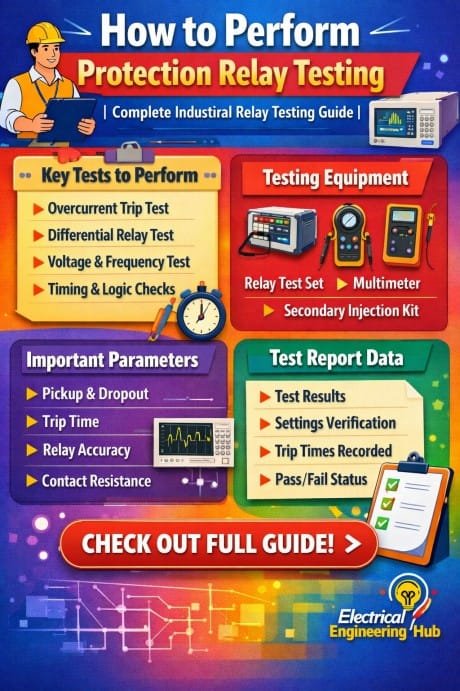
Table of Contents
Industrial plants, substations, power distribution systems, and manufacturing facilities regularly perform Protection Relay Testing to verify that relays operate correctly under fault conditions. A properly tested relay system improves electrical protection coordination and minimizes downtime.
This guide explains the complete process, testing methods, equipment requirements, safety procedures, and best practices used in industrial relay testing.
What is Protection Relay Testing?
Protection Relay Testing is the procedure used to verify the performance, accuracy, timing, and operational condition of protective relays installed in electrical systems. These relays monitor electrical parameters such as current, voltage, frequency, impedance, and phase angle.
Know more about What Are the Applications of Overcurrent Relays in Power Systems?
When abnormal conditions occur, the relay sends a trip signal to circuit breakers to isolate the faulted section. Testing ensures that the relay responds correctly and within the required time limits.
The process usually includes:
| Testing Area | Purpose |
|---|---|
| Functional Testing | Checks relay operation |
| Secondary Injection Testing | Verifies relay logic and settings |
| Primary Injection Testing | Tests complete protection circuit |
| Trip Circuit Testing | Confirms breaker tripping |
| Timing Test | Measures relay operating time |
| Calibration Test | Verifies measurement accuracy |
Importance of Protection Relay Testing
Industrial electrical systems operate under heavy loads and harsh environmental conditions. A malfunctioning relay can fail to detect faults or may trip unnecessarily. Both situations can create operational and financial losses.
Dive deeper into differential protection of alternator
Some major benefits of Protection Relay Testing include:
- Improved electrical safety
- Reduced equipment damage
- Better system reliability
- Compliance with electrical standards
- Reduced unplanned outages
- Accurate fault detection
- Enhanced protection coordination
Testing also helps maintenance teams identify hidden issues before they become serious failures.
Types of Protective Relays Used in Industries
Different types of relays are used based on system requirements and protection schemes.
| Relay Type | Application |
|---|---|
| Overcurrent Relay | Feeder and transformer protection |
| Differential Relay | Transformer and generator protection |
| Distance Relay | Transmission line protection |
| Earth Fault Relay | Ground fault detection |
| Under Voltage Relay | Voltage monitoring |
| Frequency Relay | Frequency protection |
| Motor Protection Relay | Industrial motor safety |
| Numerical Relay | Advanced digital protection |
Modern industries mostly use numerical relays because they provide advanced diagnostics, communication features, and programmable settings.
Learn more about types of generator protection relays
Equipment Required for Protection Relay Testing
Before starting relay testing, technicians prepare specialized testing equipment and safety tools.
Common Testing Equipment
| Equipment | Function |
|---|---|
| Relay Test Kit | Generates current and voltage signals |
| Secondary Injection Kit | Simulates fault conditions |
| Multimeter | Measures voltage and continuity |
| Clamp Meter | Current measurement |
| Insulation Tester | Checks insulation resistance |
| Laptop with Relay Software | Relay configuration and analysis |
| Timing Meter | Measures operating time |
Advanced relay test sets can simulate multiple fault conditions for detailed analysis.
Safety Precautions Before Relay Testing
Electrical safety is extremely important during Protection Relay Testing because technicians work near energized systems.
Get complete information about protection of alternator
Follow these safety practices before testing:
- Obtain work permits and shutdown approvals
- Follow lockout and tagout procedures
- Wear PPE including gloves and arc flash protection
- Verify isolation before touching circuits
- Check test equipment calibration
- Use proper grounding methods
- Keep unauthorized personnel away
A proper risk assessment should always be completed before beginning any testing activity.
Step-by-Step Protection Relay Testing Procedure
Industrial relay testing follows a structured process to ensure accuracy and consistency.
Visual Inspection
Start with a detailed visual inspection of the relay panel and associated wiring.
Check the following:
- Loose terminals
- Damaged cables
- Burn marks
- Dust accumulation
- Corrosion
- Incorrect labeling
Visual inspection helps identify physical issues that may affect relay performance.
Know more about alternator protection scheme
Verify Relay Settings
Before conducting injection tests, compare relay settings with approved protection coordination studies.
Important settings include:
| Relay Parameter | Example |
|---|---|
| Pickup Current | 1.2 x Full Load Current |
| Time Delay | 0.5 Seconds |
| CT Ratio | 400/5 |
| PT Ratio | 11kV/110V |
| Trip Curve | IEC Standard Inverse |
Incorrect settings can result in false tripping or protection failure.
Secondary Injection Testing
Secondary injection testing is the most common method used in Protection Relay Testing. It involves injecting simulated current and voltage signals directly into the relay terminals.
Procedure
- Disconnect relay trip outputs if required
- Connect the relay test kit
- Inject current or voltage signals
- Increase values gradually
- Observe relay pickup and trip operation
- Record timing and operating values
This method checks relay logic, accuracy, and timing without energizing primary equipment.
Explore details on IEC Standard for Differential Protection
Advantages
- Fast and safe
- Accurate testing method
- Minimal system interruption
- Suitable for routine maintenance
Primary Injection Testing
Primary injection testing verifies the complete protection circuit, including CTs, wiring, relays, and breakers.
In this method, high current is injected into the primary side of the current transformer.
Applications
- Commissioning tests
- High accuracy verification
- Complete system validation
Although primary injection testing provides realistic results, it requires larger equipment and more shutdown time.
Trip Circuit Testing
Trip circuit testing confirms that the relay can successfully operate the circuit breaker.
The procedure includes:
- Checking breaker trip coil continuity
- Simulating trip commands
- Verifying breaker opening
- Measuring trip response time
A faulty trip circuit can prevent fault isolation even when the relay operates correctly.
Find out more about transformer differential protection
Relay Timing Test
Relay timing is critical for proper coordination between upstream and downstream protection devices.
Timing tests measure:
| Test Parameter | Purpose |
|---|---|
| Pickup Time | Relay response delay |
| Trip Time | Total operating time |
| Reset Time | Relay recovery period |
Incorrect timing can create coordination problems and unnecessary outages.
Common Problems Found During Protection Relay Testing
Routine testing often reveals hidden issues within electrical protection systems.
Common Faults
- Incorrect relay settings
- CT polarity errors
- Loose wiring connections
- Defective trip circuits
- Relay calibration drift
- Communication failures
- Firmware issues in numerical relays
Early detection helps prevent major electrical failures.
Documentation and Test Reports
Proper documentation is an important part of industrial relay maintenance.
Uncover insights on high impedance protection
A standard relay testing report should include:
| Report Section | Details |
|---|---|
| Relay Identification | Model and serial number |
| Test Date | Maintenance schedule |
| Test Results | Pickup and trip values |
| Relay Settings | Protection configuration |
| Observations | Defects and remarks |
| Technician Details | Signature and approval |
Detailed records help with future troubleshooting and compliance audits.
Best Practices for Industrial Relay Testing
Industries follow several best practices to improve protection system reliability.
Recommended Practices
- Perform periodic relay testing
- Use calibrated test equipment
- Maintain updated relay settings
- Follow manufacturer recommendations
- Train maintenance personnel regularly
- Use digital test reporting systems
- Verify protection coordination annually
Modern predictive maintenance programs also use condition monitoring to improve relay performance.
Read in detail about types of transformer protection relays
Conclusion
Protection Relay Testing plays a vital role in maintaining safe and reliable industrial electrical systems. Proper testing ensures that relays detect faults accurately and isolate damaged sections before equipment failure occurs. Industries that follow structured relay maintenance procedures experience fewer outages, better system stability, and improved operational safety.
From visual inspection and secondary injection testing to timing verification and trip circuit analysis, every step contributes to the reliability of the protection system. Regular testing, accurate documentation, and adherence to safety standards are essential for long-term electrical system performance.
As industrial power systems continue to become more advanced, Protection Relay Testing remains one of the most important maintenance activities for ensuring uninterrupted operations and electrical protection reliability.
Follow Us on Social:
Subscribe our Newsletter on Electrical Insights for latest updates from Electrical Engineering Hub
#HowToPerformProtectionRelayTesting,#ProtectionRelayTesting,#RelayTestingGuide,#ElectricalTesting,#PowerSystemProtection,#IndustrialMaintenance,#RelayCommissioning,#SubstationTesting,#ElectricalEngineering,#ProtectionSystem
