
Copper Cable Testing Parameters Guide | Complete Electrical Cable Testing & Inspection Standards
Copper cables are widely used in electrical systems because of their excellent conductivity, durability, and long service life. In industrial plants, commercial buildings, solar projects, and residential wiring systems, proper testing is necessary to maintain safety and performance. Understanding Copper Cable Testing Parameters helps engineers, electricians, inspectors, and maintenance teams identify faults before they become serious problems.
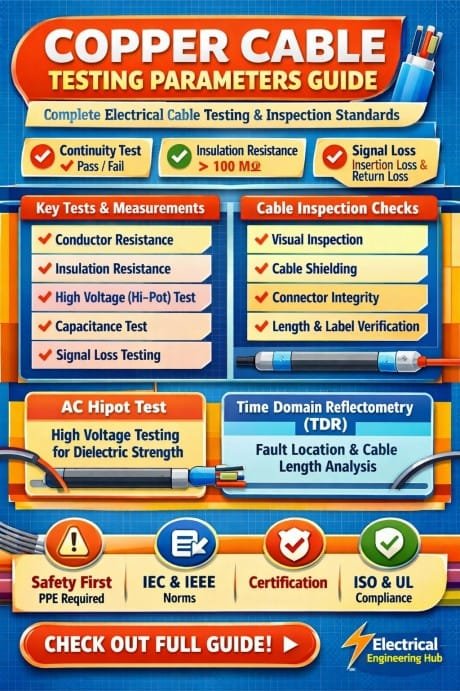
Table of Contents
Cable testing is not limited to checking continuity only. Modern inspection standards involve electrical, mechanical, thermal, and insulation-based evaluations. These tests ensure that copper cables comply with international electrical standards and perform efficiently under different operating conditions.
Importance of Copper Cable Testing
Electrical cables operate under varying loads, temperatures, and environmental conditions. If testing is ignored, hidden defects may lead to overheating, voltage drops, insulation failure, equipment damage, or electrical fires.
Use our online tool 3 phase cable size calculator
The purpose of Copper Cable Testing Parameters is to verify:
- Electrical conductivity
- Insulation quality
- Current carrying capacity
- Mechanical strength
- Safety compliance
- Voltage withstand capability
- Resistance against environmental stress
Routine inspection also increases cable lifespan and reduces maintenance costs in industrial and commercial systems.
Main Copper Cable Testing Parameters
The following table explains the most important testing parameters used during cable inspection and commissioning.
| Testing Parameter | Purpose | Typical Test Equipment |
|---|---|---|
| Continuity Test | Checks conductor continuity | Multimeter |
| Insulation Resistance Test | Measures insulation health | Megger |
| High Voltage Test | Verifies dielectric strength | HV Tester |
| Conductor Resistance Test | Measures conductor resistance | Micro-ohmmeter |
| Earth Continuity Test | Ensures grounding safety | Earth Tester |
| Polarity Test | Confirms correct wiring connections | Multimeter |
| Capacitance Test | Measures cable capacitance | LCR Meter |
| Sheath Integrity Test | Detects sheath damage | DC Voltage Tester |
These Copper Cable Testing Parameters are commonly used in power distribution systems, control wiring, instrumentation cables, and underground electrical installations.
For Accurate and Easy Cable Capacity, use our online tool Cable Trench Fill Calculator
Continuity Testing of Copper Cables
Continuity testing is one of the most basic but essential cable inspection methods. It confirms that the conductor path is complete from one end to another.
A digital multimeter is generally used for this test. Low resistance indicates that the conductor is intact and free from open circuits.
Key Points During Continuity Testing
- Disconnect the cable from power supply
- Ensure proper terminal identification
- Measure resistance across both ends
- Compare readings with standard values
This test is highly important during cable installation and troubleshooting activities.
Try our free online tool today ev charger cable size calculator
Insulation Resistance Testing
Insulation resistance testing evaluates the condition of cable insulation. Moisture, aging, dust, and mechanical damage can reduce insulation effectiveness over time.
A megger applies DC voltage between conductors and ground to measure insulation resistance in megaohms.
Standard Insulation Resistance Values
| Cable Voltage Rating | Minimum IR Value |
|---|---|
| Low Voltage Cable | 1 MΩ |
| Medium Voltage Cable | 100 MΩ |
| High Voltage Cable | Above 1000 MΩ |
Low insulation resistance may indicate:
- Insulation breakdown
- Water ingress
- Cable aging
- Physical damage
Among all Copper Cable Testing Parameters, insulation resistance testing is one of the most critical for electrical safety.
High Voltage Withstand Test
The high voltage test, also known as the dielectric withstand test, checks whether the cable insulation can handle operating voltage without failure.
Access our powerful online calculator now star delta motor cable size calculator
This test is usually conducted after installation or during factory acceptance testing.
Common HV Testing Methods
- AC High Voltage Test
- DC High Voltage Test
- VLF Testing for medium voltage cables
During testing, cables must not show flashover, leakage current spikes, or insulation breakdown.
Conductor Resistance Testing
Conductor resistance directly affects voltage drop and power loss in electrical systems. Copper cables normally have low resistance because copper is a highly conductive material.
Resistance testing helps identify:
- Improper conductor size
- Loose joints
- Damaged strands
- Manufacturing defects
Factors Affecting Conductor Resistance
| Factor | Effect on Resistance |
|---|---|
| Temperature Increase | Resistance increases |
| Smaller Cable Size | Higher resistance |
| Longer Cable Length | Higher resistance |
| Poor Connections | Increased resistance |
Accurate conductor resistance measurement is essential for maintaining system efficiency.
Start using our easy-to-use online tool earthing cable size calculator
Earth Continuity Testing
Grounding systems protect electrical installations from fault currents and electric shock hazards. Earth continuity testing confirms that the grounding conductor provides a continuous low-resistance path.
The test is generally performed using an earth continuity tester or low-resistance ohmmeter.
Benefits of Earth Continuity Testing
- Improved electrical safety
- Faster fault clearing
- Reduced risk of electric shock
- Better equipment protection
Electrical inspection standards often require earth continuity verification before system energization.
Polarity Testing in Electrical Cables
Polarity testing ensures that phase, neutral, and earth conductors are connected correctly. Incorrect polarity can damage equipment and create dangerous operating conditions.
This test is especially important in:
- Single-phase installations
- Power outlets
- Control circuits
- Solar inverter connections
Polarity verification is a standard requirement during cable commissioning and maintenance inspections.
Calculate instantly with our smart online tool cable size calculator australia
Capacitance Testing of Copper Cables
Capacitance testing is commonly used for communication, instrumentation, and shielded cables. It measures the ability of conductors to store electrical charge.
Abnormal capacitance values may indicate:
- Insulation deterioration
- Moisture contamination
- Cable deformation
- Manufacturing irregularities
This testing parameter is important in signal transmission systems where stable electrical characteristics are necessary.
Sheath Integrity Testing
Cable sheath testing checks the outer protective covering for punctures, cuts, or physical damage. Underground and outdoor cables are more vulnerable to sheath defects.
A damaged sheath can allow moisture entry, which eventually causes insulation failure.
Common Causes of Sheath Damage
- Excavation work
- Rodent attacks
- Mechanical stress
- UV exposure
- Improper cable pulling
Sheath testing improves long-term reliability and reduces maintenance issues.
Access our powerful online calculator now Electrical Diversity Calculator for accurate Load Estimation and efficient electrical Design.
International Standards for Cable Testing
Several international organizations define cable inspection and testing standards. Following these standards ensures safety, reliability, and compliance.
| Standard | Organization | Application |
|---|---|---|
| IEC 60502 | IEC | Power cable standards |
| IEC 60228 | IEC | Conductor specifications |
| IEEE 400 | IEEE | Field testing of cables |
| BS 7671 | British Standards | Electrical installations |
| ASTM Standards | ASTM | Material testing |
Professional testing procedures based on these standards improve installation quality and system performance.
Best Practices for Copper Cable Inspection
Proper testing procedures increase accuracy and reduce safety risks. The following practices are recommended during cable inspection.
Safety Guidelines
- Isolate the cable before testing
- Use calibrated testing instruments
- Wear insulated PPE
- Follow lockout and tagout procedures
- Record all test readings properly
Make your task simple with our online tool electrical cable size calculator
Inspection Checklist
| Inspection Area | Requirement |
|---|---|
| Cable Identification | Correct labeling |
| Insulation Condition | No visible damage |
| Cable Routing | Proper support and spacing |
| Joint Quality | Tight and corrosion-free |
| Grounding | Proper earthing connection |
Regular inspection helps detect faults early and prevents unexpected downtime.
Common Problems Detected During Cable Testing
Understanding common cable defects helps maintenance teams take corrective action quickly.
Frequently Identified Issues
- High conductor resistance
- Insulation leakage
- Short circuits
- Open circuits
- Loose terminations
- Overheating
- Water ingress
Using proper Copper Cable Testing Parameters allows technicians to identify these problems before system failure occurs.
Use our online tool for free Wire Size Calculator for Motors – Accurate Motor Cable Sizing Tool for Electric Loads
Why Accurate Cable Testing Matters
Electrical systems depend heavily on cable reliability. Faulty cables can interrupt production, damage expensive equipment, and create safety hazards.
Benefits of proper cable testing include:
- Reduced maintenance costs
- Improved electrical safety
- Longer cable life
- Better system efficiency
- Compliance with inspection standards
- Reduced energy losses
Modern industries now prioritize preventive maintenance because early fault detection saves time and operational expenses.
Explore our professional online tool for quick calculations kw to cable size calculator
Conclusion
Copper cable inspection and testing play a major role in electrical safety and system reliability. From continuity testing to insulation resistance measurement and high voltage verification, every procedure serves a specific purpose in identifying cable defects and ensuring performance.
Understanding Copper Cable Testing Parameters helps engineers, electricians, contractors, and maintenance professionals maintain efficient electrical installations according to international standards. Proper testing not only prevents failures but also increases the operational life of electrical systems.
Whether the application involves industrial machinery, commercial power distribution, solar energy systems, or residential wiring, following proper testing procedures is essential for long-term safety and dependable operation.
You might find this tool useful for tackling similar tasks Sub Panel Wire Size Calculator – Accurate Wire Gauge & Load Sizing Tool
Get new guides in your feed. Follow Electrical Insights on LinkedIn for new electrical standards guides, calculators and design tips from Azad Circuit Hub.
#CopperCableTesting,#CableTestingParameters,#ElectricalTesting,#InsulationResistanceTest,#ContinuityTest,#HighVoltageTesting,#PowerCableTesting,#ElectricalMaintenance,#CableFaultTesting,#IndustrialElectrical
