
How the Battery Industry Is Advancing Circular Economy Practices: Best Overview
Batteries are at the heart of many modern innovations like electric cars, renewable energy, portable electronics, and grid-scale energy storage. As their use grows, questions about resources, waste, and recycling are becoming increasingly pressing. A circular economy represents an opportunity to fundamentally rethink how we can prolong the working life of products, recover valuable materials, and ultimately reduce consumption in battery production and use.
The growth of the Battery Market has stimulated interest in developing sustainable production and management practices. The increased demand in the transportation sector, as well as in the energy and electronics industry, has prompted organizations to create cost-effective solutions that will allow reducing the amount of virgin material used in the production process as well as increasing the lifetime of batteries, their secondary use, and recycling.
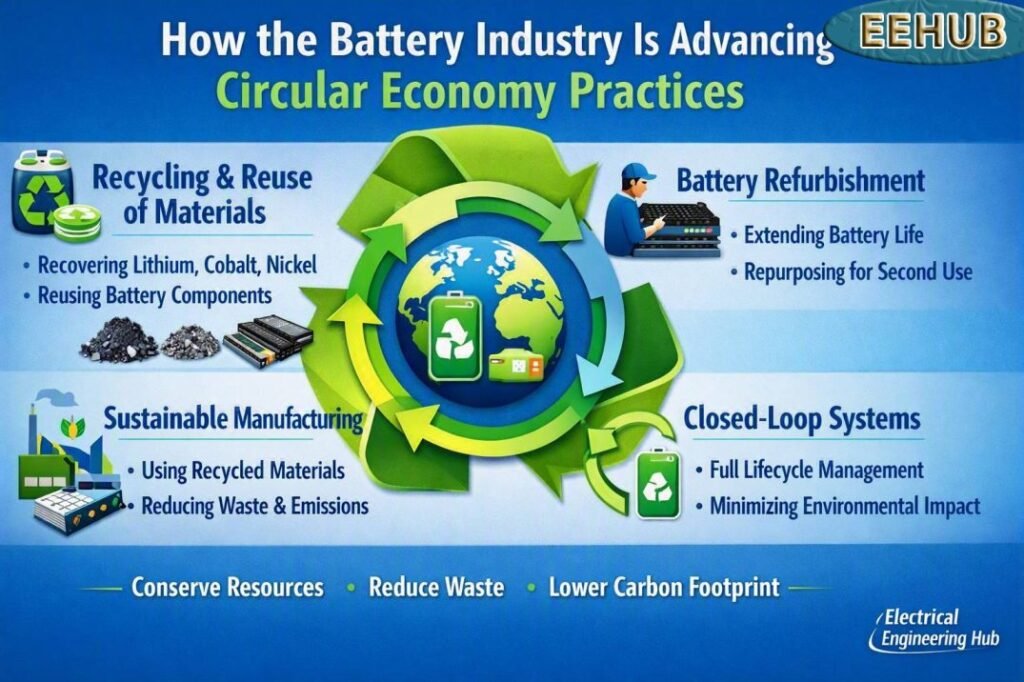
Understanding the Shift Towards a Circular Battery Economy
Traditional battery production is largely linear in nature. It implies that raw materials are extracted, turned into battery cells, assembled into a product, used by the consumer, and ultimately disposed of when they stop working. This approach has enabled the development of modern technologies; however, it has negative consequences for the environment, such as resource depletion, emissions, and waste accumulation.
The circular economy aims to keep materials in use for as long as possible and create significant value through their use. It views end-of-life products as a reservoir of resources and recycled materials that can re-enter the production cycle. The shift is critical for the battery industry, where a closed-loop system would allow for reducing material losses and waste in the production process while enabling the reclamation and reuse of valuable resources to manufacture new products.
The circularity of batteries will be facilitated by their design and extended use in various fields. It includes ways to maintain and repair devices so that they last longer, innovative approaches to second-life applications, and the establishment of efficient recycling chains at the end of the battery’s life cycle.
Creating Batteries That Last Longer
One of the key ways to improve sustainability is to prolong the lifetime of a battery. This is because the fewer replacements are needed, the lower the demand for virgin material input into the system.
Improvements in electrochemistry, manufacturing and, crucially, monitoring battery performance are enabling batteries to be utilised more reliably and predictably. Management systems are now in place that allow batteries to be maintained, monitored, diagnosed, and retired appropriately. By virtue of being able to assess battery condition, users and operators are then able to decide whether a battery is suitable for continued use, or is due for retirement or reprocessing.
Batteries need to have a design that can be easily taken apart, to be classified according to their materials and construction, in order to be readily able to enter the next stage of their life cycle.
Giving Used Batteries a Second Life
A battery that has reached the end of its service life in one technology may still have much value in another. This is especially true for batteries in electric vehicles that are approaching the end of their useful life in terms of full charge capacity, but which can still be used in other less rigorous applications.
Second-life battery recycling is a process by which batteries can be repurposed for other uses, such as stationary storage. In this way, they can also be used to manage the electricity supply, for example, as an energy buffer in photovoltaic power plants or as backup storage.
This method makes an important contribution to recycling and reusing valuable raw materials with a minimum of expenditure, since the energy already used in the production process is not wasted. Moreover, it lays the foundation for the development of alternative recycling technologies in which batteries are recycled with a view to subsequent use, thus enabling a completely new cycle of life.
The Growing Relationship Between Batteries and Renewable Energy
Battery storage is an integral element given the growth in renewable energy sources. Solar and wind power generation is dependent on weather conditions and can fluctuate throughout the day, which requires flexible storage to ensure electricity supply stability.
The increase in the Solar Energy Market has stimulated the development of storage technologies that can store extra electricity. The stored power can then be used to fulfill demand during periods of low renewable energy production.
The link between battery and solar energy is crucial to ensuring that the electricity generated continuously supplies energy. The connection is vital because it allows batteries to be recycled effectively, thus supporting the achievement of sustainable power while conserving natural resources.
Improving Battery Recycling Technologies
Recycling plays an essential role in the circular battery economy: it enables reprocessing of spent batteries to recover valuable materials for later use instead of being lost to nature.
There are several promising approaches to battery recycling, including mechanical, hydrometallurgical, and direct recycling methods.
Mechanical recycling focuses on physical separation of spent battery components to recover valuable materials that can be processed further.
Hydrometallurgical recycling involves dissolution of valuable metals through chemical processes. The metals can often be recovered in pure form for later use in new batteries. Some of the elements commonly found in batteries are lithium, nickel, cobalt, and manganese.
A third approach, direct recycling, would allow for a more sustainable process than mechanical or hydrometallurgical recycling because it would avoid the need to break the battery into its components. Instead, researchers work on a way to restore spent battery materials to their original state.
Each method has its own advantages depending on the chemical composition of the battery, the required level of material refinement, and economic factors. A great number of researchers are working on improving the viability of battery recycling to make it more energy efficient and economically competitive.
Building Better Collection and Tracking Systems
Effective recycling is only possible due to the collection and processing of used batteries. They are different from other waste because they contain valuable components. Moreover, batteries should be handled properly since they can be dangerous if they are deformed or improperly stored.
Due to modern innovations in tracking systems, it is now possible for companies to keep an excellent record of all batteries’ history and condition. Therefore, it will be easier to assign certain attributes like the amount of valuable material, production details, usage, and performance of batteries.
In addition, having access to this data will allow recycling companies to find the most appropriate way to process used batteries. Also, this information will help manufacturers determine how old batteries perform after years of usage. Overall, an advanced tracking system will improve the recycling process and ensure a sustainable supply of materials for production.
Reducing Pressure on Battery Raw Materials
Battery production relies on several resources, among which are lithium, cobalt, nickel, and graphite. The process of mining these resources is complicated and challenging, which has triggered increasing efforts to enhance recycling rates and find alternative materials and methods.
The process of recycling can significantly contribute to the reduced need for mining raw materials, although it cannot eliminate the necessity of relying on these resources. The use of recycled materials is expected to become an essential source of supply in the long run.
Moreover, researchers are also considering opportunities to replace the materials currently used in battery production with alternative resources. For instance, sodium is present in much larger quantities on the planet, compared to lithium, and sodium-ion batteries are predicted to be used in specific applications in the future.
Challenges in Creating a Circular Battery System
Despite the progress made, there are still several challenges before the circular battery system can be fully realized. For a start, the issue of diversity should be taken into consideration. There is a wide range of battery types and designs, and every type requires a specific approach during recycling. Another challenge is economic feasibility.
In this case, collection and transportation of batteries entail high costs, and the value of what can be extracted from a battery may well depend on the current supply-demand situation. Last but not least, safety is also a concern. All participants in the circular supply chain should handle batteries carefully to avoid hazardous situations. Thus, it is necessary to ensure that all facilities meet safety standards.
Finally, a circular economy requires the collaboration of many stakeholders. In relation to batteries, car manufacturers, battery recyclers, policymakers, electric utilities, and ordinary consumers should work together to ensure that production processes are optimized, proper recycling technologies are used, and batteries are handled correctly.
Looking Ahead: The Future of Circular Battery Practices
The future sustainability of battery production depends on improvements along the whole life cycle of batteries. This includes, apart from design for long-term use and enhanced digital performance, innovations in collection and recycling, as well as the re-use of materials.
Digital technologies and approaches can be used to facilitate a circular economy by supporting the development of better-performing batteries, more reliable information on their condition, and appropriate options for reuse, repurposing, and recycling. New materials can also help make batteries more sustainable through easier end-of-life processing or reduced use of critical minerals.
A truly circular economy for batteries will require more than one initiative. It will be based on continuous improvements in design, production, energy performance, collection, and recycling.
Conclusion
The battery industry is slowly transitioning to a circular economy, where the materials are used for as long as possible, and waste is minimized by carefully managing resources. It iscrucial too redesigtheee batteries to last longer, find new ways to use spent batteries, recycle the materials better, and improve tracking to ensure that nothing goes to waste.
Due to increased demand, the use of batteries in the future will increase significantly. Therefore, being prepared for a circular economy will help the industry stay ahead of the curve, be responsible, and lead the global transition to more efficient energy storage and usage.
Get new guides in your feed. Follow Electrical Insights on LinkedIn for new electrical standards guides, calculators and design tips from Azad Circuit Hub.
BatteryIndustry, #CircularEconomy, #BatteryRecycling, #SustainableEnergy, #EVBatteries, #CleanTechnology, #GreenInnovation, #EnergyStorage, #Sustainability, #BatteryLifecycle


