Beyond the Grid: How Portable Solar Power Stations Are Changing Backup Energy
Reliable electricity is something most people take for granted until an outage, camping trip, road adventure, or off-grid project changes the situation. Traditional backup generators can provide substantial power, but they often rely on fuel, produce exhaust, and require regular maintenance. Portable power stations offer another approach, particularly when paired with solar panels.
A modern portable power station combines a rechargeable battery, inverter, charging system, and multiple output ports in one unit. This makes it possible to store electricity and use it later for everything from phones and laptops to refrigerators, lights, and other essential equipment.
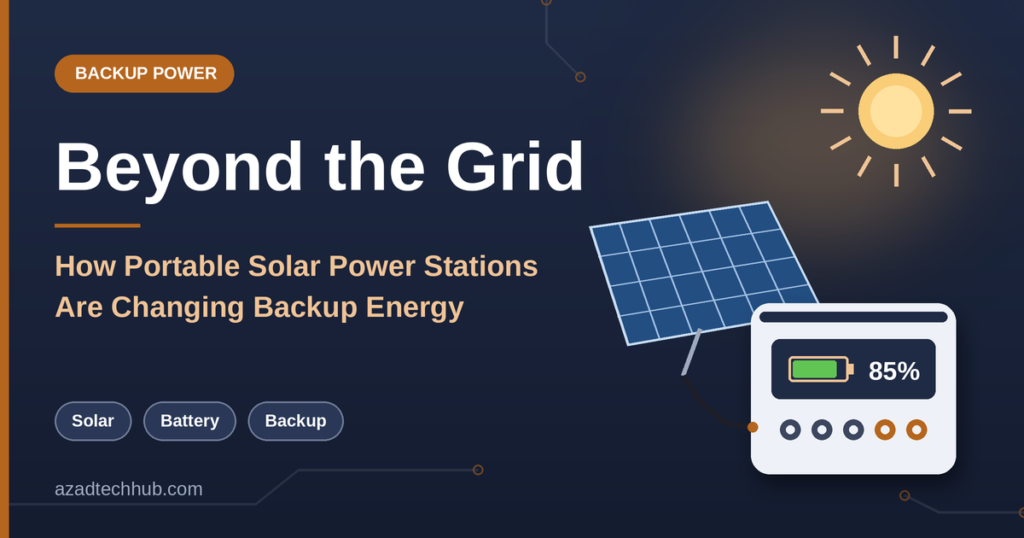
Table of Contents
Table of Contents
Why Portable Solar Power Is Becoming More Practical
One of the biggest advantages of a solar-compatible power station is flexibility. Instead of depending entirely on gasoline or another fuel source, users can recharge the battery from compatible solar panels when sunlight is available.
This can be useful for camping, RV travel, remote work, emergency preparedness, and occasional power outages. The exact usefulness depends on the battery capacity, inverter output, solar input, and the appliances being powered.
For example, a smaller unit may be appropriate for charging electronics and running lights, while a larger system can provide considerably more energy for household backup. Current portable models range from compact systems to large-capacity units designed for more demanding applications.
Understanding Battery Capacity and Power Output
Two specifications deserve particular attention when comparing portable power stations: watt-hours and watts.
Watt-hours (Wh) indicate how much energy the battery can store. A larger Wh rating generally means the system can run compatible devices for longer.
Watts (W) describe how much power the inverter can deliver at a given time. A device may have plenty of battery capacity but still be unable to operate an appliance if that appliance requires more power than the inverter can provide.
This distinction is particularly important when choosing a system for refrigerators, power tools, medical equipment, or other appliances with higher starting or continuous power requirements. Read more about home backup power.
How to Estimate Runtime: A Worked Example
A simple way to estimate how long a power station can run a device is:
Runtime (hours) ≈ (Battery Wh × 0.85) ÷ Load (W)
The 0.85 factor is a common allowance for inverter and conversion losses. Real-world results vary by model, temperature, and load, so treat the result as an estimate.
Take a 1,024Wh battery as an example. Usable energy is about 1,024 × 0.85 ≈ 870Wh. The table below shows approximate runtimes for some typical loads.
| Device (illustrative load) | Load | Approx. runtime |
|---|---|---|
| Wi-Fi router | 15 W | about 58 hours |
| LED lighting | 20 W | about 43 hours |
| Laptop | 60 W | about 14 hours |
| Small refrigerator (average draw) | 80 W | about 11 hours |
These loads are examples only, so check the label or manual of your own devices. You can also measure your real loads with an energy monitor here. Remember that refrigerators and other motor-driven appliances draw a higher surge when starting, so the inverter’s peak rating matters as well as the battery size.
The Role of Solar Charging
Solar charging can make a portable power station considerably more useful away from the electrical grid. Instead of treating the battery as a one-time source of stored electricity, users can potentially recharge it during the day and use that stored energy later.
Solar charging speed depends on several factors, including panel wattage, sunlight conditions, charging limits, and the power station’s maximum solar input. A rough estimate is:
Charging time (hours) ≈ Battery Wh ÷ (Panel W × 0.75)
The 0.75 factor reflects typical real-world losses from sun angle, which can be better estimated when you calculate solar performance ratio. Then comes the heat and cable and controller efficiency. For a 1,024Wh battery and 400W of panels, that works out to roughly 3.5 hours of strong sunlight for a full recharge. Cloud cover or low sun will increase it.
Some newer systems are designed with substantial solar-input capabilities. For instance, The Solar Lab’s testing of the Bluetti Elite 100 V2 described its 1,000W solar input as unusually high relative to its 1,024Wh battery capacity.
Battery Chemistry: Why LiFePO4 Matters
Many current portable power stations use lithium iron phosphate (LiFePO4 or LFP) cells. Compared with other lithium-ion chemistries such as NMC, LFP batteries typically offer a longer cycle life and better thermal stability, at the cost of somewhat higher weight for the same capacity. The Elite 100 V2, for example, is listed with LFP chemistry.
When comparing models, look at the manufacturer’s rated number of charge cycles and the length of the warranty, since these indicate how long the battery is expected to remain useful.
Choosing the Right Solar Power Station
When researching solar power station options, including Bluetti’s range, it is better to start with your actual power requirements rather than simply choosing the largest battery available.
Someone who primarily needs emergency phone charging, lighting, and laptop power may have very different requirements from someone trying to keep a refrigerator, internet equipment, and several household appliances operating during an outage.
Bluetti’s range includes compact portable models as well as larger systems intended for home backup, including the Elite 100 V2, Elite 200 V2, Elite 300, Elite 400, and Apex 300, with substantially different battery capacities and inverter outputs.
Portable Power Stations for Different Situations
A Bluetti portable power station can serve several different purposes depending on its size and capabilities.
For camping and outdoor activities, portability and weight may matter more than maximum capacity. For home emergency backup, battery capacity, inverter output, charging speed, and expansion options become more important.
The same principle applies to RV users and people working at remote job sites. Instead of assuming that one power station is ideal for everyone, buyers should calculate which devices they need to operate and estimate their expected runtime using the method above.
What to Check Before Buying
Before choosing a portable power station, consider:
- Battery capacity in watt-hours
- Continuous and peak inverter output
- Maximum solar input
- AC and DC output options
- Recharge time
- Battery chemistry and rated cycle life
- Weight and portability
- Expandable battery options
- Warranty and customer support
It is also worth looking at independent testing rather than relying exclusively on manufacturer specifications. Real-world efficiency, idle consumption, charging behavior, and usability can make a meaningful difference. The Solar Lab publishes hands-on Bluetti reviews covering performance, efficiency, portability, strengths, and weaknesses across multiple models.
Basic Safety Tips
Use a power station in a dry, well-ventilated area and keep it away from direct heat. Follow the manual for the correct charging cables and panel voltage limits, and do not connect loads that exceed the inverter’s rated output. Many models are not waterproof, so protect them from rain and moisture during outdoor use.
A More Flexible Approach to Backup Power
Portable solar power stations are not a replacement for every type of backup-energy system. Large homes with substantial electrical loads may require permanently installed battery storage or other solutions.
For smaller loads and situations where mobility matters, however, they provide a practical middle ground. A rechargeable battery can store energy when it is available, while solar panels can provide an additional charging source when conventional electricity is unavailable.
The key is matching the system to the actual use case. Rather than focusing only on brand names or headline battery capacity, buyers should consider how much power they need, how long they need it, and how they plan to recharge the system. For anyone comparing solar power station options, including Bluetti’s models, checking battery capacity, inverter performance, solar charging capability, and real-world testing can make the buying decision much easier.
Get new guides in your feed. Follow Electrical Insights on LinkedIn for new electrical standards guides, calculators and design tips from Azad Circuit Hub.