
Junction Box vs Pull Box: Key Differences and Sizing Rules
Many electricians, contractors, and DIY users use the terms junction box and pull box interchangeably. While they may look similar, the National Electrical Code (NEC) applies different sizing rules depending on how the enclosure is used and the size of the conductors inside it. Choosing the wrong rule can result in an undersized enclosure, difficult cable installation, or code compliance issues.
This guide explains the difference between Junction Box vs Pull Box, shows when each rule applies, and helps you determine whether you need box fill calculations or pull box dimension calculations. If you are looking for a junction box sizing calculator, this guide also explains when a pull box sizing method is actually the correct solution.
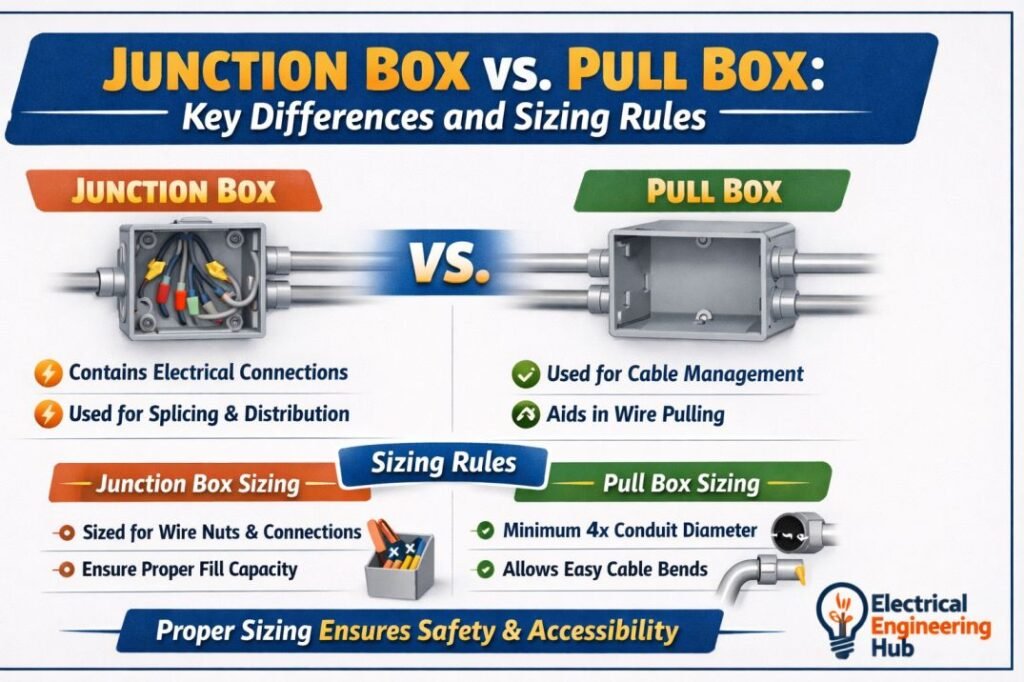
Table of Contents
Table of Contents
What Is a Junction Box?
A junction box is an electrical enclosure used to join, splice, or terminate conductors while protecting wiring connections from mechanical damage and accidental contact. These boxes are commonly installed in residential, commercial, and light industrial electrical systems.
For most applications involving conductors smaller than 4 AWG, junction boxes are sized according to NEC 314.16. Instead of using outside dimensions, this rule is based on box fill volume. Every conductor, device, grounding conductor, and internal clamp occupies a specific volume, and the total must not exceed the box capacity.
Typical applications include:
- Lighting circuits
- Receptacle outlets
- Switch boxes
- Branch circuit splices
- Small equipment connections
If you are searching for a junction box size calculator, remember that standard junction box calculations usually involve conductor count and box volume rather than enclosure dimensions.
What Is a Pull Box?
A pull box is an enclosure designed to assist with installing, pulling, changing direction, or splicing larger electrical conductors. These boxes reduce pulling tension, provide easier access during installation, and protect cable insulation from excessive bending.
Unlike junction boxes, pull boxes handling conductors that are 4 AWG and larger are governed by NEC 314.28. This section uses minimum enclosure dimensions instead of volume calculations. The required box size depends on whether conductors pass straight through the enclosure or make angle or U-pulls.
Pull boxes are commonly used for:
- Service entrance conductors
- Large feeders
- Industrial power distribution
- Motor feeders
- Underground conduit systems
For detailed code requirements, see our guide on NEC 314.28 Pull Box Sizing Requirements.
If your installation includes large conductors, use the Pull Box Sizing Calculator instead of relying on a standard junction box sizing calculator.
Junction Box vs Pull Box: Conductor Size Determines the Rule
The biggest misunderstanding is assuming the physical appearance of the enclosure determines whether it is a junction box or a pull box. In reality, the deciding factor is usually the conductor size and the applicable NEC article.
When conductors are smaller than 4 AWG, NEC 314.16 applies. The enclosure must provide enough internal volume for all conductors, devices, clamps, and grounding conductors. The calculation is based on box fill allowances.
When conductors are 4 AWG or larger, NEC 314.28 applies. Instead of calculating internal volume, the installer measures the required enclosure dimensions based on conduit size, conductor routing, and whether the pull is straight, angle, or U-shaped.
Because of this distinction, many online searches for Junction Box vs Pull Box actually relate to pull box dimension calculations rather than traditional junction box sizing.
If your conductors are 4 AWG or larger, skip the box fill calculation and use the Pull Box Sizing Calculator to determine the minimum enclosure dimensions required by NEC.
Side-by-Side Comparison
| Feature | Junction Box | Pull Box |
|---|---|---|
| Governing Rule | NEC 314.16 | NEC 314.28 |
| Conductor Size | Under 4 AWG | 4 AWG and larger |
| Sizing Method | Box fill and conductor volume | Dimension-based calculations |
| Primary Purpose | Splicing and terminating conductors | Pulling, redirecting, or splicing large conductors |
| Common Applications | Lighting, receptacles, switches | Feeders, service conductors, industrial wiring |
| Calculation Method | Volume allowances per conductor | Straight pull, angle pull, or U-pull dimensions |
| Main Design Factor | Internal box volume | Minimum enclosure dimensions |
| Calculator Used | Electrical Junction Box Sizing Calculator | Pull Box Sizing Calculator |
Which One Do You Have? Quick Check
The fastest way to determine which NEC rule applies is to identify the largest conductor entering the enclosure.
Use these simple checks:
- Conductors smaller than 4 AWG → Follow NEC 314.16 box fill requirements.
- Conductors 4 AWG or larger → Follow NEC 314.28 pull box sizing requirements.
- Large feeder or service conductors changing direction inside the enclosure → Use the Pull Box Sizing Calculator to determine the required dimensions.
This quick check eliminates confusion and helps you apply the correct sizing method before selecting an enclosure.
Size Your Box the Right Way
Choosing between a junction box and a pull box is only the first step. The next step is selecting the correct box size based on the conductor size and the applicable NEC requirements. In the context of Junction Box vs Pull Box, the deciding factor is whether the largest conductor is smaller than 4 AWG or 4 AWG and larger. Follow the appropriate sizing method below and use the right calculator to ensure your installation remains code-compliant and practical.
Conductors Under 4 AWG → Junction Box
If the largest conductor in your installation is smaller than 4 AWG, the enclosure is generally sized according to NEC 314.16 box fill requirements. The box volume must accommodate the number of conductors, devices, fittings, and equipment grounding conductors without exceeding allowable fill limits. Use the Electrical Junction Box Sizing Calculator to quickly determine the minimum code-compliant box size for your installation.
Conductors 4 AWG and Larger → Pull Box
When your largest conductor is 4 AWG or larger, the enclosure is typically governed by NEC 314.28 pull box sizing rules. Instead of box volume, the required dimensions depend on whether the conductors make a straight pull, angle pull, or U-pull. Use the Pull Box Sizing Calculator to calculate the minimum dimensions instantly and ensure compliance with NEC requirements.
Use the Pull Box Sizing Calculator
Related Guides & Tools
Frequently Asked Questions
Is a junction box the same thing as a pull box?
No. Although the terms are often used interchangeably, they follow different NEC requirements. Junction boxes for conductors under 4 AWG are generally sized using NEC 314.16 box fill rules, while pull boxes for 4 AWG and larger conductors are sized using NEC 314.28 dimension requirements.
What size wire requires a pull box instead of a junction box?
NEC 314.28 generally applies when the enclosure contains conductors that are 4 AWG or larger. These installations require dimension-based sizing rather than box fill calculations.
Can one enclosure serve as both a junction box and a pull box?
Yes. A single enclosure may perform both functions if it contains conductor splices while also allowing conductors to be pulled through. In such cases, the applicable NEC requirements must still be satisfied based on conductor size and installation method.
Does NEC 314.16 or 314.28 apply to my box?
Start by checking the largest conductor in the enclosure. If all conductors are smaller than 4 AWG, NEC 314.16 typically applies. If the enclosure contains 4 AWG or larger conductors, NEC 314.28 governs the minimum enclosure dimensions. When in doubt, use the Pull Box Sizing Calculator and review the NEC 314.28 Pull Box Sizing Requirements guide to verify compliance.
Follow Us on Social:
Subscribe our Newsletter on Electrical Insights for latest updates from Electrical Engineering Hub
JunctionBoxVsPullBox, #JunctionBox, #PullBox, #ElectricalInstallation, #NECCode, #ElectricalEngineering, #CableManagement, #ElectricalDesign, #ConduitSystems, #ElectricalSafety
