
Comed Average Bill by Address: Accurate Utility Cost Estimate & Electricity Bill Checker Tool
Understanding electricity costs before the bill arrives has become increasingly important for households and small businesses. Many users now search for tools that provide location-based estimates, especially when trying to plan monthly expenses or compare utility usage across different properties. The concept of Comed Average Bill by Address helps users estimate their electricity cost based on residential location, consumption patterns, and local tariff structures.
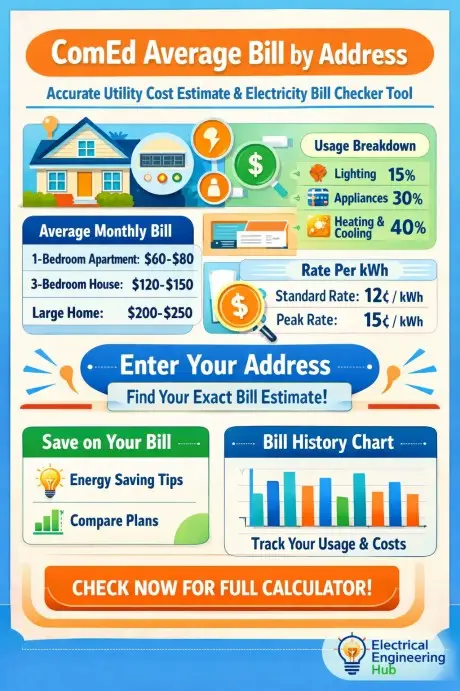
Table of Contents
This approach is especially useful for tenants, homebuyers, and property managers who want a clearer picture of monthly utility expenses without waiting for an actual bill. It uses historical usage data, address-based consumption trends, and average ComEd pricing to deliver a practical estimate of electricity charges.
Comed Average Bill by Address is increasingly used with online electricity bill checker tools that simplify the entire process by allowing users to input an address and receive an estimated monthly cost.
Use this online tool for free to estimate energy costs ComEd Bill Calculator
What Comed Average Bill by Address Means
Comed Average Bill by Address refers to the estimated monthly electricity cost calculated using an address-based consumption model. Instead of relying only on manual meter readings, this method uses regional consumption data, household size patterns, and tariff rates to calculate a realistic bill estimate.
In most cases, utility providers like ComEd structure their billing based on kilowatt-hour (kWh) usage. When combined with address-specific consumption averages, users get a more accurate view of expected expenses. This is especially useful for budgeting and energy planning.
For example, a small apartment in a dense urban area may show lower usage compared to a suburban home with heating or cooling systems running more frequently. This makes Comed Average Bill by Address a practical tool for both new and existing residents.
Comed Average Bill by Address Calculator
ComEd Bill
Average Cost Calculator
Estimate your monthly electricity cost by address or ZIP code using ComEd’s current tariff structure, seasonal usage patterns, and Illinois rate schedules.
How to Use This Calculator
Enter LocationEnter your ComEd service address or Illinois ZIP code. The calculator uses zone data to apply correct distribution charges.
Select Home ProfileChoose your home type, size, and heating/cooling fuel. This sets baseline consumption benchmarks.
Set Usage DetailsInput occupants, main appliances, and any solar or net metering credits if applicable.
Choose Rate PlanSelect your ComEd rate plan — most residential customers are on Rider DS. RRTP is the hourly real-time pricing option.
CalculateClick Calculate to see your itemized monthly bill estimate broken down by each ComEd charge component.
Review BreakdownScroll through the full line-item breakdown — delivery, supply, taxes, and riders — to understand exactly where each dollar goes.
Location
Home Profile
Usage & Occupancy
Rate Plan & Account Type
Estimated Bill Results
Technical Notes
- All charges reflect ComEd’s 2024–2025 tariff schedules filed with the Illinois Commerce Commission (ICC). Rates are subject to periodic adjustment.
- The Purchased Power Adjustment (PPA) and Fuel Adjustment Clause are applied as filed. These fluctuate monthly based on wholesale energy market conditions.
- Distribution charges include the basic facilities charge, energy delivery charge, and voltage transformation adjustment for standard residential single-phase service.
- State and local taxes include Illinois Excise Tax (5.1%), Municipal Utility Tax (varies by ZIP), and the Illinois Infrastructure Maintenance Fee.
- The Renewable Portfolio Standard (RPS) Rider and the Energy Efficiency Rider (EE) are mandatory pass-through charges assessed on all accounts.
- Net metering credits are calculated at the full retail rate for excess generation fed back to the grid, consistent with Illinois CEJA net metering provisions.
- RRTP estimates use a blended average hourly price for the selected month based on PJM historical data. Actual real-time costs vary hour by hour.
- This tool provides estimates only. Your actual bill depends on meter read dates, any applicable late fees, and other account-specific adjustments.
How Electricity Bill Estimation Works
Electricity estimation tools rely on several data points to produce accurate results. These include historical usage patterns, appliance load, seasonal changes, and regional pricing.
Use this online tool for free Duke Energy Florida Bill Calculator
Comed Average Bill by Address works by analyzing these inputs and converting them into a projected monthly cost. The process generally follows these steps:
- The user enters a property address
- The system identifies regional consumption trends
- Average kWh usage is calculated based on household type
- Current ComEd tariff rates are applied
- Final estimated bill is generated
This method provides a more reliable alternative to manual guesswork and helps users understand their electricity consumption behavior.
Key Factors That Influence Electricity Bills
Several variables affect the final electricity bill. Understanding them helps improve accuracy when using estimation tools.
Comed Average Bill by Address considers these factors:
- Household size and number of occupants
- Seasonal temperature changes affecting HVAC usage
- Appliance efficiency and energy rating
- Peak and off-peak electricity rates
- Property type (apartment, house, commercial unit)
- Daily usage patterns
All these elements combine to determine how much electricity is consumed and how much it costs under ComEd billing structures.
Explore this free online tool FPL Bill Calculator
Estimated Monthly Cost Breakdown Table
The following table provides a general idea of electricity cost variations based on property type and usage level.
| Property Type | Monthly Usage (kWh) | Estimated Bill (USD) |
|---|---|---|
| Small Apartment | 300 – 500 | 45 – 80 |
| Medium House | 600 – 900 | 90 – 150 |
| Large Family Home | 1000 – 1500 | 160 – 250 |
| Commercial Small Unit | 1200 – 2000 | 200 – 350 |
These estimates are commonly used in Comed Average Bill by Address calculations to give users a realistic financial overview before receiving an actual bill.
Why Address-Based Billing Estimates Are Useful
Modern households rely heavily on accurate budgeting tools. Comed Average Bill by Address helps users predict electricity expenses in advance, which is particularly helpful during seasonal changes or relocation.
Some key benefits include:
- Better monthly budgeting and expense planning
- Comparison of rental properties based on utility costs
- Early detection of unusually high consumption
- Improved energy efficiency awareness
- Support for solar and backup power planning
This makes address-based estimation a valuable tool for both homeowners and tenants.
Use this online tool PG&E Bill Calculator
Tools Used for Bill Estimation
Most online calculators that support Comed Average Bill by Address use a combination of energy analytics and utility rate databases. These tools function as electricity usage calculators and utility bill estimators.
Common features include:
- Address lookup system
- kWh consumption tracker
- Real-time ComEd rate integration
- Seasonal adjustment algorithm
- Monthly and yearly projection reports
Such tools simplify complex billing structures into easy-to-understand estimates.
Step-by-Step Guide to Check Estimated Bill
Using an online electricity bill checker is straightforward. Here is a typical process:
- Open an electricity estimation tool
- Enter your property address
- Select household type or number of residents
- Input approximate appliance usage if required
- Click calculate to view results
The system will then display an estimated monthly bill based on Comed Average Bill by Address logic, helping you understand your expected utility expenses.
Estimate Your Monthly Energy Costs with our Con Edison Bill Calculator
Tips to Reduce Electricity Costs
Even though estimation tools provide insights, reducing actual consumption is equally important. Here are practical tips:
- Switch to LED lighting for lower energy consumption
- Unplug devices when not in use
- Use energy-efficient appliances
- Optimize thermostat settings during peak seasons
- Schedule heavy appliance usage during off-peak hours
These small changes can significantly reduce monthly electricity expenses over time.
Sample Bill Comparison Table
The table below shows how consumption affects monthly billing estimates.
| Usage Level | Daily kWh Usage | Estimated Monthly Bill |
|---|---|---|
| Low Usage | 10 – 15 | 50 – 90 |
| Moderate Usage | 20 – 30 | 100 – 170 |
| High Usage | 35 – 50 | 180 – 300 |
This type of breakdown is often used in Comed Average Bill by Address tools to help users visualize consumption impact.
Accurately estimate electricity cost with Georgia Power Bill Calculator
Frequently Asked Questions
What is Comed Average Bill by Address used for?
Comed Average Bill by Address is used to estimate monthly electricity costs based on property location, usage patterns, and ComEd tariff rates. It helps users plan utility expenses more accurately.
How accurate is an address-based electricity estimate?
The accuracy depends on data quality and usage inputs. In most cases, Comed Average Bill by Address provides a close approximation of real billing when average consumption data is used.
Can renters benefit from this estimation tool?
Yes, renters can use Comed Average Bill by Address to understand expected utility costs before signing a lease or moving into a new property.
Does seasonal change affect electricity estimates?
Yes, heating and cooling significantly impact electricity usage, which is reflected in Comed Average Bill by Address calculations.
Is this tool useful for commercial properties?
Comed Average Bill by Address can also estimate commercial electricity usage, especially for small offices and retail units, by analyzing average kWh consumption patterns.
Conclusion
Comed Average Bill by Address provides a practical and data-driven way to estimate electricity costs before receiving an actual bill. By combining address-based insights, consumption patterns, and utility rate structures, it helps users make informed financial decisions.
Whether you are moving into a new home, managing rental properties, or simply tracking monthly expenses, this method offers a reliable foundation for understanding electricity costs and improving energy planning.
Follow Us on Social:
Subscribe our Newsletter on Electrical Insights for latest updates from Electrical Engineering Hub
#comedaveragebillbyaddress,#comedbill,#averageelectricitybill,#energycostcalculator,#utilitybillestimate,#electricityusage,#comedenergy,#billbyaddresslookup,#electricitycostanalysis,#utilitybillcalculator