
Electric Motor Polarization Index Test: Complete Guide for Accurate Motor Insulation Testing & Maintenance
Electric motors are the backbone of modern industrial systems. From manufacturing plants to irrigation systems and power stations, motors operate continuously under different environmental and electrical conditions. Over time, heat, moisture, dust, and vibration can weaken insulation resistance and increase the risk of motor failure. This is why the Electric Motor Polarization Index Test is considered one of the most important preventive maintenance procedures for rotating equipment.
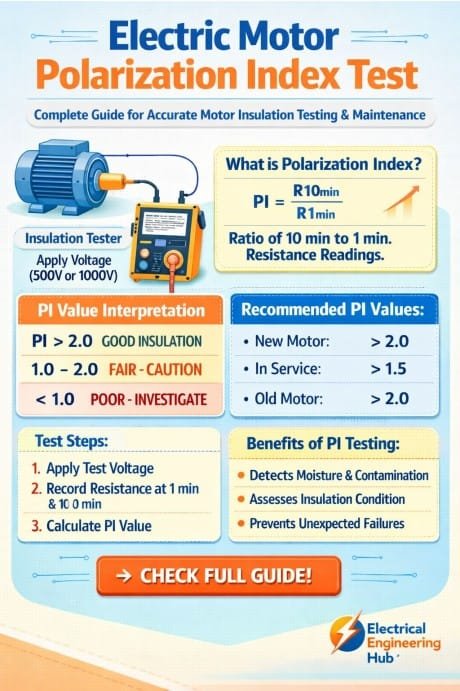
Table of Contents
The Electric Motor Polarization Index Test helps maintenance engineers evaluate the health of motor winding insulation. It provides valuable insight into insulation contamination, moisture absorption, aging, and deterioration. By conducting this test regularly, industries can prevent unexpected shutdowns, reduce repair costs, and improve equipment reliability.
What is Electric Motor Polarization Index Test?
The Electric Motor Polarization Index Test is an insulation diagnostic test used to determine the condition of electrical motor insulation systems. It measures the change in insulation resistance over a specific time period, usually 10 minutes.
Use our free online tool Generator Sizing Calculator for VFD Motors
The test compares:
| Measurement Time | Description |
|---|---|
| 1 Minute Reading | Initial insulation resistance value |
| 10 Minute Reading | Final insulation resistance value |
The Polarization Index (PI) is calculated using the following formula:
| Formula | Description |
|---|---|
| PI = 10-Minute IR Reading ÷ 1-Minute IR Reading | Standard PI calculation |
A higher PI value generally indicates cleaner and drier insulation, while a lower value may point to contamination, moisture, or insulation deterioration.
Importance of Motor Insulation Testing
Motor insulation failure is one of the leading causes of electrical motor breakdowns. Regular insulation testing helps maintenance teams identify hidden issues before they become critical.
Some major benefits include:
- Detects insulation weakness at an early stage
- Prevents unexpected motor failures
- Improves motor reliability and efficiency
- Reduces costly downtime
- Extends motor service life
- Supports predictive maintenance programs
- Ensures electrical safety compliance
Uncover insights on motor generator transformer manufacturers
Industrial facilities that implement routine insulation resistance testing often experience fewer emergency shutdowns and lower maintenance expenses.
How the Polarization Index Test Works
During the Electric Motor Polarization Index Test, a DC voltage is applied to the motor winding insulation using an insulation resistance tester or megohmmeter.
When voltage is applied:
- Leakage current initially flows through the insulation
- The current gradually decreases as insulation absorbs the charge
- Insulation resistance increases with time if the insulation is healthy
Healthy insulation will show a significant rise in resistance over the 10-minute period. Damaged or contaminated insulation usually shows little improvement.
Equipment Required for the Test
The following tools are commonly used for insulation testing:
| Equipment | Purpose |
|---|---|
| Insulation Resistance Tester (Megger) | Measures insulation resistance |
| Digital Multimeter | Confirms voltage absence |
| Safety Gloves | Personal protection |
| Lockout/Tagout Devices | Ensures electrical isolation |
| Temperature Meter | Measures winding temperature |
| Test Leads and Clips | Electrical connections |
Using calibrated instruments is essential for accurate test results.
Access our powerful online calculator now star delta motor cable size calculator
Standard PI Values for Electric Motors
Different industries follow IEEE and IEC guidelines for acceptable PI values.
| PI Value | Insulation Condition |
|---|---|
| Below 1.0 | Dangerous condition |
| 1.0 – 1.5 | Poor insulation |
| 1.5 – 2.0 | Questionable condition |
| 2.0 – 4.0 | Good insulation |
| Above 4.0 | Excellent insulation |
Large industrial motors generally require a PI value above 2.0 for reliable operation.
Step-by-Step Procedure for Electric Motor Polarization Index Test
Proper testing procedures are critical for obtaining reliable readings.
1. Isolate the Motor
Disconnect the motor completely from the power supply. Follow lockout and tagout procedures to ensure safety.
2. Inspect the Motor
Perform a visual inspection before testing.
Check for:
- Moisture
- Dust accumulation
- Oil contamination
- Loose connections
- Damaged cables
Use our online tool for free Wire Size Calculator for Motors – Accurate Motor Cable Sizing Tool for Electric Loads
3. Verify Zero Voltage
Use a digital multimeter to confirm that no voltage is present on motor terminals.
4. Connect the Megger
Connect the insulation tester between:
| Connection Type | Testing Points |
|---|---|
| Phase to Ground | Winding to motor body |
| Phase to Phase | Between motor phases |
5. Apply Test Voltage
The selected voltage depends on motor rating.
| Motor Voltage Rating | Recommended Test Voltage |
|---|---|
| Up to 1 kV | 500 V DC |
| 1 kV to 5 kV | 1000 V DC |
| Above 5 kV | 2500 V to 5000 V DC |
6. Record Readings
Take insulation resistance readings at:
- 1 minute
- 10 minutes
7. Calculate PI Value
Use the formula:
PI = 10-Minute Reading ÷ 1-Minute Reading
8. Discharge the Motor
After testing, discharge stored electrical energy safely to prevent electric shock.
Know more about How to Check 3 Phase Motor Winding with Multimeter
Factors Affecting PI Test Results
Several conditions can influence insulation resistance readings.
Temperature
Insulation resistance decreases as temperature increases. Readings should be corrected to standard reference temperatures when comparing historical data.
Moisture
Humidity and water ingress can significantly reduce insulation resistance values.
Dirt and Contamination
Oil, grease, dust, and carbon deposits create leakage paths across insulation surfaces.
Aging Insulation
Old insulation systems naturally degrade over time due to thermal stress and electrical loading.
Test Duration
Consistent timing is essential for accurate trend analysis.
Common Problems Identified by PI Testing
The Electric Motor Polarization Index Test helps detect several hidden insulation issues.
| Problem | Typical Indication |
|---|---|
| Moisture Contamination | Low and unstable PI |
| Dirty Windings | Reduced resistance values |
| Insulation Aging | Gradual decline in PI trend |
| Cracked Insulation | Sudden low readings |
| Overheating Damage | Weak resistance growth |
Early detection allows maintenance teams to schedule corrective action before motor failure occurs.
Know more about How to Size a VFD for a Motor. This is an expert Guide for Accurate Selection
Best Practices for Accurate Insulation Testing
Following proper testing methods improves consistency and reliability.
Keep Historical Records
Maintain a database of all insulation resistance readings for trend analysis.
Test Under Similar Conditions
Temperature and humidity should remain consistent during periodic testing.
Clean the Motor Before Testing
Remove dust, oil, and moisture from the motor surface.
Use Correct Test Voltage
Applying improper voltage may produce inaccurate results or damage insulation.
Follow Manufacturer Recommendations
Always follow motor manufacturer guidelines and IEEE testing standards.
Difference Between Insulation Resistance Test and PI Test
Many technicians confuse these two tests, but they serve different purposes.
| Feature | Insulation Resistance Test | Polarization Index (PI) Test |
|---|---|---|
| Purpose | Measures the overall insulation resistance of a motor winding | Evaluates insulation condition and insulation aging over time |
| Test Duration | Normally 1 minute | Conducted for 10 minutes |
| Measurement Type | Single insulation resistance reading | Ratio of 10-minute reading to 1-minute reading |
| Formula Used | No ratio calculation required | PI = 10-Minute Reading ÷ 1-Minute Reading |
| Diagnostic Accuracy | Basic insulation assessment | More detailed insulation health analysis |
| Moisture Detection | Limited capability | Highly effective in detecting moisture contamination |
| Insulation Aging Analysis | Not very effective | Excellent for detecting insulation deterioration |
| Common Equipment Used | Megger / Insulation Resistance Tester | Megger / Insulation Resistance Tester |
| Result Interpretation | Based on insulation resistance value only | Based on insulation resistance trend and ratio |
| Application | Routine electrical checks | Predictive maintenance and condition monitoring |
| Reliability of Results | Moderate | High |
| Recommended For | Quick inspections and basic testing | Critical motors and preventive maintenance programs |
The PI test provides deeper insight into insulation condition and long-term motor reliability.
Applications of Polarization Index Testing
The Electric Motor Polarization Index Test is widely used across multiple industries.
Industrial Manufacturing
Factories use PI testing for motors operating conveyors, compressors, pumps, and production machinery.
Power Generation Plants
Generators and auxiliary motors require regular insulation monitoring to maintain operational reliability.
Oil and Gas Industry
Hazardous environments demand strict insulation maintenance practices.
Water Treatment Facilities
Pumps and blower motors are routinely tested to prevent operational interruptions.
Know more about How does the star delta starter reduce starting current?
Agricultural Irrigation Systems
Large irrigation motors and solar-powered pumping systems benefit from scheduled insulation testing programs.
Safety Precautions During PI Testing
Electrical testing must always be performed safely.
Important precautions include:
- Wear insulated PPE
- Use lockout/tagout procedures
- Verify absence of voltage
- Never touch energized conductors
- Discharge windings after testing
- Use properly rated testing equipment
- Follow local electrical safety regulations
Ignoring safety procedures can result in severe injury or equipment damage.
Conclusion
The Electric Motor Polarization Index Test is a vital maintenance procedure for evaluating motor insulation health and preventing unexpected failures. By measuring insulation resistance behavior over time, technicians can identify moisture, contamination, insulation aging, and other developing problems before they cause major breakdowns.
Regular PI testing improves equipment reliability, enhances electrical safety, and extends motor operating life. Whether used in industrial plants, power stations, irrigation systems, or commercial facilities, this test remains one of the most effective tools for predictive motor maintenance.
Know more about Motor Overload Protection Chart
Companies that implement a structured motor insulation testing program can reduce downtime, improve operational efficiency, and protect valuable electrical assets for the long term.
Follow Us on Social:
Subscribe our Newsletter on Electrical Insights for latest updates from Electrical Engineering Hub
#ElectricMotorPolarizationIndexTest,#PolarizationIndexTest,#MotorInsulationTesting,#ElectricalMaintenance,#MotorTesting,#InsulationResistanceTest,#IndustrialMotorTesting,#ElectricalSafety,#MotorDiagnostics,#PreventiveMaintenance
