Partial Discharge Cable Testing Procedure: Step-by-Step Guide for Accurate Cable Diagnostics and Reliable Insulation Testing
The reliability of power cables depends heavily on insulation health. Even minor defects inside insulation can grow silently and lead to sudden failures. This is where the partial discharge cable testing procedure becomes essential. It helps detect early-stage insulation defects before they turn into costly breakdowns.
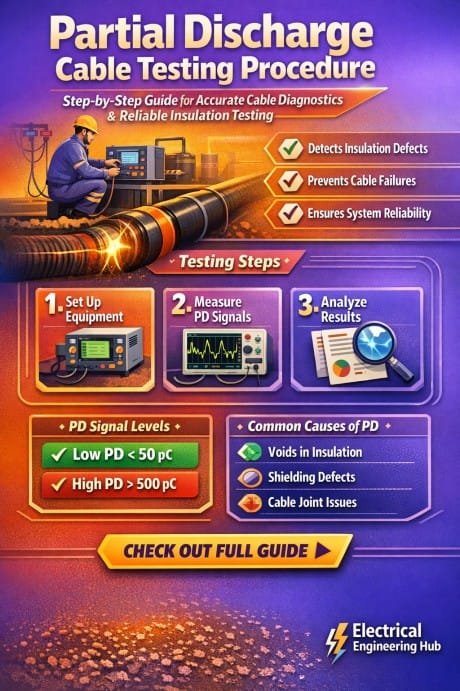
Table of Contents
Partial discharge is a localized electrical discharge that does not completely bridge the insulation between conductors. It usually occurs due to voids, cracks, moisture, or contamination inside cable insulation. By following a proper partial discharge cable testing procedure, engineers can assess cable condition, improve system reliability, and plan maintenance effectively.
Understanding Partial Discharge in Cables
Partial discharge activity is a sign of insulation weakness. It may occur in joints, terminations, or along the cable length. Common causes include poor installation, aging insulation, manufacturing defects, and environmental stress.
A well-executed partial discharge cable testing procedure allows early detection of these issues. This prevents unexpected outages and extends cable life. It also supports condition-based maintenance strategies in industrial and utility applications.
Find all about Partial Discharge vs Tan Delta Cable Testing: Important Key Differences Every Engineer Must Know
Importance of Partial Discharge Testing
Carrying out a structured partial discharge cable testing procedure offers several practical benefits. It improves operational safety and reduces long-term maintenance costs.
Key advantages include:
- Early detection of insulation defects
- Reduced risk of cable failure
- Improved asset reliability
- Better maintenance planning
- Compliance with international testing standards
Explore details on iec standard for underground cable laying
Equipment Required for Testing
Before starting the partial discharge cable testing procedure, it is important to ensure all necessary equipment is available and properly calibrated.
| Equipment Name | Purpose |
|---|---|
| High Voltage Source | Applies test voltage to the cable |
| Partial Discharge Detector | Measures discharge activity |
| Coupling Capacitor | Captures PD signals |
| Measuring Impedance | Converts signals into measurable values |
| Data Acquisition System | Records and analyzes PD patterns |
| Calibration Device | Ensures measurement accuracy |
Using high-quality testing equipment ensures accurate results and reliable diagnostics.
Know more about Partial Discharge Test Equipment Price in USA & Europe
Step-by-Step Partial Discharge Cable Testing Procedure
A systematic approach is critical for achieving accurate results. The following steps outline a complete partial discharge cable testing procedure.
Visual Inspection
Start with a detailed inspection of the cable system. Check for visible damage, loose connections, and environmental exposure. Pay special attention to joints and terminations.
System Preparation
Disconnect the cable from the power supply and isolate it completely. Ensure proper grounding and safety measures are in place before starting the test.
Equipment Setup
Connect the testing equipment according to the manufacturer’s guidelines. Proper connections between the high voltage source, coupling capacitor, and measuring system are essential.
Calibration
Calibration is a crucial step in the partial discharge cable testing procedure. Inject a known charge into the system to verify measurement accuracy.
Find all about Top 15 Partial Discharge Tester Suppliers in United States
Voltage Application
Gradually increase the test voltage to the required level. Monitor the system closely while applying voltage. Avoid sudden voltage spikes to prevent insulation stress.
Measurement and Recording
Measure partial discharge levels at different voltage stages. Record data such as discharge magnitude, repetition rate, and phase angle.
Data Analysis
Analyze the recorded data to identify discharge patterns. Different patterns indicate different types of defects such as internal voids or surface discharges.
Reporting
Prepare a detailed report including observations, measurements, and recommendations. This helps in decision-making for maintenance or replacement.
Find all about High Voltage Cable Testing Standards: Complete Guide for Engineers
Key Parameters in Partial Discharge Testing
Understanding test parameters is important for interpreting results correctly during the partial discharge cable testing procedure.
| Parameter | Description |
|---|---|
| PD Magnitude (pC) | Strength of discharge |
| Inception Voltage | Voltage at which PD starts |
| Extinction Voltage | Voltage at which PD stops |
| Pulse Repetition Rate | Frequency of discharge events |
| Phase Angle | Position of discharge in AC cycle |
Monitoring these parameters provides a clear picture of insulation condition.
Common Types of Partial Discharge
Different discharge types indicate different insulation issues. Identifying them correctly is a key part of the partial discharge cable testing procedure.
- Internal discharge: Occurs within insulation voids
- Surface discharge: Appears on insulation surfaces
- Corona discharge: Happens in air gaps around conductors
- Treeing discharge: Develops in aged or stressed insulation
Find all about Partial Discharge vs Tan Delta Cable Testing: Important Key Differences Every Engineer Must Know
Each type requires a different maintenance approach.
Best Practices for Accurate Testing
To achieve reliable results, certain best practices should always be followed during the partial discharge cable testing procedure.
- Ensure proper grounding of the system
- Use shielded cables to minimize noise interference
- Conduct testing in a low-noise environment
- Verify calibration before and after testing
- Maintain consistent environmental conditions
These practices help improve measurement accuracy and repeatability.
Safety Considerations
High voltage testing involves risks. Safety must be a priority during the partial discharge cable testing procedure.
- Use proper personal protective equipment
- Keep unauthorized personnel away from the test area
- Follow lockout and tagout procedures
- Ensure emergency shutdown systems are functional
Find all about VLF Tan Delta Testing of MV Cables: Ensure Reliable High-Voltage Cable Performance
A safe testing environment reduces the risk of accidents and equipment damage.
Applications of Partial Discharge Testing
The partial discharge cable testing procedure is widely used across different industries.
| Industry قطاع | Application Area |
|---|---|
| Power Utilities | Transmission and distribution cables |
| Industrial Plants | Motor and equipment cable testing |
| Renewable Energy | Solar and wind farm cable diagnostics |
| Oil and Gas | Hazardous area cable monitoring |
Its versatility makes it an essential diagnostic tool in modern electrical systems.
Challenges in Partial Discharge Testing
Despite its benefits, the partial discharge cable testing procedure comes with certain challenges.
- Electrical noise interference
- Complex data interpretation
- Requirement of skilled personnel
- High initial equipment cost
Findt all about AC Hipot Test Procedure for Cables
Proper training and advanced instruments can help overcome these limitations.
Conclusion
A well-structured partial discharge cable testing procedure plays a critical role in maintaining cable health and ensuring reliable power delivery. It helps detect hidden insulation defects, supports preventive maintenance, and improves system performance.
By following the correct steps, using proper equipment, and applying best practices, engineers can obtain accurate diagnostic results. This not only enhances safety but also reduces operational costs over time.
In modern power systems, adopting a reliable partial discharge cable testing procedure is no longer optional. It is a necessary step toward achieving long-term efficiency, reliability, and compliance in electrical infrastructure.
Learn more about earthing cable size as per iec
Follow Us on Social:
Subscribe our Newsletter on Electrical Insights for latest updates from Electrical Engineering Hub
#PartialDischarge,#CableTesting,#ElectricalTesting,#HighVoltageTesting,#InsulationTesting,#PDTesting,#CableDiagnostics,#PowerEngineering,#TestingProcedure,#ElectricalMaintenance