NEMA vs IEC Motor Control Center: Important Differences, Standards, Selection Guide & Industrial Applications
NEMA vs IEC Motor Control Center is a common comparison in modern industrial electrical systems where engineers select control equipment based on performance, safety, and regional standards. The debate of NEMA vs IEC Motor Control Center is especially important in manufacturing plants, oil and gas facilities, water treatment stations, and heavy automation environments where motor reliability directly impacts production efficiency.
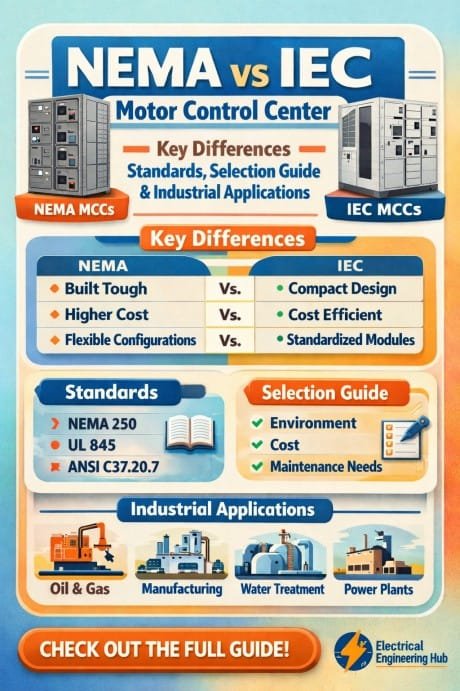
Motor Control Centers (MCCs) are centralized assemblies used to control electric motors from a single location. They include circuit breakers, contactors, overload relays, and protection devices designed to ensure safe motor operation. Understanding NEMA vs IEC Motor Control Center helps engineers choose the right system based on environmental conditions, duty cycles, and cost efficiency.
Overview of Motor Control Centers
Motor Control Centers are designed to manage multiple motor loads from one central cabinet system. They improve operational safety, simplify maintenance, and reduce wiring complexity in industrial setups. These systems are widely used in conveyor systems, irrigation pumping stations, HVAC plants, and production lines.
When comparing NEMA vs IEC Motor Control Center, the primary distinction starts with the governing standards. NEMA (National Electrical Manufacturers Association) is widely used in North America, while IEC (International Electrotechnical Commission) is more common in Europe, Asia, and other global markets. Both standards ensure safety and performance but differ in design philosophy and testing methods.
Know more about Top 12 Motor Control Center Manufacturers USA
NEMA vs IEC Motor Control Center Standards Comparison
The comparison between NEMA vs IEC Motor Control Center begins with their underlying design standards and engineering approach. NEMA focuses on heavy-duty construction and conservative safety margins, while IEC emphasizes compact design, modularity, and cost efficiency.
Standards Comparison Table
| Feature | NEMA Standard MCC | IEC Standard MCC |
|---|---|---|
| Design Philosophy | Heavy-duty, robust | Compact, modular |
| Safety Margin | Higher conservative rating | Defined operational categories |
| Size | Larger footprint | Smaller footprint |
| Cost | Generally higher | More cost-effective |
| Maintenance | Easy and rugged | Requires trained technicians |
| Fault Tolerance | High | Moderate to high |
In industrial environments where vibration, dust, and harsh conditions are common, NEMA vs IEC Motor Control Center selection often depends on durability requirements. NEMA systems are preferred in such demanding applications, while IEC systems are chosen for space-saving and automation-heavy environments.
Key Differences Between NEMA vs IEC Motor Control Center
A deeper look into NEMA vs IEC Motor Control Center reveals differences in overload protection, contactor sizing, and short-circuit ratings. NEMA components are typically larger and designed for long-term durability under extreme stress. IEC components, on the other hand, are more compact and rely on precise coordination of protective devices.
Find all about Motor Control Center Installation Cost
Key Differences Table
| Aspect | NEMA MCC | IEC MCC |
|---|---|---|
| Contactor Rating | Sized for maximum load | Utilization category based |
| Short Circuit Protection | Built-in rugged margin | Coordinated protection required |
| Flexibility | Limited modularity | High modular flexibility |
| Heat Dissipation | Better due to size | Efficient but compact |
| Replacement Cost | Higher | Lower |
In practical installations, NEMA vs IEC Motor Control Center decisions also depend on downtime tolerance. Industries that cannot afford frequent maintenance downtime often lean toward NEMA, while automated factories prefer IEC systems for easier expansion and integration.
Selection Guide for Industrial Applications
Choosing between NEMA vs IEC Motor Control Center requires evaluating operational conditions, load types, and long-term maintenance expectations. Engineers must consider electrical load behavior, ambient temperature, and available installation space.
Know more about Motor Control Center Bucket Replacement Cost
Selection Factors
- Environmental conditions such as dust, humidity, and vibration levels
- Motor load type including constant torque or variable torque applications
- Space availability inside electrical rooms or panels
- Budget constraints for initial and lifecycle costs
- Maintenance skill level of on-site technicians
- Required compliance with regional electrical codes
In many global projects, NEMA vs IEC Motor Control Center selection is also influenced by equipment sourcing availability. IEC systems are easier to source internationally, while NEMA systems are more common in North American supply chains.
Industrial Applications of Motor Control Centers
Motor Control Centers are essential in industries where multiple motors operate simultaneously. The selection between NEMA vs IEC Motor Control Center can significantly impact system performance and efficiency.
Application Comparison Table
| Industry | Preferred MCC Type | Reason |
|---|---|---|
| Oil & Gas | NEMA | High durability and harsh environment resistance |
| Water Treatment | IEC | Modular expansion and cost efficiency |
| Manufacturing Plants | IEC | Automation integration |
| Mining Operations | NEMA | Rugged and vibration resistant |
| HVAC Systems | IEC | Compact design and scalability |
In heavy industries, NEMA vs IEC Motor Control Center decisions are often made based on long-term reliability versus installation flexibility. For example, mining and cement plants typically prefer NEMA due to extreme working conditions, while food processing and packaging industries lean toward IEC systems for precision control.
Find all about How Does a Motor Control Center Work
Cost, Maintenance, and Safety Considerations
Cost plays a major role in NEMA vs IEC Motor Control Center selection. IEC systems generally have lower upfront costs and are easier to expand. However, NEMA systems offer long-term durability, reducing replacement frequency in harsh environments.
Maintenance requirements also differ significantly. NEMA systems are simpler to troubleshoot due to their robust design, while IEC systems require more precise coordination of protective devices but allow faster module replacement.
From a safety perspective, both systems comply with strict electrical standards, but NEMA provides higher physical protection, whereas IEC focuses on electrical coordination and system efficiency.
Conclusion
Understanding NEMA vs IEC Motor Control Center is essential for engineers, project managers, and industrial designers aiming to build reliable and efficient motor control systems. Both standards offer strong advantages depending on application needs, environmental conditions, and budget considerations.
Know more about What is a Motor Control Center (MCC)
While NEMA systems excel in durability and harsh environments, IEC systems provide flexibility, compact design, and cost efficiency. A well-informed decision ensures improved operational reliability, reduced downtime, and optimized energy management in industrial operations.
Get new guides in your feed. Follow Electrical Insights on LinkedIn for new electrical standards guides, calculators and design tips from Azad Circuit Hub.
#NEMAvsIECMCC,#NEMA,#IEC,#MotorControlCenter,#MCC,#ElectricalPanels,#IndustrialAutomation,#PowerSystems,#ControlPanels,#ElectricalEngineering