
Overload Relay Amp Lists: Standard Amp Ranges, Selection Chart & Sizing Guide
Selecting the correct overload relay is essential for protecting electric motors from overheating and long-term damage. An overload relay must match the motor’s full-load current rather than its starting current. The following Overload Relay Amp Lists provide quick reference values for common relay ranges used in industrial motor control panels.
Before selecting a relay, you can also use our Overload Relay Setting Calculator to calculate the recommended setting based on your motor’s full-load current and service factor.
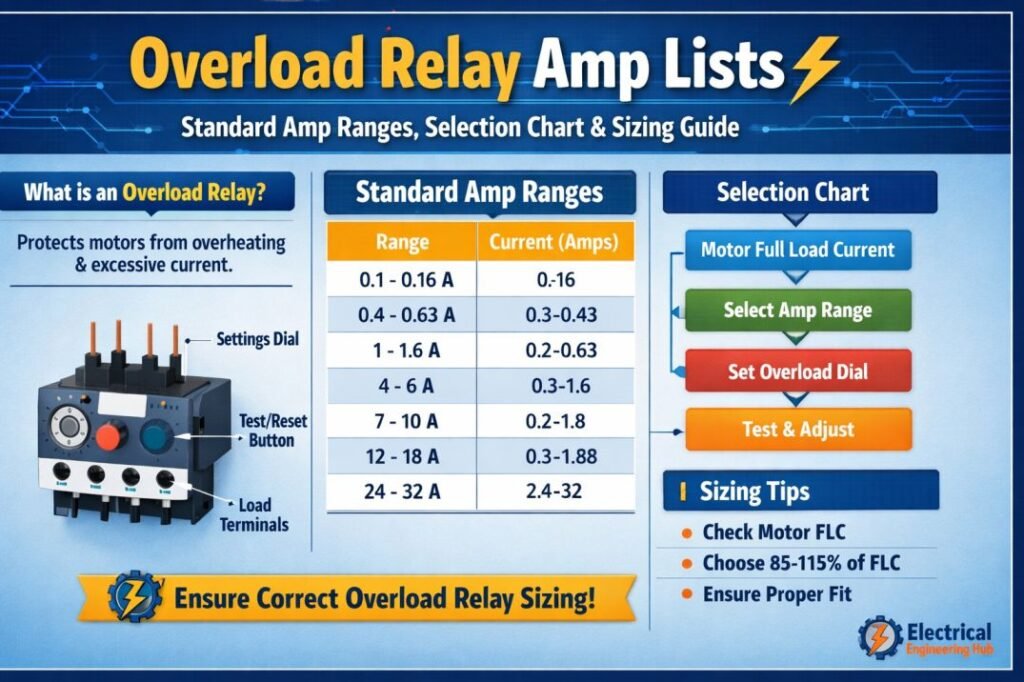
Table of Contents
Table of Contents
Overload Relay Amp Lists
| Motor Full Load Current (A) | Typical Overload Relay Range |
|---|---|
| 0.10–0.16 | 0.10–0.16 A |
| 0.16–0.25 | 0.16–0.25 A |
| 0.25–0.40 | 0.25–0.40 A |
| 0.40–0.63 | 0.40–0.63 A |
| 0.63–1.00 | 0.63–1.00 A |
| 1.00–1.60 | 1.00–1.60 A |
| 1.60–2.50 | 1.60–2.50 A |
| 2.50–4.00 | 2.50–4.00 A |
| 4.00–6.00 | 4.00–6.00 A |
| 5.50–8.00 | 5.50–8.00 A |
Common Industrial Relay Ranges
| Relay Range (A) | Typical Motor Size |
|---|---|
| 7–10 A | Small pumps |
| 9–13 A | Fans and blowers |
| 12–18 A | Compressors |
| 17–25 A | Industrial motors |
| 23–32 A | Heavy-duty equipment |
| 30–40 A | Large conveyors |
| 37–50 A | Process plants |
| 48–65 A | High-power motors |
What Are Overload Relay Amp Lists?
Overload Relay Amp Lists are standardized current ranges offered by relay manufacturers to match different motor full-load current ratings. Instead of one fixed current value, each overload relay covers an adjustable current range.
For example, if a motor draws 11.5 A at full load, a relay with an adjustable range of 9–13 A would normally be selected. The relay is then adjusted according to the motor nameplate current and applicable standards.
Using the correct relay range improves motor protection, minimizes nuisance tripping, and increases equipment reliability.
Why Standard Amp Ranges Are Used
Manufacturers design overload relays with adjustable ranges so one relay can protect several motors with similar current ratings.
Benefits include:
- Simplified inventory management
- Easy replacement during maintenance
- Accurate motor protection
- Lower installation costs
- Better flexibility for industrial applications
These standardized ranges are widely available from manufacturers such as Siemens, Schneider Electric, ABB, Eaton, Allen-Bradley, Mitsubishi Electric, and LS Electric.
Standard Overload Relay Amp Lists
The table below shows commonly available overload relay ranges used worldwide.
| Relay Number | Adjustable Current Range |
|---|---|
| 1 | 0.10–0.16 A |
| 2 | 0.16–0.25 A |
| 3 | 0.25–0.40 A |
| 4 | 0.40–0.63 A |
| 5 | 0.63–1.00 A |
| 6 | 1.00–1.60 A |
| 7 | 1.60–2.50 A |
| 8 | 2.50–4.00 A |
| 9 | 4.00–6.00 A |
| 10 | 5.50–8.00 A |
| 11 | 7.00–10.00 A |
| 12 | 9.00–13.00 A |
| 13 | 12.00–18.00 A |
| 14 | 17.00–25.00 A |
| 15 | 23.00–32.00 A |
| 16 | 30.00–40.00 A |
| 17 | 37.00–50.00 A |
| 18 | 48.00–65.00 A |
| 19 | 55.00–70.00 A |
| 20 | 63.00–80.00 A |
Actual relay ranges may vary slightly depending on the manufacturer and product series.
How to Select the Correct Relay Range
Choosing the proper overload relay involves more than simply matching the motor current.
Consider the following factors:
| Selection Factor | Importance |
|---|---|
| Motor full-load current | Primary selection criterion |
| Service factor | Determines allowable setting adjustment |
| Ambient temperature | Can affect thermal performance |
| Starting method | Direct-on-line, star-delta, or soft starter |
| Duty cycle | Continuous or intermittent operation |
| Manufacturer recommendations | Ensures compatibility |
If you already know your motor current, our Overload Relay Setting Calculator helps determine the recommended relay adjustment before commissioning.
Example of Relay Selection
Suppose a three-phase induction motor has the following specifications.
| Parameter | Value |
|---|---|
| Rated Power | 7.5 kW |
| Voltage | 415 V |
| Full Load Current | 14.8 A |
Since the motor current is 14.8 A, the suitable relay range would be:
12–18 A
The adjustment knob would then typically be set close to the motor nameplate full-load current while considering service factor and applicable electrical standards.
Typical Applications
Different relay ranges are commonly used in different industrial equipment.
| Equipment | Typical Relay Range |
|---|---|
| Small exhaust fans | 1–2.5 A |
| Water pumps | 4–8 A |
| Air compressors | 9–18 A |
| Conveyor systems | 17–32 A |
| HVAC motors | 12–25 A |
| Cooling towers | 17–40 A |
| Industrial mixers | 23–50 A |
| Large process pumps | 37–80 A |
These values are examples and should always be verified against the motor nameplate.
Common Mistakes When Using Overload Relay Amp Lists
Many motor protection issues occur because of incorrect relay selection rather than equipment failure.
Avoid these common mistakes:
- Selecting a relay based on motor horsepower only
- Ignoring the motor nameplate current
- Using the starting current instead of full-load current
- Setting the relay above the allowable current
- Choosing a relay with an unsuitable adjustment range
- Ignoring ambient temperature corrections
- Not following manufacturer recommendations
Proper relay selection reduces unexpected downtime and extends motor life.
Standards Related to Overload Relay Selection
Several international standards provide guidance for overload relay application and motor protection.
| Standard | Description |
|---|---|
| IEC 60947-4-1 | Contactors and motor starters |
| IEC 60947-4-2 | Semiconductor motor controllers |
| IEC 60947-5-1 | Control circuit devices |
| NEMA ICS 2 | Industrial motor controllers |
| NEC Article 430 | Motor branch circuits and protection |
Following these standards helps ensure safe and reliable motor protection in industrial installations.
Frequently Asked Questions
How do I choose an overload relay amp range?
Select a relay whose adjustable current range includes the motor’s full-load current shown on the nameplate. Then adjust the relay according to the manufacturer’s recommendations.
Can one overload relay protect different motors?
Yes. Adjustable overload relays can protect multiple motors as long as each motor’s full-load current falls within the relay’s adjustment range.
Should I use motor starting current for relay selection?
No. Overload relays are selected using the motor’s full-load current, not the inrush or starting current.
Do overload relay amp lists vary by manufacturer?
Yes. Most manufacturers follow similar current ranges, but some relay series may have slightly different adjustment values. Always verify the product datasheet before installation.
Related Tools & Guides
- Overload Relay Setting Calculator according to NEC 430.32 & IEC 60947-4-1
- Differences in Bimetal Overload and Ambient-Compensated Overload Relays
- Overload Relay for Motor
- Overload Setting for Motor
Conclusion
Using accurate Overload Relay Amp Lists makes motor protection simpler and more reliable. Matching the relay’s adjustable range to the motor’s full-load current helps prevent overheating, nuisance trips, and premature equipment failure.
While standard amp lists provide an excellent starting point, the final relay adjustment should always be based on the motor nameplate, installation conditions, and applicable electrical standards. For faster and more accurate sizing, calculate the recommended setting with the Overload Relay Setting Calculator before selecting and adjusting your overload relay.
Follow Us on Social:
Subscribe our Newsletter on Electrical Insights for latest updates from Electrical Engineering Hub

Hello! I just wish to give a huge thumbs up for the good information you might have right here on this post. I will be coming back to your blog for more soon.