N-channel Enhancement Type MOSFET! A Brief Introduction
N-Channel enhancement type MOSFET normally goes in off condition whenever the voltages across the source and the gate terminals are at zero. So, in order to keep the n-channel enhancement type MOSFET in ON condition we must supply the voltages at the Gate terminal of the MOSFET. The doping of substrate in this type of MOSFET is very light and consists of P-type material. We can also call this substrate the body of the MOSFET.
The doping of the Source and the drain terminals in n-channel enhancement type MOSFET is very heavy. They consist of n-type material and normally connect to the ground terminal. So, the turning on and off procedure for n-channel MOSFET is very easy. We can achieve it by just controlling the “VDD” and the gate voltages.
To keep the MOSFET in the on condition we need to apply sufficient “VDD” (drain voltages). And also apply positive voltages across the gate and the source terminal. To turn off the MOSFET, we can follow two steps either remove the drain voltages or the gate positive voltages. Both will take the n-channel MOSFET in the off condition.
N-channel enhancement type MOSFET
Let’s have a look at the below figure of the n-channel and p-channel MOSFET.
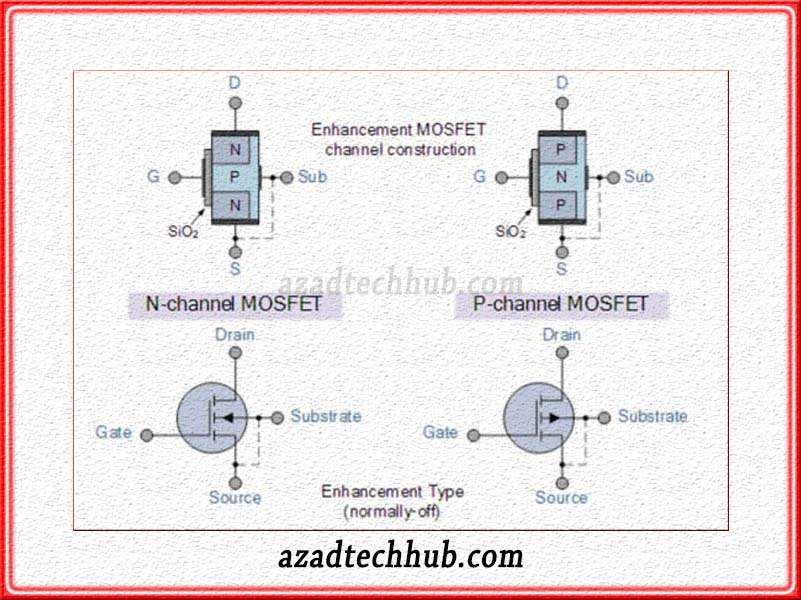
As we can see in the above figure the P-channel and the source connect together. The gate terminal connects itself with the P-channel through a fine layer of silicon dioxide material. In other words, the gate terminal does not connect with the p-channel electrically and isolates itself from the channel. The below figure shows the symbolic representation of the n-channel MOSFET where we can see the substrate connects with the source.
On the other hand, when we look at the P-channel enhancement type MOSFET, the channel consists of n-type material where doping is very light. While the drain and the source terminals are p-type materials and doping is very high.
Topics You might be interested in:
- Cable Trench Design Calculation | Important Guide
- Cable Trench vs Cable Tray: Best Choice | Cabling Systems
- Cable Trench Inspection Checklist: Comprehensive Guide
- Cable Trench Design Guide for Safe Electrical Projects: Step by Step
- IEC 61537 Explained: Cable Management | Comprehensive Guide
- Insulation Resistance Test Between Conductors: Quick Guide
- IEC 60270 Insulation Resistance: Comprehensive Guide
- IS 10810 Part 53 Explained: Essential Guide for Accurate Testing
- IS 14255 Explained: Essential Guide for Better Compliance
- High Voltage Cable Trench Depth Standards | Best Guide
- BS7671 Buried Cable Depth: Essential Installation Guide
- Underground Fiber Optic Cable Installation Standards: Best Guide