6 Common Junction Box Sizing Mistakes (and How to Avoid Them)
Junction box sizing mistakes are among the most common reasons electrical installations fail inspections. In many cases, electricians and DIY installers understand the general code requirements but make small counting errors that result in an undersized box. A missed device allowance, forgotten grounding conductor, or incorrect conductor volume can quickly make a compliant installation non-compliant.
Fortunately, these issues are easy to avoid when you understand how box fill calculations work. This practical guide explains the most frequent Junction Box Sizing Mistakes, why they happen, and how to prevent them. Whether you calculate manually or use a junction box sizing calculator, avoiding these common errors will improve safety, simplify inspections, and ensure code compliance.
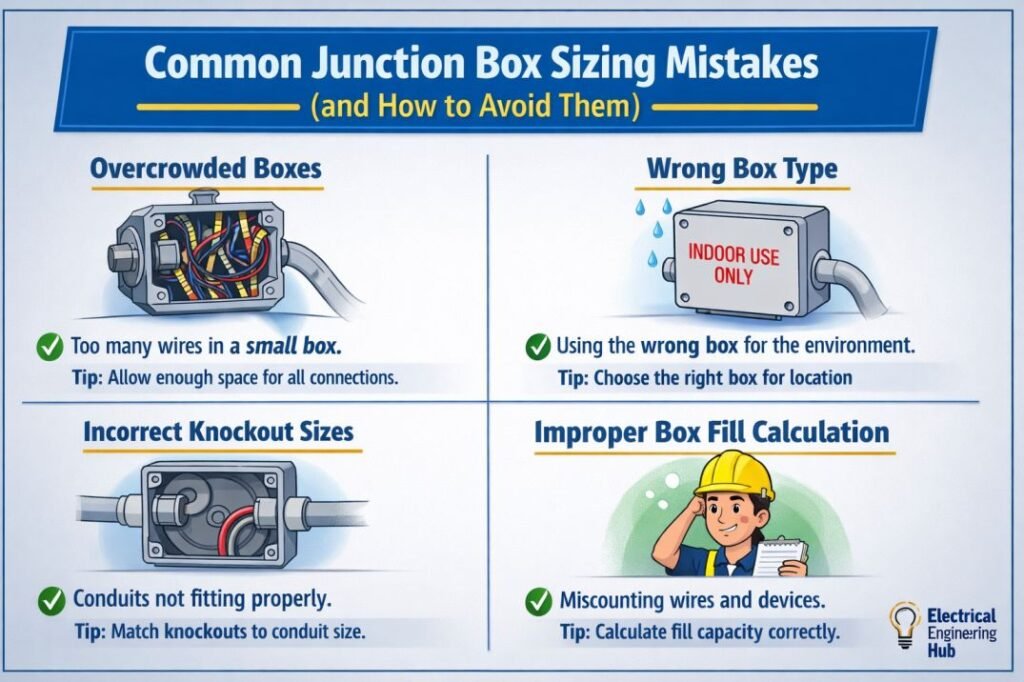
Table of Contents
Table of Contents
6 Common Junction Box Sizing Mistakes
Mistake 1 — Miscounting Devices
One of the most frequent Junction Box Sizing Mistakes is counting switches, receptacles, or similar devices incorrectly. Under NEC 314.16, each yoke-mounted device typically counts as two conductor volume allowances based on the largest conductor connected to it—not one.
Many installers only count the wires entering the box and forget that the device itself occupies additional volume. This often results in a box that appears large enough but exceeds the allowable fill.
For example:
| Component | Common Mistake | Correct Method |
|---|---|---|
| Switch | Counted as one conductor | Count as two conductor volumes |
| Duplex receptacle | Ignored completely | Count as two conductor volumes |
| Device yoke | Excluded from calculation | Include per NEC rules |
When sizing junction boxes manually, always include every mounted device. If you need more guidance, see our detailed guide on How Many Wires Can Fit in a Junction Box. This guide explains how devices affect box fill calculations with practical examples.
Mistake 2 — Forgetting Grounding Conductors
Grounding conductors create another common source of calculation errors. Many people either forget to include them or count every individual ground wire separately.
The code requires all equipment grounding conductors inside the box to count as only one conductor volume based on the largest grounding conductor present.
The correct approach is simple:
| Ground Conductors Present | Volume Allowance |
|---|---|
| One ground wire | One conductor volume |
| Three ground wires | One conductor volume |
| Five bonded grounds | One conductor volume |
Missing this allowance or counting each grounding conductor individually produces incorrect junction box sizing calculations. Always verify the grounding conductor count before selecting a box.
Mistake 3 — Ignoring Internal Clamps and Fittings
Internal cable clamps and support fittings occupy valuable space inside an electrical box. During retrofit projects, these components are often overlooked because installers focus only on conductor count.
If the clamp is internal to the box, it requires one conductor volume allowance. External clamps generally do not affect the box fill calculation.
Common items that should be checked include:
| Component | Included in Box Fill? |
|---|---|
| Internal cable clamp | Yes |
| External cable clamp | No |
| Internal support fitting | Check applicable code |
| Connector outside box | No |
Many failed inspections occur because installers ignore these small components. Accurate junction box sizing requires evaluating everything installed inside the enclosure—not just the wires.
Mistake 4 — Mixing Conductor Gauges Without Adjusting
Not every conductor occupies the same volume. Another frequent Junction Box Sizing Mistake is assuming that every wire counts equally regardless of gauge.
Larger conductors require greater volume allowances. For example, a box containing both 12 AWG and 14 AWG conductors cannot be calculated using a simple wire count alone.
The following table illustrates the difference under NEC conductor volume allowances.
| Conductor Size | Volume Allowance (cu. in.) |
|---|---|
| 18 AWG | 1.50 |
| 16 AWG | 1.75 |
| 14 AWG | 2.00 |
| 12 AWG | 2.25 |
| 10 AWG | 2.50 |
Whenever multiple conductor sizes enter the same enclosure, each conductor must be counted using its correct volume allowance. This is one of the biggest reasons manual calculations become inaccurate.
An electrical junction box size calculator automatically applies the proper conductor volumes, reducing calculation errors and improving code compliance.
Mistake 5 — Applying the Wrong Standard
Not every electrical installation follows the same rules. Some projects are designed according to the National Electrical Code (NEC), while others follow International Electrotechnical Commission (IEC) standards.
A common mistake is applying NEC box fill calculations to an IEC enclosure or assuming IEC equipment follows NEC volume allowances.
The differences include:
| NEC Installations | IEC Installations |
|---|---|
| Uses NEC 314.16 box fill rules | Uses IEC enclosure requirements |
| Conductor volume allowances | Different design philosophy |
| Device volume calculations | Manufacturer and IEC guidance |
Before beginning any junction box sizing calculation, verify which standard governs your project.
If you’re unsure about the differences, read our NEC vs. IEC Junction Box Sizing guide for a detailed comparison of both approaches.
Mistake 6 — Confusing Junction Box Rules with Pull Box Rules
Many installers mistakenly apply junction box fill calculations to pull boxes. These are entirely different requirements under the NEC.
Standard junction boxes containing conductors smaller than 4 AWG typically use NEC 314.16 box fill calculations.
However, once conductors reach 4 AWG or larger, pull box sizing generally falls under NEC 314.28, which is based on physical dimensions rather than conductor volume.
The distinction is summarized below.
| Box Type | Governing Rule |
|---|---|
| Junction box | NEC 314.16 |
| Pull box | NEC 314.28 |
| Straight pull | Dimension-based sizing |
| Angle/U pull | Additional spacing requirements |
Applying the wrong calculation method is one of the most serious Junction Box Sizing Mistakes because the selected enclosure may meet volume requirements but still violate minimum dimensional requirements.
For a complete explanation, refer to our guide on Junction Box vs. Pull Box before selecting the enclosure.
How to Avoid These Mistakes Going Forward
Most box fill errors happen during manual calculations. A missed device, forgotten clamp, incorrect conductor gauge, or overlooked grounding allowance can make an otherwise safe installation fail inspection.
The easiest way to improve accuracy is to use a j box calculator that automatically applies conductor volume allowances, grounding rules, device counts, and internal clamp adjustments according to the applicable standard.
For complete calculations, start with our Electrical J Box Calculator. It helps simplify junction box sizing while reducing human error and ensuring code-compliant results. If your installation follows NEC requirements, also review the dedicated NEC 314.16 guide before finalizing the box selection.
Frequently Asked Questions
What’s the most common junction box code violation?
The most common violation is overfilling the box by miscounting conductor volumes. Installers often forget device allowances, grounding conductors, or internal clamps, resulting in a box that exceeds the permitted fill.
Can an inspector fail a box for being one wire over?
Yes. Electrical inspections are based on code compliance rather than approximation. Even one additional conductor volume beyond the allowable limit can result in a failed inspection and require correction.
Does overfilling always fail inspection, or just look bad?
Overfilling is more than an appearance issue. It can create overheating, conductor damage, difficult maintenance, and code violations. Inspectors typically evaluate box fill against applicable electrical standards, making proper sizing essential for both safety and compliance.
Get new guides in your feed. Follow Electrical Insights on LinkedIn for new electrical standards guides, calculators and design tips from Azad Circuit Hub.
JunctionBoxSizing, #ElectricalEngineering, #NECCode, #ElectricalSafety, #JunctionBox, #ElectricalInstallation, #ElectricalDesign, #CodeCompliance, #Electricians, #IndustrialElectrical