
Busbar Weight Calculator | Copper & Aluminum
Busbars are widely used in switchboards, panel boards, substations, distribution systems, and industrial power installations. Before purchasing or fabricating a busbar, engineers must know its weight to estimate material costs, transportation requirements, enclosure loading, and structural support.
A Busbar Weight Calculator helps determine the approximate weight of copper or aluminum busbars using simple dimensions and material density. Whether you are designing a low-voltage distribution panel or a high-current bus duct, calculating busbar weight improves project planning and material estimation.
For a complete guide on formulas, dimensions, and engineering calculations, refer to our detailed guide on Busbar Weight Calculation.
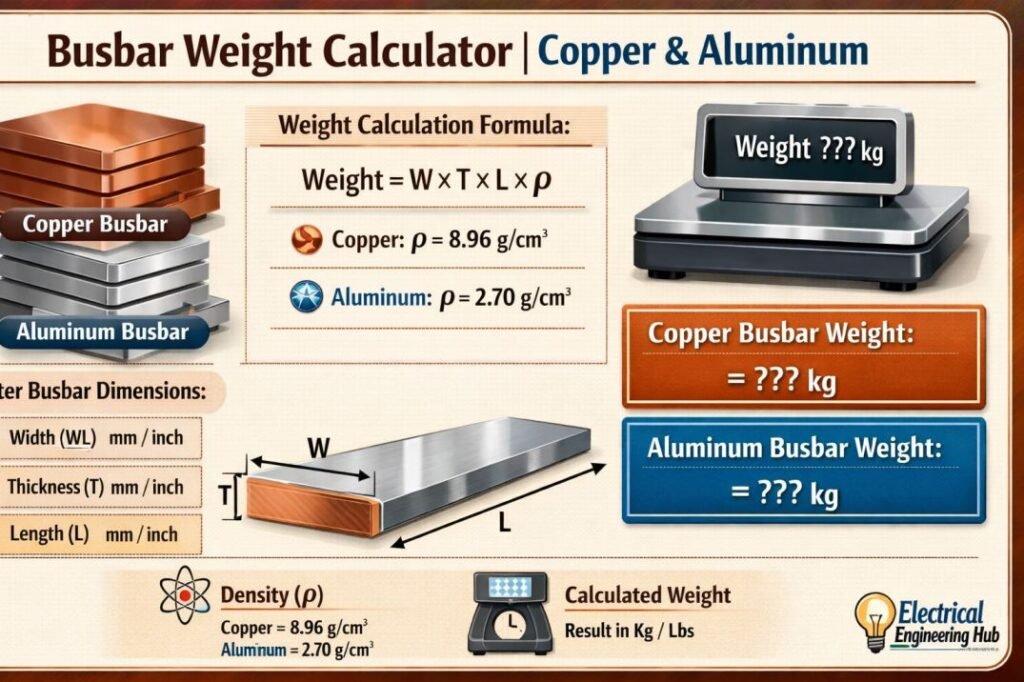
Table of Contents
Table of Contents
Busbar Weight Calculator | Copper & Aluminum
What Is a Busbar Weight Calculator?
A Busbar Weight Calculator is an engineering tool that estimates the weight of a busbar based on its:
- Width
- Thickness
- Length
- Material (Copper or Aluminum)
Instead of manually calculating the volume and multiplying it by material density, the calculator performs the calculation instantly and accurately.
It is commonly used by:
- Electrical engineers
- Panel manufacturers
- EPC contractors
- Procurement teams
- Estimation engineers
- Industrial maintenance professionals
Why Busbar Weight Matters
Knowing the weight of a busbar is important for several engineering activities.
| Application | Why Weight Matters |
|---|---|
| Material Procurement | Accurate quantity estimation |
| Project Costing | Better budget planning |
| Structural Design | Support frame sizing |
| Transportation | Shipping weight calculation |
| Installation | Handling and lifting requirements |
| Panel Manufacturing | Enclosure load assessment |
Incorrect weight estimation can lead to inaccurate quotations, excessive material purchases, or insufficient structural support.
Busbar Weight Formula
The calculation is based on the volume of the conductor multiplied by the density of the material.
Formula
Weight = Width × Thickness × Length × Density
Where:
| Parameter | Unit |
|---|---|
| Width | mm |
| Thickness | mm |
| Length | m |
| Density of Copper | 8.96 g/cm³ |
| Density of Aluminum | 2.70 g/cm³ |
Most engineering calculators automatically convert units into kilograms.
Copper Busbar Weight Calculator
A Copper Busbar Weight Calculator estimates the weight of copper conductors used in electrical distribution systems.
Copper has a higher density than aluminum, making it heavier for the same dimensions. However, it provides excellent electrical conductivity and mechanical strength.
Copper busbars are commonly used in:
- Main LT panels
- Generator synchronization panels
- MCCs
- PCC panels
- UPS systems
- Transformer connections
Copper Density
| Property | Value |
|---|---|
| Density | 8.96 g/cm³ |
| Approximate Weight Factor | 8.96 kg per liter of copper |
Because of its higher density, copper busbars significantly increase the overall weight of switchgear assemblies.
Aluminum Busbar Weight Calculator
An Aluminum Busbar Weight Calculator estimates the weight of aluminum conductors using the same dimensions but a different material density.
Aluminum weighs much less than copper, making it suitable for large electrical installations where weight reduction is important.
Typical applications include:
- Bus duct systems
- Utility substations
- Solar power plants
- Industrial switchyards
- Large distribution boards
Aluminum Density
| Property | Value |
|---|---|
| Density | 2.70 g/cm³ |
| Approximate Weight Factor | 2.70 kg per liter of aluminum |
Aluminum busbars are nearly one-third the weight of equivalent copper busbars.
Copper vs Aluminum Busbar Weight
The table below compares the two materials.
| Property | Copper | Aluminum |
|---|---|---|
| Density | 8.96 g/cm³ | 2.70 g/cm³ |
| Weight | Higher | Lower |
| Conductivity | Excellent | Good |
| Mechanical Strength | High | Moderate |
| Cost | Higher | Lower |
| Typical Use | Compact panels | Large installations |
The same dimensions produce a much lighter busbar when aluminum is selected.
Sample Busbar Weight Comparison
Assume a busbar with:
- Width = 100 mm
- Thickness = 10 mm
- Length = 2 m
| Material | Approximate Weight |
|---|---|
| Copper | 17.92 kg |
| Aluminum | 5.40 kg |
This comparison shows why aluminum is preferred when reducing installation weight is a priority.
Factors Affecting Busbar Weight
Several factors influence the final busbar weight.
Busbar Width
Increasing the width increases the cross-sectional area, resulting in a heavier conductor.
Busbar Thickness
A thicker busbar contains more material and therefore weighs more.
Busbar Length
Weight increases directly with length. Doubling the length doubles the weight.
Material Type
Copper is significantly heavier than aluminum due to its higher density.
Multiple Busbars
Many panels use double or triple busbar arrangements, which increase the total assembly weight.
Standard Busbar Weight Reference Chart
The following table provides approximate weights per meter.
| Busbar Size (mm) | Copper Weight (kg/m) | Aluminum Weight (kg/m) |
|---|---|---|
| 20 × 3 | 0.54 | 0.16 |
| 25 × 5 | 1.12 | 0.34 |
| 40 × 5 | 1.79 | 0.54 |
| 50 × 5 | 2.24 | 0.68 |
| 50 × 10 | 4.48 | 1.35 |
| 75 × 10 | 6.72 | 2.03 |
| 100 × 10 | 8.96 | 2.70 |
| 100 × 12 | 10.75 | 3.24 |
These values are approximate and may vary slightly depending on manufacturing tolerances.
Applications of a Busbar Weight Calculator
A Busbar Weight Calculator is useful during every phase of an electrical project.
Common applications include:
- Electrical panel design
- Switchgear manufacturing
- Tender preparation
- Material procurement
- Cost estimation
- Fabrication planning
- Structural analysis
- Shipping calculations
- Solar power projects
- Industrial substations
Using a calculator reduces manual work while improving engineering accuracy.
Engineering Tips for Accurate Weight Estimation
Follow these practices to obtain reliable results.
- Measure width and thickness accurately.
- Use the finished fabrication length instead of the drawing length.
- Include bends or extensions if required.
- Select the correct material before calculation.
- Consider plating separately because tin or silver coating adds only a small amount of weight.
- Calculate each busbar individually when multiple sizes are used.
For complete sizing methods, formulas, and engineering examples, explore our guide on Busbar Weight Estimation to understand practical calculation techniques.
Common Mistakes During Busbar Weight Calculation
Avoid these errors during estimation.
| Mistake | Impact |
|---|---|
| Using incorrect density | Wrong weight result |
| Mixing units | Calculation errors |
| Ignoring fabrication length | Underestimation |
| Assuming copper values for aluminum | Significant inaccuracy |
| Rounding dimensions too early | Reduced precision |
Careful measurement ensures more accurate material planning.
Benefits of Using a Busbar Weight Calculator
Using a calculator offers several practical advantages.
- Saves engineering time
- Reduces manual calculation errors
- Improves quotation accuracy
- Helps estimate transportation costs
- Simplifies procurement planning
- Supports structural design
- Enhances project budgeting
- Speeds up fabrication planning
These benefits make the calculator valuable for engineers, contractors, and manufacturers.
Related Guide & Tools
- Electrical Bus Bar types and Applications
- Busbar Size Calculator According to IEC and NEC
- Busbar Weight Calculation
Conclusion
A Busbar Weight Calculator is an essential tool for estimating the weight of copper and aluminum busbars before manufacturing or installation. By entering the width, thickness, length, and material type, engineers can quickly determine the required material weight for procurement, costing, transportation, and structural planning.
Whether you use a Copper Busbar Weight Calculator for compact switchboards or an Aluminum Busbar Weight Calculator for lightweight power distribution systems, accurate calculations help reduce errors and improve project efficiency. For complete formulas, detailed examples, and advanced methods, visit our comprehensive guide on Busbar Kg Calculation.
Follow Us on Social:
Subscribe our Newsletter on Electrical Insights for latest updates from Electrical Engineering Hub
BusbarWeightCalculator, #CopperBusbar, #AluminumBusbar, #ElectricalEngineering, #BusbarDesign, #PowerDistribution, #ElectricalCalculations, #Switchgear, #ElectricalTools, #EngineeringCalculator
Busbar Weight Calculator | Copper & Aluminum : Electrical Engineering Hub

Busbar Weight Calculator helps you accurately calculate copper and aluminum busbar weight based on dimensions and material type. Use this engineering tool for switchgear design, cost estimation, material planning, and electrical power distribution projects.
Price Currency: USD
Operating System: Web Browser
Application Category: UtilitiesApplication
