
How Many Wires Can Fit in a Junction Box? Best Guide
When people ask, “How Many Wires Can Fit in a Junction Box?”, the answer is never a fixed number. The allowable wire count depends on the internal volume of the box, the wire gauge, and whether switches, outlets, clamps, or grounding conductors are installed inside the enclosure.
For example, a standard 4×4-inch junction box with approximately 21 cubic inches of volume typically accommodates about 10 conductors of 14 AWG under common box fill calculations. However, adding a switch, receptacle, or internal clamp reduces the available space. Instead of guessing, use an Electrical Junction Box Calculator or a junction box sizing calculator to determine the exact conductor capacity for your installation.
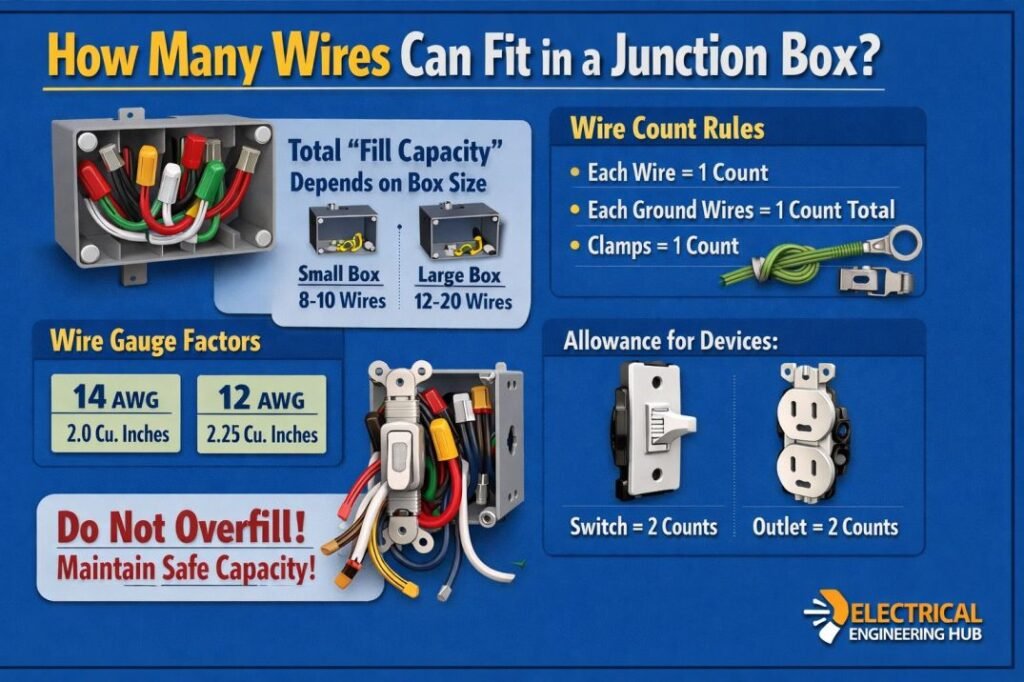
Table of Contents
Table of Contents
Why There’s No Single Answer
The reason there is no universal answer to how many wires in a junction box is that electrical box fill is based on volume rather than physical space alone. Every conductor occupies a specific volume allowance that changes according to wire size. Larger conductors require more room, so fewer of them can safely fit inside the same enclosure.
For instance, a box that safely accommodates around 10 conductors of 14 AWG may only hold about 8 or 9 conductors of 12 AWG because each 12 AWG conductor has a larger volume allowance. Devices such as switches and receptacles also consume conductor volume even though they are not wires themselves.
This is why electricians calculate box fill instead of estimating by appearance. If you want to understand the complete NEC requirements, read our guide on NEC 314.16 Junction Box Fill Requirements. For quick calculations, an Electrical Junction Box Calculator or junction box size calculator eliminates manual errors.
How Many Wires Can Fit in a Junction Box? Quick Answers by Common Box Size
The table below provides a quick reference for common junction box sizes. These values are general estimates and should always be verified using NEC 314.16(B) before installation.
| Box Size | Approx. 14 AWG Wires | Approx. 12 AWG Wires |
|---|---|---|
| Standard Single-Gang (18 cu in) | ~9 | ~8 |
| Standard Double-Gang (30 cu in) | ~15 | ~13 |
| 4×4 Square Box (21 cu in) | ~10 | ~9 |
These numbers assume standard conductor fill conditions. Internal clamps, cable connectors, switches, receptacles, and grounding conductors may reduce the final allowable conductor count.
For a complete conductor capacity table covering additional box sizes, see our Junction Box Fill Chart. If you need an exact answer instead of an estimate, use the Electrical Junction Box Calculator or a j box size calculator to determine the correct capacity for your specific installation.
Does a Switch or Outlet Count as a Wire?
A switch or outlet does not count as a single wire. Instead, the National Electrical Code treats each device as two conductor volume allowances based on the largest conductor connected to that device.
This rule surprises many homeowners because they assume only the actual wires matter. In reality, a receptacle or light switch occupies valuable space inside the electrical box, reducing the number of conductors that can be installed safely.
For example, if a box contains eight conductors and one duplex receptacle, the receptacle uses the equivalent of two additional conductor allowances. Internal cable clamps may also require additional box fill allowance depending on the box design.
Whenever you install devices, calculate the complete box fill rather than simply counting wires. An Electrical Junction Box Calculator or junction box sizing calculator automatically includes these allowances and helps avoid costly installation mistakes.
Do Ground Wires Count Separately?
Grounding conductors are treated differently from current-carrying conductors. No matter how many equipment grounding conductors are inside a junction box, they collectively count as only one conductor volume allowance based on the largest grounding conductor present.
For example, three, four, or even five bare copper grounding wires still use only one conductor allowance. This rule helps simplify box fill calculations while ensuring sufficient working space inside the enclosure. Even so, the grounding conductors must still be properly connected and arranged according to electrical code requirements.
What Happens If You Overfill a Junction Box?
Overfilling a junction box creates more than just a code compliance issue. It can affect safety, maintenance, and long-term reliability of the electrical system.
When too many conductors are packed into a small enclosure, the wires become difficult to bend properly. Tight bends can damage insulation, loosen wire connectors, or place unnecessary stress on terminal screws. Crowded boxes also make future troubleshooting more challenging.
An overfilled box may also reduce heat dissipation around conductors, particularly in circuits carrying higher current. During an electrical inspection, an inspector may reject the installation if the box fill exceeds allowable limits under NEC requirements.
Common problems caused by an overfilled junction box include:
| Issue | Potential Result |
|---|---|
| Limited working space | Difficult wire splicing |
| Damaged insulation | Increased risk of short circuits |
| Loose connections | Poor electrical reliability |
| Inspection failure | Code violation |
| Future maintenance difficulties | Longer repair times |
Proper sizing junction boxes before installation is always easier than replacing an undersized box later. A junction box size calculator helps verify capacity before any wiring begins.
Get an Exact Count for Your Box
General charts provide useful estimates, but every installation is different. Wire gauge, conductor quantity, devices, grounding conductors, and internal clamps all affect the final box fill calculation.
Instead of estimating, enter your exact box dimensions, conductor sizes, and installed devices into our Electrical Junction Box Calculator. The calculator performs the box fill calculation automatically and provides a precise conductor limit based on recognized code requirements. Whether you are designing a new electrical installation or modifying an existing circuit, the Electrical Junction Box Calculator, junction box sizing calculator, and j box size calculator make sizing junction boxes much faster and more accurate.
FAQs (How Many Wires Can Fit in a Junction Box?)
How many 14 AWG wires can go in a 4×4 junction box?
A typical 4×4 junction box with approximately 21 cubic inches of volume can usually accommodate around 10 conductors of 14 AWG under standard box fill calculations. Devices and internal clamps reduce the allowable count.
Does a wire nut count toward box fill?
No. Wire connectors such as wire nuts do not have a separate box fill allowance. However, the conductors connected by the wire nut are still counted individually according to box fill rules.
Can I add more wires later if the box isn’t full?
Yes. Additional conductors can be added later as long as the final conductor count remains within the allowable box fill capacity after considering devices, grounding conductors, and clamps.
What size junction box do I need for 6 wires?
The required junction box depends on the wire gauge and whether switches, receptacles, or internal clamps are installed. A small single-gang box may be sufficient for six 14 AWG conductors under certain conditions, but the safest approach is to verify the capacity using an Electrical Junction Box Calculator or junction box size calculator before installation.
Follow Us on Social:
Subscribe our Newsletter on Electrical Insights for latest updates from Electrical Engineering Hub
JunctionBox, #BoxFillCalculator, #ElectricalWiring, #NECCode, #ElectricianTips, #JunctionBoxSizing, #ElectricalSafety, #WireCapacity, #ElectricalEngineering, #DIYElectrical
