Best PC Based Oscilloscopes: Top 5 Picks
A PC-based oscilloscope is a practical choice for engineers, technicians, electronics students, and repair professionals who want waveform analysis without investing in a traditional bench oscilloscope. These devices connect to a computer through USB and use dedicated software to display, capture, measure, and analyze electrical signals.
Choosing the Best PC Based Oscilloscopes requires more than comparing bandwidth. Sampling rate, memory depth, input voltage limits, channel count, software features, and probe quality all affect measurement performance.
As an electrical engineer with more than 15 years of experience in electrical systems, industrial automation, and troubleshooting, I find USB oscilloscopes particularly useful for examining control signals, PWM waveforms, sensor outputs, and communication circuits. They are also convenient when working on a laptop or a crowded electronics workbench.
In this guide, I compare five PC-based oscilloscopes for different budgets and applications.
Best PC Based Oscilloscopes: Quick Comparison
| Oscilloscope | Channels | Bandwidth | Sampling Rate | Best For |
|---|---|---|---|---|
| PicoScope 2204A | 2 | 10 MHz | 100 MS/s | Beginners |
| Hantek 6022BE | 2 | 20 MHz | 48 MSa/s | Budget electronics work |
| PicoScope 2206B | 2 | 50 MHz | Check model specifications | Professional troubleshooting |
| Hantek 6254BD | 4 | 250 MHz | 200 MSa/s | Multi-channel analysis |
| Analog Discovery 3 | 2 analog | 125 MHz* | 125 MS/s | Engineering and education |
Analog Discovery 3 offers 125 MS/s sampling and 125 MHz analog bandwidth is not implied; verify the manufacturer’s published analog bandwidth and operating specifications before purchase.

Table of Contents
Table of Contents
1. Pico Technology PicoScope 2204A – Best for Beginners
The PicoScope 2204A is a compact USB oscilloscope designed for engineers and electronics enthusiasts who need basic waveform measurement capabilities.
It offers two analog input channels, 10 MHz bandwidth, and a maximum sampling rate of 100 MS/s. Its small size makes it easy to carry with a laptop, which is useful for field troubleshooting and electronics laboratory work.
One advantage of Pico Technology products is their dedicated PicoScope software. You can use the software to display waveforms, measure signal parameters, capture events, and examine signal behavior.
The supplied waveform generator is another useful feature for basic circuit testing.

- Use your PicoScope 2000 Series as an advanced oscilloscope, spectrum analyzer, function generator, arbitrary waveform ge…
- PicoScope 2204A 2 Channel Oscilloscope kit includes: USB 2.0 cable (USB 3.0/3.1 compatible), two x1/x10 passive probes a…
- 10 MHz bandwidth, 100 MS/s maximum sampling rate, 8 kS capture memory and Up to 12 bits enhanced vertical resolution.
Key Features:
- Two analog channels
- 10 MHz bandwidth
- 100 MS/s maximum sampling rate
- 8 kS capture memory
- USB computer connectivity
- PicoScope 7 software
- Supplied probes
- Integrated waveform generator
My assessment: The 2204A is suitable for basic electronics testing, educational projects, low-frequency control signals, and simple circuit troubleshooting. Its limited bandwidth and capture memory make it less suitable for demanding high-speed measurements.
Check Price on Amazon: Pico Technology PicoScope 2204A USB Oscilloscope
2. Hantek 6022BE – Best Budget PC Oscilloscope
The Hantek 6022BE is an affordable two-channel USB digital storage oscilloscope. It provides 20 MHz bandwidth and a maximum sampling rate of 48 MSa/s.
This model is worth considering if you are learning waveform analysis or need an inexpensive instrument for occasional electronics troubleshooting.
Its two input channels allow you to compare signals at different points in a circuit. This is useful when checking sensor outputs, power supply ripple, and basic digital signals.
The supplied probes and USB cable help get you started without purchasing every accessory separately.

- TWO-CHANNEL SIGNAL CAPTURE – Two analog channels, 20 MHz bandwidth, 48 MSa/s maximum real-time sample rate and up to 1 M…
- USB 2.0 CONNECTION AND POWER – A single USB connection provides computer communication and operating power, so no extern…
- MEASUREMENT AND ANALYSIS TOOLS – Supports 20 automatic measurements, FFT spectrum analysis, waveform math, X-Y display, …
Key Features:
- Two input channels
- 20 MHz bandwidth
- 48 MSa/s sampling rate
- USB 2.0 connectivity
- PC-based waveform display
- Two supplied probes
- Digital storage oscilloscope functionality
My assessment: The Hantek 6022BE is a reasonable entry-level option for hobbyists and students. However, its sampling rate and bandwidth are limited compared with more advanced USB oscilloscopes.
Check Price on Amazon: Hantek 6022BE USB Oscilloscope
3. Pico Technology PicoScope 2206B – Best for Advanced Troubleshooting
The PicoScope 2206B is a more capable option for users who need additional bandwidth for electronics development and troubleshooting.
It provides two analog channels and 50 MHz bandwidth. Compared with the 2204A, the higher bandwidth makes it more suitable for examining faster signal transitions and a wider range of electronic circuits.
The PicoScope software is an important part of the package. It provides waveform visualization, automatic measurements, triggering, and advanced analysis tools, depending on the software version and configuration.
For technicians working with embedded electronics, switching circuits, and control systems, this combination can be useful.

- Use your PicoScope 2000 Series as an advanced oscilloscope, spectrum analyzer, function generator, arbitrary waveform ge…
- PicoScope 2 channel 2206B Oscilloscope comes with 2x switchable 10:1/1:1 probes, USB cable and Quick Start Guide.
- 50 MHz bandwidth, 32 MS capture memory, 500 MS/s maximum sample rate and Up to 12 bits enhanced vertical resolution.
Key Features:
- Two analog channels
- 50 MHz bandwidth
- USB connectivity
- PicoScope 7 software
- Supplied probes
- Portable computer-based operation
- Advanced waveform analysis
My assessment: The 2206B is a good step up from basic USB scopes. It is worth considering when 10 MHz or 20 MHz bandwidth is no longer enough for your testing requirements.
Check Price on Amazon: Pico Technology PicoScope 2206B
4. Hantek 6254BD – Best Four-Channel PC Oscilloscope
If you need to observe several signals simultaneously, the Hantek 6254BD deserves attention.
It offers four input channels and 250 MHz advertised bandwidth, making it a more advanced option for electronics development and multi-signal troubleshooting.
Four channels are especially useful when examining control systems. For example, you can compare input signals, output signals, switching behavior, and feedback signals during the same test.
The instrument also includes a DDS arbitrary waveform generator, adding signal-generation capability to the setup.
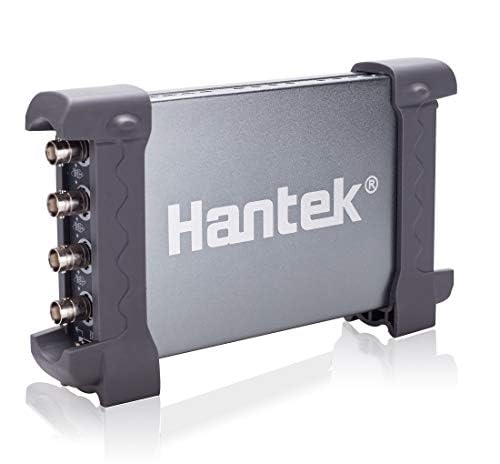
- 4CH oscilloscope&function/Arb. waveform generator with high performance comparable to benchtop oscilloscope, 4 independe…
- Function/Arbitrary Waveform Generator with 200MSa/s DDS, 12bits of vertical resolution, built-in variety of standard wav…
- Pass/fail test, resourceful trigger function, dynamic cursor tracking, waveform record and replay function with an opera…
Key Features:
- Four analog channels
- 250 MHz advertised bandwidth
- 200 MSa/s sampling rate
- USB 2.0 interface
- DDS arbitrary waveform generator
- PC-based waveform analysis
- Multi-channel signal comparison
My assessment: This is an interesting choice for engineers who need four channels at a relatively accessible price. However, pay close attention to the sampling rate per channel, memory depth, and bandwidth specifications. A 250 MHz bandwidth rating does not mean the instrument can accurately capture every fast signal at its maximum rated bandwidth under all operating conditions.
Check Price on Amazon: Hantek 6254BD Four-Channel Oscilloscope
5. Analog Discovery 3 – Best All-in-One Engineering Instrument
The Analog Discovery 3 is more than a conventional USB oscilloscope. It combines several electronics laboratory instruments in one compact device.
It provides a two-channel oscilloscope with a maximum sampling rate of 125 MS/s, along with a waveform generator, logic analyzer, and variable power supply.
This makes it especially attractive for electronics students, embedded-system developers, and engineers who work with both analog and digital circuits.
The included software environment provides tools for waveform visualization, signal generation, logic analysis, and circuit experimentation.
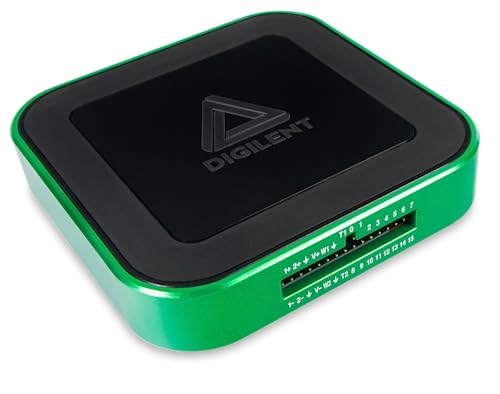
- Oscilloscope: Two differential channels with 14-bit resolution at up to 125 MS/s per channel with a +/-25 V input range,…
- Arbitrary Waveform Generator: Two channels with 14-bit resolution at up to 125 MS/s per channel with a +/-5 V output ran…
- Logic Analyzer and Pattern Generator: 16 digital I/O channels at up to 125 MS/s per channel; Individually-configurable 3…
Key Features:
- Two-channel USB oscilloscope
- 125 MS/s maximum sampling rate
- Waveform generator
- Digital logic analyzer
- Variable power supply
- Computer-based instrument control
- Suitable for electronics development and education
My assessment: The Analog Discovery 3 is an excellent choice if you need several laboratory instruments in one compact device. Its versatility makes it particularly useful for circuit development and educational laboratories.
Check Price on Amazon: Analog Discovery 3 USB Test Instrument
How to Choose a PC-Based Oscilloscope
Before purchasing, I recommend checking five important specifications.
1. Bandwidth
Bandwidth determines the range of signal frequencies an oscilloscope can measure accurately.
For example:
- 10–20 MHz: Basic electronics and low-frequency troubleshooting.
- 50 MHz: General electronics development.
- 100 MHz and above: Faster digital and switching circuits.
As a general guideline, choose an oscilloscope with bandwidth around five times the highest signal frequency when you need good amplitude accuracy. Fast signal edges may require much higher bandwidth.
2. Sampling Rate
Sampling rate determines how many samples the oscilloscope collects per second.
A higher sampling rate helps capture signal details, especially fast transitions and short events. However, sampling rate should always be considered alongside bandwidth and memory depth.
3. Number of Channels
Two channels are sufficient for many basic measurements. Four channels are more useful when comparing several signals at once.
For example, in industrial automation troubleshooting, four channels can help examine sensor inputs, PLC outputs, and related control signals simultaneously.
4. Software Compatibility
Check whether the oscilloscope supports your computer’s operating system. Also consider waveform export, automatic measurements, triggering, FFT analysis, and data recording.
5. Input Voltage and Probe Safety
Never connect an oscilloscope directly to a high-voltage circuit without checking the input limits and measurement arrangement.
Probe attenuation, grounding, common-mode limits, and isolation are important. Standard USB oscilloscopes generally have grounded inputs and are not isolated from the connected computer.
For mains measurements, use an appropriately rated differential probe or isolated measurement instrument. Never remove protective earth connections to work around grounding issues.
PC-Based vs Traditional Bench Oscilloscopes
| Feature | PC-Based Oscilloscope | Bench Oscilloscope |
|---|---|---|
| Display | Computer screen | Built-in screen |
| Portability | Usually compact | Depends on model |
| Software | PC software | Built-in interface |
| Storage | Computer storage | Internal/USB storage |
| Setup | Requires computer | Usually standalone |
| Best application | Portable testing and development | General laboratory work |
A USB oscilloscope is attractive when you already have a capable laptop. A traditional bench instrument may be more convenient when you need a dedicated display, quick operation, and standalone measurement capability.
Frequently Asked Questions
1. Are PC-based oscilloscopes accurate?
Yes, they can provide accurate measurements when used within their specified bandwidth, sampling rate, voltage limits, and probe ratings. Actual accuracy varies by model.
2. Do USB oscilloscopes need external power?
Many USB oscilloscopes receive power directly from the computer. However, power requirements vary by model, so check the manufacturer’s specifications.
3. Can I use a PC oscilloscope for automotive troubleshooting?
Yes. They can help examine sensor signals, PWM outputs, and communication waveforms. For automotive applications, verify input protection, grounding, voltage limits, and probe requirements.
4. Is a 50 MHz oscilloscope enough for electronics work?
For many general electronics projects, 50 MHz is sufficient. However, high-speed digital circuits and fast switching signals may require greater bandwidth and sampling performance.
5. Which is better, PicoScope or Hantek?
PicoScope models are attractive for their software environment and measurement capabilities. Hantek offers several budget-friendly models, including four-channel options. The better choice depends on your required bandwidth, channels, software, and budget.
Final Verdict
The right PC oscilloscope depends on the signals you intend to measure and the level of analysis you need.
The PicoScope 2204A is a good starting point for beginners, while the Hantek 6022BE offers an affordable entry into USB waveform measurement. The PicoScope 2206B provides additional bandwidth, the Hantek 6254BD offers four-channel measurement, and the Analog Discovery 3 combines several laboratory instruments in one device.
Before making your purchase, compare bandwidth, sampling rate, memory depth, probe ratings, and software support. These specifications will have a much greater impact on measurement quality than the appearance or size of the instrument.
If you are working with a limited budget, read my guide to the Best Oscilloscope Under 200 Dollar for more affordable choices.
For higher-performance instruments, my comparison of the Best Oscilloscope Under 500 Dollar covers additional options for electronics technicians and engineers.
Get new guides in your feed. Follow Electrical Insights on LinkedIn for new electrical standards guides, calculators and design tips from Azad Circuit Hub.