
Types of Electric Motor Testing: Complete Industrial Motor Testing Guide for Performance & Reliability
Electric motors are the backbone of modern industries. From manufacturing plants and water treatment systems to HVAC units and agricultural operations, motors drive critical equipment every day. Because these machines operate continuously under different load conditions, regular testing becomes essential for safety, efficiency, and long-term reliability.
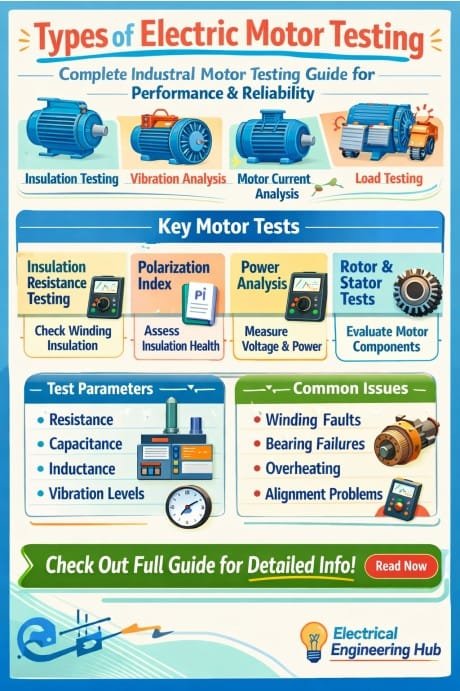
Table of Contents
Understanding the Types of Electric Motor Testing helps industries reduce downtime, prevent unexpected failures, improve energy efficiency, and extend motor lifespan. Proper testing also supports predictive maintenance programs and ensures motors operate within design specifications.
This complete guide explains the most important motor testing methods used in industrial applications, including electrical, mechanical, thermal, and performance-based evaluations.
Why Electric Motor Testing Is Important
Industrial motors often work in harsh environments involving dust, heat, vibration, moisture, and voltage fluctuations. Over time, these conditions can damage insulation, bearings, windings, shafts, and other internal components.
Regular testing provides several benefits:
- Detects faults before major breakdowns
- Reduces maintenance costs
- Improves operational safety
- Increases motor efficiency
- Extends equipment service life
- Minimizes production downtime
- Supports preventive maintenance planning
Companies that implement scheduled motor diagnostics usually experience fewer emergency shutdowns and lower repair expenses.
Know more about How to Size a VFD for a Motor
Main Types of Electric Motor Testing
The Types of Electric Motor Testing can generally be divided into three categories:
| Testing Category | Purpose | Common Tests |
|---|---|---|
| Electrical Testing | Checks electrical health and insulation condition | Insulation resistance, winding resistance, surge testing |
| Mechanical Testing | Evaluates moving parts and physical condition | Vibration analysis, bearing inspection |
| Performance Testing | Measures motor efficiency and operating behavior | Load testing, temperature testing, efficiency analysis |
Each testing method provides valuable information about motor health and operational reliability.
Insulation Resistance Testing
Insulation resistance testing is one of the most widely used motor tests. It measures the condition of insulation between motor windings and ground.
A megohmmeter, commonly called a Megger, is used to apply DC voltage and measure insulation resistance in megaohms.
Purpose of Insulation Resistance Testing
- Detect moisture contamination
- Identify insulation deterioration
- Prevent short circuits
- Reduce risk of electrical failure
Typical Resistance Values
| Motor Condition | Insulation Resistance |
|---|---|
| Excellent | Above 100 MΩ |
| Good | 50–100 MΩ |
| Acceptable | 10–50 MΩ |
| Poor | Below 10 MΩ |
Low insulation resistance may indicate dirt, aging insulation, humidity, or internal winding damage.
Know more about How to Check 3 Phase Motor Winding with Multimeter
Winding Resistance Testing
Winding resistance testing measures the resistance of motor windings to identify loose connections, damaged conductors, or phase imbalance.
This test is especially important for three-phase motors because unequal winding resistance can lead to overheating and efficiency loss.
Key Benefits
- Detects shorted windings
- Finds loose terminal connections
- Verifies balanced phase resistance
- Supports preventive maintenance
Technicians usually compare readings between phases to identify abnormalities.
Surge Testing
Surge testing evaluates insulation strength between winding turns. It is commonly used during motor manufacturing, repair, and maintenance procedures.
A high-voltage pulse is applied to the winding, and waveform comparisons are analyzed.
Surge Test Applications
- Detect turn-to-turn insulation faults
- Identify weak winding insulation
- Verify motor rewind quality
- Prevent future winding failures
This test is highly effective for detecting hidden insulation weaknesses that standard resistance tests may not reveal.
Use our online tool for free Wire Size Calculator for Motors – Accurate Motor Cable Sizing Tool for Electric Loads
Polarization Index Testing
Polarization Index testing is an advanced insulation evaluation method. It measures insulation resistance over time to determine insulation cleanliness and dryness.
The polarization index value is calculated using the following formula:
| Formula | Description |
|---|---|
| PI = 10-minute IR reading ÷ 1-minute IR reading | Indicates insulation quality |
PI Value Interpretation
| PI Value | Condition |
|---|---|
| Above 2.0 | Excellent |
| 1.5–2.0 | Acceptable |
| Below 1.5 | Poor insulation condition |
This test is commonly used for large industrial motors and generators.
Vibration Analysis Testing
Vibration testing helps identify mechanical problems before serious damage occurs. Excessive vibration can reduce motor life and damage connected equipment.
Technicians use vibration analyzers to monitor vibration frequency and amplitude.
Common Causes of Motor Vibration
- Bearing wear
- Shaft misalignment
- Rotor imbalance
- Loose foundations
- Mechanical looseness
Access our powerful online calculator now star delta motor cable size calculator
Benefits of Vibration Testing
- Predicts mechanical failures
- Improves equipment reliability
- Reduces unexpected shutdowns
- Supports condition monitoring programs
Many industries now use online vibration monitoring systems for continuous motor health tracking.
Motor Current Signature Analysis
Motor Current Signature Analysis (MCSA) is a non-invasive diagnostic technique used to detect electrical and mechanical problems through current waveform analysis.
This test helps identify:
- Broken rotor bars
- Air gap eccentricity
- Bearing defects
- Voltage imbalance
- Load abnormalities
MCSA is becoming increasingly popular because it allows testing without dismantling the motor.
High Voltage Testing
High voltage testing verifies insulation strength under elevated voltage conditions. It ensures the motor can safely withstand operating stress.
Types of High Voltage Tests
| Test Type | Purpose |
|---|---|
| Hipot Test | Checks insulation breakdown resistance |
| Dielectric Test | Measures insulation withstand capability |
These tests are commonly performed after motor rewinding or major repairs.
Uncover insights on motor generator transformer manufacturers
Temperature Testing
Temperature testing measures motor heat levels during operation. Excessive temperature is one of the leading causes of motor failure.
Technicians use thermal cameras, RTDs, thermocouples, or infrared thermometers to monitor motor temperatures.
Areas Commonly Monitored
- Bearings
- Windings
- Terminal boxes
- Cooling systems
Advantages of Thermal Testing
- Detects overheating issues
- Improves motor efficiency
- Prevents insulation damage
- Supports predictive maintenance
Thermal imaging is particularly effective because it quickly identifies abnormal hot spots.
Load Testing
Load testing evaluates motor performance under actual operating conditions. It helps determine whether the motor can safely handle operational demands.
Use our free online tool Generator Sizing Calculator for VFD Motors
Parameters Measured During Load Testing
| Parameter | Importance |
|---|---|
| Current | Indicates electrical load |
| Voltage | Confirms power quality |
| Speed | Verifies motor performance |
| Torque | Measures output capability |
| Temperature | Monitors heating behavior |
Load testing ensures the motor operates efficiently without excessive stress.
No-Load Testing
No-load testing is performed when the motor runs without mechanical load. This test helps analyze basic electrical and mechanical behavior.
Key Measurements
- No-load current
- Voltage
- Rotational speed
- Core losses
No-load testing is often conducted during commissioning and troubleshooting procedures.
Efficiency Testing
Energy efficiency is critical in industrial operations because motors consume a large portion of electrical power.
Efficiency testing determines how effectively the motor converts electrical energy into mechanical output.
Know more about What Provides Short Circuit Protection for the Motor
Why Efficiency Testing Matters
- Reduces energy costs
- Improves sustainability
- Identifies power losses
- Supports energy audits
High-efficiency motors can significantly lower operational expenses over time.
Bearing Testing
Bearings are among the most failure-prone motor components. Bearing testing helps detect lubrication problems, wear, and electrical discharge damage.
Common Bearing Testing Methods
| Testing Method | Purpose |
|---|---|
| Ultrasound Testing | Detects early bearing defects |
| Vibration Monitoring | Identifies mechanical wear |
| Temperature Analysis | Finds overheating issues |
Early detection prevents catastrophic failures and expensive downtime.
Choosing the Right Motor Testing Method
Different motors require different testing approaches depending on their size, voltage level, operating environment, and criticality.
Factors to Consider
- Motor type and rating
- Operating conditions
- Maintenance history
- Industry standards
- Critical production requirements
Use our online tool Short Circuit Current Calculator for Motors: Best Tool
A combination of electrical and mechanical testing usually provides the most accurate assessment of motor condition.
Best Practices for Industrial Motor Testing
Following proper testing procedures improves accuracy and safety.
Recommended Practices
- Follow manufacturer guidelines
- Use calibrated testing instruments
- Maintain detailed testing records
- Perform regular preventive maintenance
- Analyze trends over time
- Train maintenance personnel properly
Consistent testing schedules help identify gradual performance deterioration before major failures occur.
Conclusion
Understanding the Types of Electric Motor Testing is essential for maintaining reliable industrial operations. Regular testing helps detect insulation problems, winding faults, vibration issues, overheating, and efficiency losses before they lead to costly breakdowns.
Know more about HT Motor Tan Delta Testing – Best Guide for High Voltage Motor Insulation Diagnostic & Preventive Maintenance
Modern industries rely heavily on predictive maintenance strategies, and motor testing plays a central role in these programs. By combining insulation testing, vibration analysis, thermal monitoring, load testing, and efficiency evaluations, companies can improve equipment reliability, reduce downtime, and extend motor service life.
As industrial systems continue to evolve, advanced motor diagnostics and condition monitoring technologies will become even more important for ensuring safe, efficient, and uninterrupted operations.
Follow Us on Social:
Subscribe our Newsletter on Electrical Insights for latest updates from Electrical Engineering Hub
#TypesOfElectricMotorTesting,#ElectricMotorTesting,#MotorTestingMethods,#IndustrialMotorTesting,#ElectricMotorMaintenance,#MotorEfficiencyTesting,#ElectricalTesting,#MotorDiagnostics,#ThreePhaseMotorTesting,#MotorPerformanceTest
