Glow Wire Test Standard: Complete IEC 60695 Electrical Safety & Fire Resistance Guide
Electrical products are expected to operate safely under demanding conditions. Heat, overload, loose connections, and short circuits can generate extremely high temperatures inside electrical devices. To reduce fire hazards and improve product safety, manufacturers follow the Glow Wire Test Standard during product development and certification.
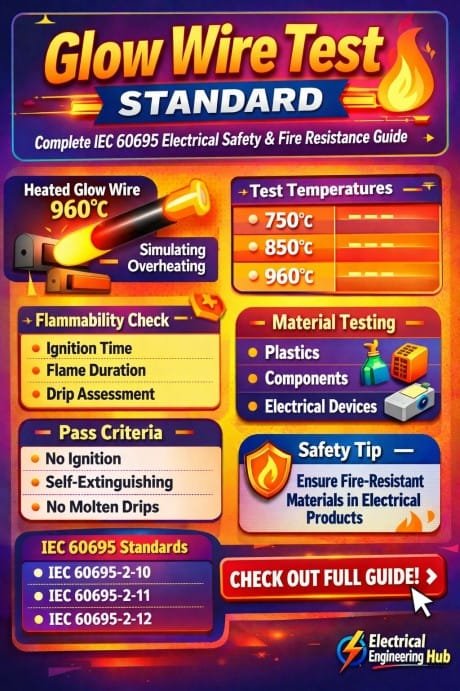
Table of Contents
The Glow Wire Test Standard is one of the most important fire safety evaluation methods used for electrical and electronic equipment. It helps determine whether insulating materials can resist ignition when exposed to heated components. Industries such as consumer electronics, automotive manufacturing, industrial automation, home appliances, switchgear production, and cable management rely heavily on this testing method.
This guide explains the purpose, procedure, IEC requirements, temperature classifications, applications, and importance of the Glow Wire Test Standard in modern electrical safety engineering.
What Is Glow Wire Test Standard?
The Glow Wire Test Standard is a fire hazard testing method defined under IEC 60695. It evaluates the resistance of plastic and insulating materials against ignition caused by overheated electrical components.
During the test, a heated wire loop is pressed against the test specimen for a specified duration. Engineers observe whether the material ignites, how long the flame persists, and whether burning droplets spread fire to nearby materials.
Learn more about earthing cable size as per iec
The primary objective of the Glow Wire Test Standard is to reduce the risk of electrical fires in residential, commercial, and industrial products.
Key Objectives of the Test
| Objective | Description |
|---|---|
| Fire Prevention | Prevent ignition caused by overheated components |
| Material Evaluation | Assess flame resistance of insulating materials |
| Product Safety | Improve safety compliance in electrical devices |
| Regulatory Compliance | Meet IEC and international safety standards |
| Risk Reduction | Minimize fire propagation inside equipment |
Understanding IEC 60695 Standard
IEC 60695 is the international standard series related to fire hazard testing for electrotechnical products. The Glow Wire Test Standard falls under this framework and is widely accepted across global markets.
Manufacturers use IEC 60695 testing to verify that components can withstand abnormal heat conditions without causing ignition hazards.
Important Parts of IEC 60695
| IEC Standard | Purpose |
|---|---|
| IEC 60695-2-10 | Glow wire apparatus and general test method |
| IEC 60695-2-11 | Glow wire flammability test procedure |
| IEC 60695-2-12 | Glow wire flammability index |
| IEC 60695-2-13 | Glow wire ignition temperature |
These standards help maintain consistency in electrical product testing across different countries and industries.
Discover everything about cable bending radius iec standard
How Glow Wire Testing Works
The Glow Wire Test Standard uses a nickel-chromium wire heated electrically to a specific temperature. The wire simulates an overheated electrical component inside equipment.
The heated wire is pressed against the sample material with controlled force and contact duration. Testing laboratories then evaluate the reaction of the material.
Basic Test Procedure
- Prepare the test sample according to IEC dimensions
- Heat the glow wire to the required temperature
- Apply the glow wire to the specimen for 30 seconds
- Observe ignition behavior
- Measure flame duration
- Check whether flaming particles ignite surrounding tissue paper
The material passes if flames extinguish within the specified limit and no ignition spreads beyond acceptable conditions.
Common Glow Wire Test Temperatures
Different products require different glow wire temperatures depending on their application and safety classification.
Standard Glow Wire Temperature Ratings
| Temperature | Typical Application |
|---|---|
| 550°C | General insulation materials |
| 650°C | Low-risk electrical components |
| 750°C | Household appliances |
| 850°C | Switches and connectors |
| 960°C | High-risk unattended equipment |
Higher temperatures indicate stricter fire resistance requirements.
Dive deeper into instrument earthing iec standard
Importance of Glow Wire Testing in Electrical Safety
The Glow Wire Test Standard plays a major role in reducing electrical fire incidents. Modern electronic devices contain compact circuits and polymer-based components that can ignite under abnormal operating conditions.
Testing ensures that electrical materials do not easily catch fire or spread flames.
Major Safety Benefits
- Improves fire resistance performance
- Reduces risk of electrical ignition
- Enhances consumer protection
- Supports international certification
- Increases product reliability
- Helps manufacturers meet compliance requirements
Many regulatory authorities require glow wire compliance before products can enter international markets.
Industries That Use Glow Wire Test Standard
The Glow Wire Test Standard is used in multiple industries where electrical safety is critical.
Common Industrial Applications
| Industry | Tested Products |
|---|---|
| Consumer Electronics | Chargers, adapters, routers |
| Home Appliances | Refrigerators, washing machines |
| Automotive | EV components, wiring systems |
| Industrial Equipment | Control panels, relays |
| Lighting Industry | LED fixtures, drivers |
| Electrical Accessories | Switches, sockets, connectors |
Manufacturers use glow wire testing during both product development and quality assurance stages.
Glow Wire Flammability Index and Ignition Temperature
Two important concepts associated with the Glow Wire Test Standard are GWFI and GWIT.
Glow Wire Flammability Index (GWFI)
GWFI refers to the highest temperature at which the material does not ignite or extinguishes quickly after ignition.
Glow Wire Ignition Temperature (GWIT)
GWIT represents the minimum temperature at which the material ignites and continues burning for a specified duration.
These values help engineers select suitable materials for electrical applications with higher thermal risks.
Know more about Phase to Phase Clearance as per IEC 61439: Best Guide
Materials Commonly Tested
Many non-metallic materials undergo glow wire testing to ensure compliance with electrical safety standards.
Frequently Tested Materials
- Polycarbonate
- ABS plastic
- Polyamide
- PVC insulation
- Thermoplastics
- Thermosetting materials
- Engineering polymers
Manufacturers often compare material grades based on glow wire performance before selecting them for production.
Difference Between Glow Wire Test and UL 94
Many people confuse the Glow Wire Test Standard with UL 94 flammability testing. Although both evaluate fire resistance, they use different methods.
Comparison Table
| Feature | Glow Wire Test | UL 94 Test |
|---|---|---|
| Standard | IEC 60695 | UL 94 |
| Heat Source | Heated wire | Open flame |
| Purpose | Simulate overheated parts | Measure flame spread |
| Main Focus | Ignition resistance | Flammability behavior |
| Common Use | Electrical safety | Plastic material rating |
Manufacturers often perform both tests for complete fire safety evaluation.
Know more about IEC Standard for Busbar Clearance
Factors Affecting Glow Wire Test Results
Several factors can influence the outcome of the Glow Wire Test Standard.
Important Variables
- Material thickness
- Test temperature
- Environmental conditions
- Moisture absorption
- Sample orientation
- Polymer composition
- Additives and flame retardants
Even small changes in material formulation can affect ignition resistance significantly.
Compliance Requirements for Manufacturers
Manufacturers must maintain strict documentation and quality control procedures when conducting glow wire testing.
Compliance Checklist
| Requirement | Importance |
|---|---|
| Certified laboratory testing | Ensures accurate results |
| IEC standard adherence | Supports global approval |
| Material traceability | Maintains consistency |
| Test reports | Required for certification |
| Production quality control | Prevents safety failures |
Products that fail the Glow Wire Test Standard may require redesign or material replacement.
Explore all about IEEE Standard for Cable Insulation Resistance Test
Choosing the Right Material for Glow Wire Compliance
Selecting suitable materials is essential for achieving compliance with IEC 60695 requirements.
Engineers usually prioritize materials with:
- High thermal stability
- Low flame propagation
- Strong electrical insulation
- Reduced smoke generation
- Better ignition resistance
Material suppliers often provide GWFI and GWIT ratings to help manufacturers select compliant polymers.
Future of Glow Wire Testing
Electrical systems continue to evolve rapidly with electric vehicles, renewable energy equipment, smart appliances, and compact electronics. As heat density increases inside devices, the importance of the Glow Wire Test Standard also continues to grow.
Manufacturers are now developing advanced flame-retardant polymers and safer insulating materials to meet stricter global fire safety regulations.
Automation and digital monitoring systems are also improving testing accuracy and repeatability in laboratories worldwide.
Find all about IEEE Standard for Insulation Resistance Test
Conclusion
The Glow Wire Test Standard is a critical part of modern electrical fire safety compliance. It helps manufacturers evaluate whether insulating materials can withstand abnormal heating conditions without causing ignition hazards.
Based on IEC 60695 requirements, this testing method improves product reliability, protects consumers, and supports international certification for electrical and electronic equipment. Industries across automotive, appliances, electronics, and industrial systems rely on glow wire testing to reduce fire risks and improve operational safety.
As electrical technology advances, compliance with the Glow Wire Test Standard will remain essential for manufacturers seeking safer, more reliable, and globally accepted products.
Follow Us on Social:
Subscribe our Newsletter on Electrical Insights for latest updates from Electrical Engineering Hub
#GlowWireTest,#GlowWireTestStandard,#IEC60695,#ElectricalSafetyTesting,#FireResistanceTest,#MaterialFlammability,#ProductCompliance,#SafetyStandards,#GlowWireFlammability,#ElectricalTesting
